
Imagine waking up tomorrow with an employee who never sleeps, never takes leave, never misses a lead, and works 24/7. That employee already exists, and it's called an AI agent.
For years, "AI" in most businesses meant a clunky chatbot that answered one question and got stuck on the second. That era is over. In 2026, AI agents have quietly grown into something closer to an AI employee, software that doesn't just answer, but reads context, makes decisions, uses your tools, and finishes whole tasks on its own. The question business owners are asking has flipped: it's no longer "can AI help my business?" but "which parts of my business should an AI agent fully own?"
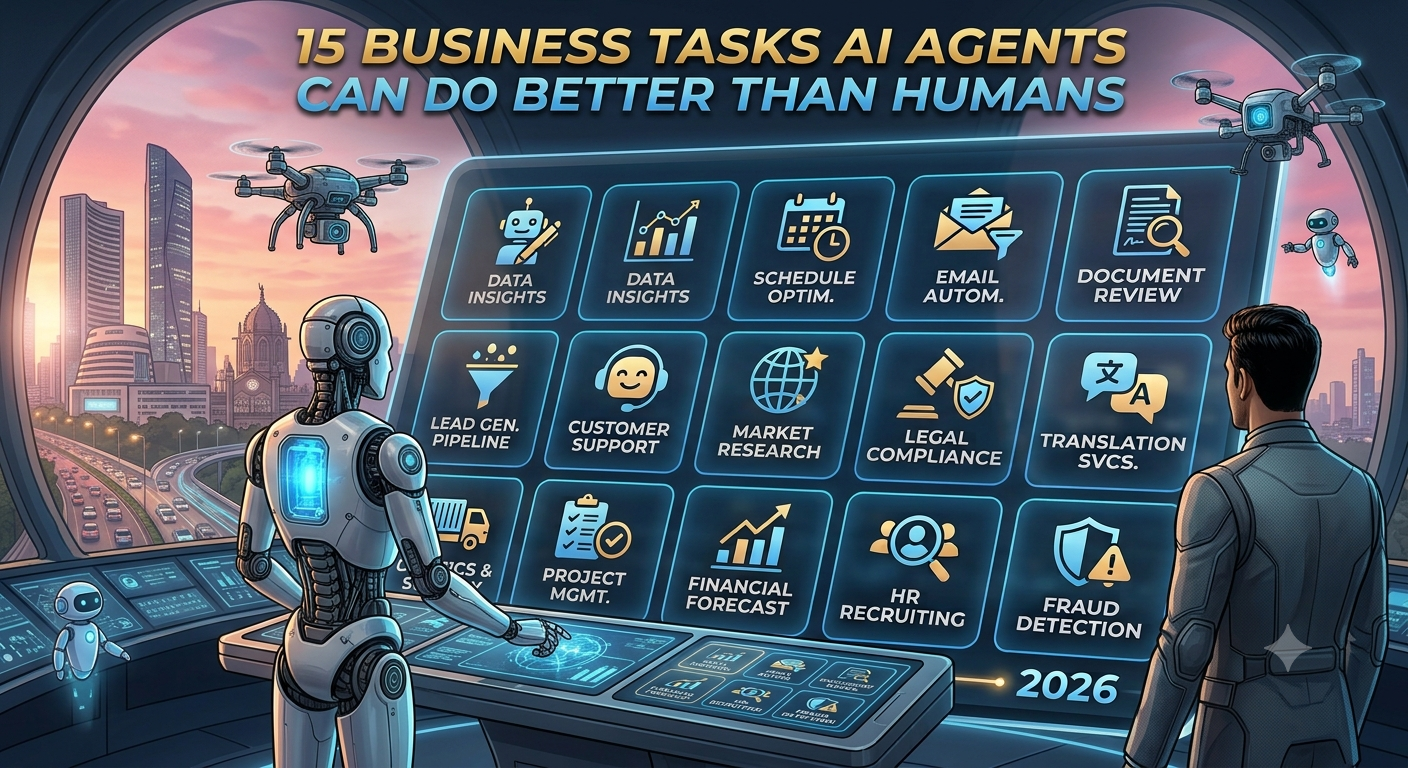
This guide is a practical, no-hype look at the 15 business tasks AI agents can already do better than humans, faster, cheaper, around the clock, and without the inconsistency that comes with a tired team on a busy Monday. For each task you'll see what the agent actually does, why it beats the manual way, and how a real business, whether a five-person agency in Mumbai or a growing retail brand, can put it to work this month. We'll also be honest about the tasks where humans still win, because knowing that line is what separates businesses that profit from AI agents for business from those that waste money on them.
The shift is bigger than it looks from the outside. McKinsey's latest research found 88% of organizations now use AI in at least one function, and Gartner projects that 40% of enterprise applications will embed task-specific AI agents by the end of 2026, up from under 5% a year earlier. The AI agents for business automation market has crossed several billion dollars and is growing close to 46% a year. Translation: the "AI employee" isn't a sci-fi headline anymore. It's already on a lot of payrolls, just not the kind you run through HR.
- ✅ The 15 business tasks AI agents already automate
- ✅ Which tasks still genuinely need a human
- ✅ What AI agents actually cost for a business in India
- ✅ How businesses are saving 20+ hours every week
- ✅ A simple plan to hire your first AI agent
Why the "AI Employee" Suddenly Became Real in 2026
Three things changed at once. First, the models got reliable, today's systems follow multi-step instructions and stay consistent in ways that earlier tools simply couldn't, so businesses can trust them with real workflows instead of demos. Second, the price collapsed, an automation that needed a serious IT budget in 2023 now runs a small business a few thousand rupees a month. Third, connecting an agent to your actual stack, your CRM, inbox, WhatsApp, spreadsheets, and accounting tools, got dramatically easier thanks to standards like the Model Context Protocol and no-code platforms like Make, n8n, and Zapier.
The deeper change is the move from rule-following to judgment. A traditional automation could only do "when X happens, do Y." An AI agent can read a messy customer message, decide what it means, pick the right action, do it, check its own work, and escalate to a human when it's unsure. That single leap is why so many business tasks AI can do have suddenly expanded from "answer FAQs" to "run the whole workflow." It's also why this matters for owners who never had clean, perfectly-defined processes: agents handle the fuzzy, in-between steps that used to require a person. For a broader view of the forces driving this, see our breakdown of the top AI automation trends every business must know in 2026.
| Factor | Human Employee | AI Agent |
|---|---|---|
| Working hours | ~8 hours a day | 24/7, 365 days |
| Time off | Leave, sick days, holidays | Never |
| Lead follow-up | Manual and inconsistent | Automatic and instant |
| Error rate | Rises with fatigue | Very low and consistent |
| Cost | Monthly salary + overheads | Affordable monthly subscription |
| Scaling up | Hire, train, wait weeks | Instant, on demand |
The 15 Business Tasks AI Agents Do Better Than Humans
These are ranked by real-world impact and how ready they are today, not by how futuristic they sound. You don't need all 15. Read the list, then circle the two or three tasks where your business is leaking the most time, money, or missed customers.
1. Customer Support and Ticket Resolution
This is the single highest-volume job for AI agents in 2026, and the one where they most clearly beat humans on the basics. A modern AI customer support agent, the grown-up evolution of the basic chatbot, pulls answers from your product docs and past tickets, resolves a large share of routine queries instantly, and escalates the genuinely tricky ones to a human with full context already attached. Leading platforms now autonomously close 60 to 80% of support tickets while keeping satisfaction scores level with human teams, and they do it 24/7 with zero overtime. For any business drowning in repetitive "where's my order / how do I reset this" messages, this is the fastest win on the list.
2. Lead Qualification and Follow-Up
Most businesses lose money not from a lack of leads but from leads going cold. An AI sales agent, wired into your CRM, reads every incoming enquiry, scores it, replies in seconds, and keeps following up on a schedule no human consistently maintains, nudging the prospect who opened the email but didn't reply, escalating the one who's ready to buy. It never forgets, never gets busy, and never lets a hot lead sit for four hours. For Indian businesses fielding enquiries from IndiaMART, Justdial, and their website, this one task alone often pays for the entire AI automation for business stack.
3. Appointment Booking and Scheduling
Coordinating calendars, sending reminders, handling reschedules, the back-and-forth that eats a receptionist's whole morning, is exactly the kind of structured, rule-based work AI agents handle flawlessly. The agent checks availability, books the slot, sends confirmations and reminders, and quietly cuts no-shows. Clinics, salons, consultants, and service businesses see the impact immediately, because every reminder the agent sends is a slot that would otherwise have gone empty.
4. WhatsApp and Chat Replies, 24/7
In India, this is arguably the most commercially powerful task on the list. WhatsApp automation powered by an AI agent answers instantly at 2am, qualifies the lead, shares product details, books the appointment, and sends a payment link, often in Hindi or a regional language. With well over 500 million WhatsApp users in the country and open rates near 98%, an agent that never sleeps on the channel your customers actually use is frequently the difference between a captured sale and a lost one.
5. Invoicing, GST and Bookkeeping
Generating invoices, matching payments, flagging mismatches, and preparing GST-ready data is repetitive, deadline-driven, and unforgiving of human error, which is precisely why an AI agent does it better. It captures the order, produces a compliant invoice, reconciles the payment, and updates the books without the typos and missed entries that creep in at month-end. One Indian trading firm cut its monthly GST preparation from three full days to four hours by handing the data collection and reconciliation to an agent. For finance-heavy small businesses, this is quiet, compounding time back every single month.
6. Data Entry and Document Processing
Reading a PDF, pulling the right fields, and dropping them into a system is mind-numbing for people and a magnet for mistakes, and it's one of the clearest cases where machines simply outperform. AI agents extract data from invoices, forms, resumes, and contracts, structure it, and file it correctly in seconds, at a consistency no human sustains over a hundred documents. Any business still copy-pasting between apps is paying salary for work an agent does faster and more accurately.
7. Email Management and Inbox Triage
Sorting, prioritizing, drafting routine replies, and surfacing what actually needs a human, the daily inbox grind, is a natural fit for an AI agent. It reads incoming mail, categorizes it, drafts first-pass responses in your tone, and flags the messages that genuinely need you. Instead of opening 80 emails to find the 6 that matter, you open 6. For founders and small teams, reclaiming the inbox is one of the most felt productivity gains an AI virtual assistant for business delivers.
8. Resume Screening and Recruitment
Early-stage hiring is high-volume, repetitive, and slow, exactly where an AI HR agent shines. It screens incoming resumes against your criteria, shortlists candidates, schedules interviews, and sends onboarding documents, freeing your team to focus only on final-round conversations and offers. A Mumbai logistics company cut its average time-to-hire from 45 days to 18 by handing screening and scheduling to an agent. The human judgment stays where it belongs, the actual hiring decision, while the grunt work disappears.
9. Inventory and Order Management
For product businesses, stockouts mean lost sales and overstocking ties up cash, and balancing the two is a data problem AI handles better than gut feel. An inventory AI agent monitors stock levels, predicts demand, flags reorder points, and updates records as orders flow in. A pharmaceutical distributor in Surat cut stockouts by 70% and excess inventory by 25% after deploying one. This is the kind of always-watching, never-distracted task where an agent's consistency directly protects revenue.
10. Market and Competitor Research
Continuously monitoring competitors, news, pricing, and market chatter is tedious for a person and perfect for an AI agent that works like a 24/7 research analyst. It scans sources, summarizes what changed, and flags opportunities or threats early, so a competitor's repositioning or a new trend reaches you while it still matters. Instead of a human spending hours browsing and skimming, you get a tight brief of what's worth your attention. Among the most useful AI agent use cases for founders who need to stay ahead without drowning in tabs.
11. Content Creation and Social Media
AI agents now draft product descriptions, blog outlines, ad variations, captions, and social posts at a speed and volume no human matches, then schedule and publish on a consistent cadence. The smartest setups learn your brand voice, so output stays on-message rather than generic. The honest caveat: AI is excellent at first drafts, repurposing, and volume, while your best, most original creative still benefits from a human hand. Used well, an agent handles 80% of the routine content load so your people spend their time only on the work that needs a human spark.
12. Cold Outreach and Sales Prospecting
Identifying ideal customers, researching them, personalizing the first message, and following up based on behavior is exactly the consistent, never-tiring process a human sales rep struggles to maintain, and an AI sales agent excels at. It runs a real outbound pipeline, adjusts the follow-up when a prospect engages, and escalates warm replies to a human to close. For solo founders and lean teams, this means a professional sales motion without hiring a full SDR desk, one of the highest-leverage AI agents for small business plays of 2026.
13. Internal Knowledge and Onboarding
"Where is that documented?" quietly eats a chunk of every team's week. An internal-knowledge AI agent lets staff ask in plain language about processes, policies, or past projects and instantly returns an answer with links to the source. This is a game-changer for onboarding new hires and for killing the constant interruptions that pull senior people off real work. As your business grows, this agent turns scattered tribal knowledge into something searchable, the kind of task a human "knowledge keeper" could never do at scale.
14. Reporting, Dashboards and Analytics
Pulling numbers from five tools, cleaning them, and assembling a weekly report is hours of work that an AI agent compresses into minutes, with fewer errors. It gathers data across your systems, builds the report, highlights what changed, and flags anomalies worth a second look. Instead of a person stitching spreadsheets together every Friday, the agent delivers the insight and the human spends their time deciding what to do about it, which is the part that actually needs a brain.
15. Voice Calls and Phone Enquiries
Text isn't the only frontier. Voice AI agents now handle phone enquiries, appointment booking, reminders, and first-line support, and for India specifically, vernacular voice is one of the most underrated capabilities of 2026. An agent that answers in Hindi or a regional language opens markets English-only tools can't reach, and it never puts a caller on hold or misses the after-hours ring. For any business whose phone line rings off the hook, or whose customers prefer talking to typing, voice automation is the next obvious hour-saver.
The pattern across all 15 tasks is the same: AI agents beat humans at work that is repetitive, high-volume, rule-based, and time-sensitive, and they free your people for the work that needs judgment, empathy, and creativity. Don't try to automate all 15. Pick the one task that's costing you the most right now, hand it to an agent, measure the hours saved, then add the next.
What This Means for Indian Businesses
For Indian businesses, the AI agents for business opportunity is unusually large and still under-contested. The country has structural tailwinds built for this: a dominant WhatsApp channel with hundreds of millions of users, a UPI-powered payments backbone that turns every transaction into clean, structured data an agent can act on, and government-driven digitization through GST and ONDC that creates constant demand for automated compliance. Modern agents already speak Hindi, Gujarati, Tamil, and other regional languages, so they meet customers where they actually are.
The practical playbook for an Indian SME is to start where money leaks. Automate lead response so no enquiry from IndiaMART, Justdial, or your website goes cold, deploy a WhatsApp automation agent so a 2am customer still gets answered, and hand GST invoicing and reconciliation to an agent to kill manual paperwork. The economics are hard to argue with: a serious AI agents for small business stack in India typically runs ₹16,000 to ₹40,000 a month, a fraction of two or three salaries, with payback usually inside two to three months. For a business in Mumbai, Pune, Bangalore, or any growing market, hiring a few well-scoped AI employees is how a lean team out-competes much larger players.
At GInfomedia, we help businesses across India design and deploy AI agents, from WhatsApp and lead-response automation to invoicing, reporting, voice, and full multi-step agentic workflows that run on autopilot and scale as you grow.
Click Here to Chat with Us on WhatsApp and get a free AI automation audit for your business today!
Where Humans Still Win (and Always Will)
An honest guide has to draw the line. AI agents are not "AI employees" that replace whole people, they replace tasks, specifically the repetitive, structured ones. The research is clear that fewer than 5% of jobs are made up entirely of automatable tasks, and the strongest results come from human-and-AI teams, not AI alone. Companies that fired their humans and handed everything to bots have publicly walked it back when the agents stumbled on edge cases, angry customers, and judgment calls.
Humans still win decisively at high-stakes judgment, genuine creativity, relationship-building, negotiation, and any decision where being wrong is expensive or personal. The businesses pulling ahead in 2026 aren't the ones replacing people with agents, they're the ones letting agents handle the volume so their people can focus on the nuance. Keep a human in the loop for anything brand-defining, customer-sensitive, or irreversible. That combination, AI on the repetitive 80%, humans on the critical 20%, is what produces durable savings instead of a pile of automations nobody trusts.
How to Hire Your First AI Employee
If you take one thing from this guide, let it be this: the tools are ready, the cost is low, and the only thing between you and a recovered workday is starting. You don't hire all 15 agents at once, you onboard one, prove it, then add the next.
Run a one-week time audit, write down every repetitive, manual task your team does and how long it takes. Pick the single task from the 15 above that's both high-volume and rule-heavy, support, lead follow-up, invoicing, scheduling, or WhatsApp automation, and automate just that one using a no-code platform or a done-for-you partner. Measure the baseline before and the hours saved after. Once you have two weeks of clear data, hire your next AI employee for the next task, and keep governance and a human checkpoint in place for anything sensitive. Measure at the task level so you always know exactly which agents are earning their keep.
The cost of waiting in 2026 is now higher than the cost of starting. Every week you run fully manual is a week your AI-equipped competitors answer faster, serve more customers, and reinvest the hours you're still spending on copy-paste. Hire one AI employee this month, reclaim your first few hours, and let the system compound from there.
AI Agents for Business: Quick FAQs
Can AI agents really replace human employees?
Not whole roles, but specific tasks, yes. AI agents already do repetitive, rule-based business tasks like support, lead follow-up, invoicing, and scheduling faster and more consistently than humans. But fewer than 5% of jobs are fully automatable, and the best results come from AI handling volume while humans keep judgment, creativity, and relationships.
What business tasks can AI agents do today?
The highest-impact AI agent use cases in 2026 include customer support, lead qualification and follow-up, appointment booking, WhatsApp automation, invoicing and GST data, document processing, email triage, resume screening, inventory management, research, content creation, cold outreach, internal knowledge, reporting, and voice calls.
How much does an AI agent cost for a small business in India?
A practical AI agents for small business stack in India typically runs ₹16,000 to ₹40,000 a month, far less than hiring two or three staff, and usually pays back within two to three months. Most owners start with one agent on their biggest time-drain and expand only what clearly delivers ROI.
