
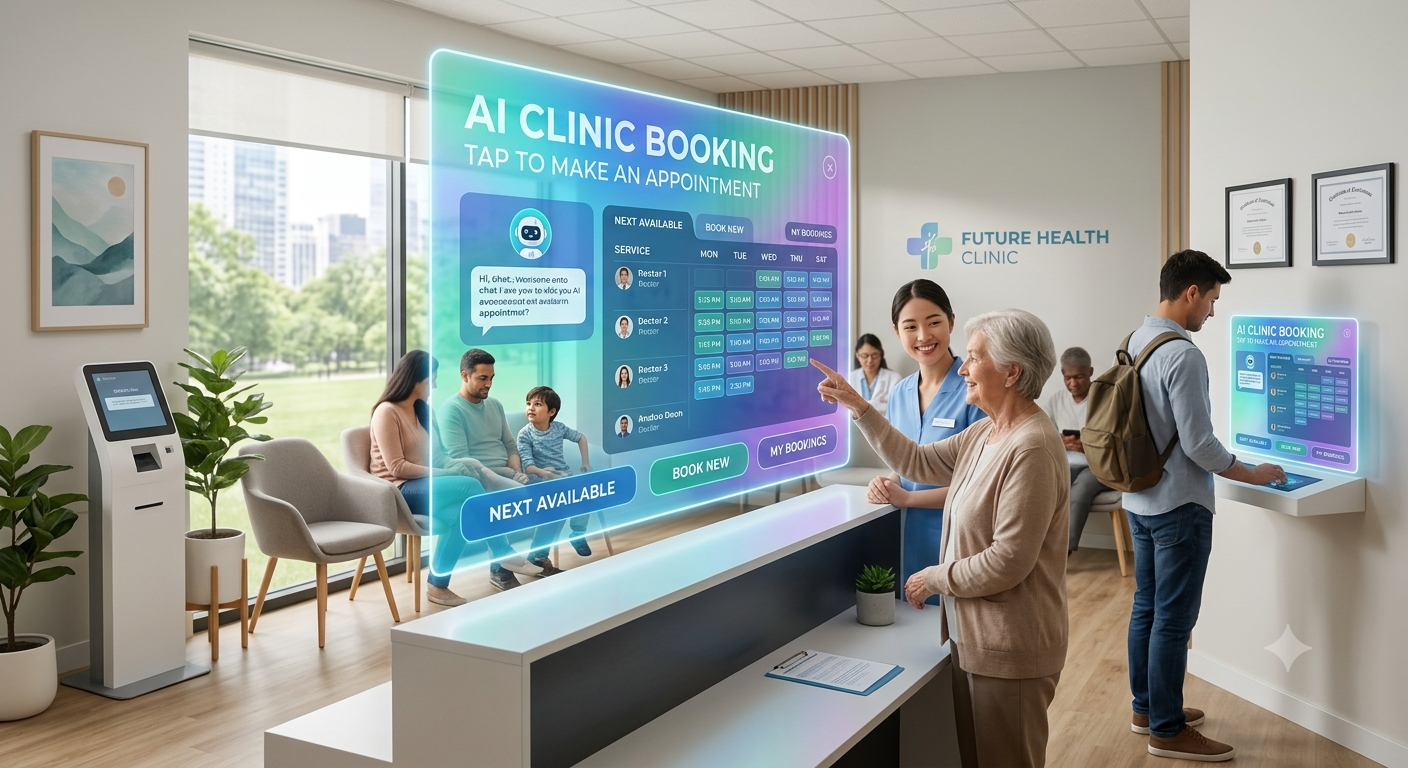
Every clinic loses patients it never knows about. The caller who hit a busy line at 9 PM and booked elsewhere. The follow-up reminder that went out as an SMS and was never read. The cancellation that sat open for three hours because the front desk was swamped. Individually these moments feel small, but across a month they add up to empty chairs, lost revenue, and a patient experience that feels a step behind every app on your patient's phone. This is the exact gap that AI appointment booking for clinics is built to close.
AI appointment booking for clinics uses intelligent assistants — on WhatsApp, on the phone, and on your website — to let patients schedule, reschedule, and cancel appointments in a natural conversation, any hour of the day, without a staff member ever picking up. The assistant checks live availability in your calendar or clinic software, books a confirmed slot, sends reminders, and quietly fills cancellations from a waitlist. It is the difference between a front desk that closes at seven and a digital front door that never sleeps.
For clinics, dental practices, diagnostic centres, and multi-doctor setups across India, this is no longer a futuristic add-on. With patients firmly WhatsApp-first and front-desk teams stretched thin, AI-powered patient scheduling has become one of the highest-return investments a practice can make in 2026. Here is exactly how it works, what it costs you to ignore it, and how to set it up for your clinic.
Why AI Appointment Booking Matters for Clinics Right Now
The bottleneck in most clinics is no longer clinical capacity — it is the front desk. A small team is expected to answer every incoming call, coordinate appointments, verify details, and manage walk-ins, all at the same time. Scheduling becomes reactive and rushed, which means long hold times, missed calls, and follow-ups that slip through the cracks. The patients who suffer most are exactly the ones a clinic most wants to keep.
AI appointment booking solves this by shifting routine scheduling off the phone and into channels that run automatically, 24/7. Patients can book through a WhatsApp chat, a website widget, or a voice call handled by an AI agent, and the request lands directly in your calendar — no re-typing, no phone tag, no after-hours blind spots. Roughly a third of inbound scheduling calls are simple questions that block a booking ("Do you take this insurance?", "How long is the visit?", "Where do I park?"), and an AI assistant answers these instantly so your staff can focus on the patients standing in front of them.
The timing matters because patient expectations have shifted permanently. People now expect to reach a clinic the same way they reach everyone else — by message, instantly, in their own language. A practice that only responds between nine and seven is effectively invisible the rest of the time. AI appointment booking is how a normal clinic meets that expectation without hiring a single extra person.
Here is everything a clinic owner or practice manager needs to know about AI appointment booking — how it works, what no-shows really cost you, the tools available in India today, and how to roll it out without disrupting your team.
How AI Appointment Booking Works for Clinics
The Core Booking Channels: WhatsApp, Voice & Web
A modern AI booking system meets patients where they already are. In India, that means WhatsApp first. A patient simply messages the clinic — "I need an appointment with Dr. Sharma tomorrow evening" — and the AI assistant interprets the request, checks available slots, confirms the booking, and updates the calendar, all inside one chat. Because messaging is the primary channel for hundreds of millions of Indians, a WhatsApp-based booking flow is the lowest-friction option a clinic can offer.
Voice is the second pillar. An AI voice agent answers calls the moment they ring, guides the patient through booking, rescheduling, or cancelling, and handles common questions about timings, doctors, and location — so no call goes to voicemail and no opportunity is lost during peak hours. The third channel is your website: a chat widget or online booking form that converts visitors into confirmed appointments around the clock. The strongest setups keep all three channels in sync, so availability is always accurate and double-bookings never happen.
Key Capabilities: Reminders, Rescheduling & Smart Routing
Beyond taking the initial booking, the real value of AI appointment scheduling lies in everything that happens around it. Automated confirmations and reminders go out by WhatsApp, SMS, or voice the moment a slot is booked and again before the visit, keeping the appointment top-of-mind without any staff effort. When a patient cancels, the system can instantly offer that slot to the next person on a waitlist — turning a gap in the day into a filled chair.
Smart routing is what separates a basic chatbot from a genuine scheduling assistant. The AI can match each patient to the right doctor based on the reason for the visit, urgency, language preference, and location, and apply your clinic's own rules around buffer times, emergency slots, and provider availability. Crucially, a well-built system never invents slots — it interprets patient intent and then calls your real scheduling tool, which owns the single source of truth for what is actually open.
Integration With Your Clinic Software, EMR & Calendar
An AI booking assistant is only as good as its connection to your existing systems. The booking flow needs real-time read-and-write access to wherever your appointments live — a hospital or clinic management system, an EMR, a third-party booking tool, or even a shared Google Calendar. When that integration is done right, a booking made over WhatsApp at 9 PM lands directly in the doctor's calendar and the patient record without anyone re-typing it the next morning.
Equally important is human handoff. A good system knows its limits: low-confidence requests, medical-advice questions, billing or insurance complexity, and frustrated patients should all be escalated to your staff, ideally with the full conversation attached. This is what keeps automation safe in a healthcare setting — the AI handles the routine 70 to 80 percent of scheduling, and your team handles the exceptions that genuinely need a human.
What No-Shows and Missed Calls Really Cost Your Clinic
The strongest argument for AI appointment booking is not the technology — it is the money quietly leaking out of your schedule. No-shows are a persistent drain on clinics, with rates commonly ranging from 10 to 30 percent and costing the wider healthcare industry billions every year. Every missed appointment is a slot that could have served another patient and a unit of revenue that simply disappears.
Missed and after-hours calls are the second leak. Most clinics only count the revenue from appointments that actually happen; they never see the patient who tried to book at night and gave up, or the cancellation that sat open because no one had time to fill it. Multiply those small losses across a week, a month, and a year, and the cost of "we'll get to it" becomes substantial.
AI appointment booking attacks both leaks at once. Timely automated reminders and easy one-tap rescheduling have been shown to reduce no-shows by up to 30 percent, while round-the-clock booking captures the after-hours demand that manual systems lose entirely. For most practices, the system pays for itself by recovering appointments that were already slipping away — which is why clinics increasingly treat it as core infrastructure rather than a nice-to-have.
The Tools Powering AI Appointment Booking Today
The market for AI scheduling has matured quickly, and clinics today can choose from several distinct categories of tools depending on their size and existing systems. Understanding the landscape helps you pick the right entry point rather than the loudest brand.
The first category is WhatsApp Business API platforms, which are especially relevant in India. These connect a clinic to an official, verified WhatsApp number and layer AI chatbots, appointment management, and reminders on top — often at accessible monthly price points that suit single-location practices. The second category is AI voice agents, which answer phone calls and run the full booking workflow conversationally, acting as a tireless virtual front desk. The third is integrated clinic-software assistants, where conversational AI sits inside the same platform that runs your scheduling, records, and billing, so a booking never has to sync between separate apps.
For most Indian clinics, the practical starting point is a WhatsApp-first assistant connected to a reliable calendar or clinic management system, with voice and web added as the practice grows. The key is choosing a platform built around the WhatsApp Business API through an authorised provider, so your number stays compliant and your patients see the trusted verified-business badge.
At GInfomedia, we help Indian clinics and healthcare practices deploy AI-powered booking on WhatsApp, voice, and web — integrated with your calendar, compliant, and built to reduce no-shows from day one.
👉 Click Here to Chat with Us on WhatsApp and get a free clinic automation consultation today!
Real-World Results: What Clinics Are Seeing
AI appointment booking is not an aspiration — clinics and platforms are already reporting measurable results from live deployments. These outcomes define the kind of impact a well-implemented system is designed to deliver.
On no-shows, predictive reminders make a real, documented difference. In one analysis of tens of thousands of imaging appointments, pairing machine-learning risk scoring with simple reminder calls to high-risk patients pulled the no-show rate down from roughly 19 percent to 16 percent in six months — a meaningful recovery of otherwise wasted capacity. A senior-care provider that rolled out AI voice agents for scheduling reported a 38 percent jump in scheduling satisfaction while filling previously underused provider slots.
On front-desk load, the gains are just as clear. Practices and platforms commonly report up to 70 percent fewer scheduling calls reaching human staff and around 30 percent better provider utilisation after adopting AI scheduling, freeing the equivalent of one to two full-time roles' worth of administrative time. The pattern across these cases is consistent: AI handles the repetitive booking volume, and clinics convert that saved time into either lower costs or more patients seen.
The common thread is that none of these are proofs of concept. They are live systems handling real patient bookings at scale — which is precisely what AI appointment booking is designed to do for clinics of every size.
What This Means for Clinics in India
India's clinics are uniquely positioned to benefit from AI appointment booking, because the country's healthcare communication has already gone WhatsApp-first. Patients expect to reach a practice by message, instantly, and increasingly in their own language. A clinic that answers only by phone, only during working hours, is invisible to those patients the rest of the time — and AI booking closes exactly that gap.
The shortcomings of older tools make the case even stronger. SMS delivery in India hovers around 80 to 85 percent and read rates are far lower, which means reminders go out but quietly fail to land. WhatsApp, by contrast, is read almost immediately, replies flow back into the schedule, and the whole loop closes automatically. For a country where messaging is the default channel for over half a billion people, this is a structural advantage that Indian clinics should be using.
Language is the other Indian differentiator. The best systems handle bookings in Hindi, English, and major regional languages, so a patient in rural Maharashtra and one in urban Tamil Nadu both get the same effortless experience. And affordability is no longer a barrier — WhatsApp Business API platforms now offer clinic-ready plans at accessible monthly price points, putting AI appointment booking within reach of single-doctor practices, not just large hospital chains.
How to Set Up AI Appointment Booking for Your Clinic
Getting AI appointment booking live is more straightforward than most clinic owners expect — many practices go from decision to a working assistant in a couple of weeks. The work falls into three practical tracks.
The first is choosing your channels and connecting your schedule. Decide where patients will book — WhatsApp is the natural first channel in India, with voice and web added next — and connect that booking flow to your real source of truth, whether that is a clinic management system, an EMR, or a shared calendar. This integration is the single most important step: without live read-and-write access to your actual availability, the assistant cannot book confirmed slots safely.
The second is setting your rules and guardrails. Define your open hours per doctor, buffer times between visits, emergency slots, blackout periods for lunch and meetings, and the appointment types the AI is allowed to book versus the ones that need a human. Just as important, decide when the system should hand off to your staff — for medical questions, insurance complexity, or any frustrated patient. Clear rules are what make automation feel professional rather than robotic.
The third is measuring and improving. After launch, track booking completion rate, time to confirmation, the share of calls deflected from your front desk, no-show reduction from reminders, and how many WhatsApp conversations turn into confirmed appointments. The clinics that win are the ones that assign a clear owner — usually the practice manager — to review these numbers regularly and refine the assistant over time.
AI appointment booking is not a set-and-forget gadget. It is operational infrastructure that rewards a clean integration, sensible rules, and steady measurement. Clinics that set it up thoughtfully build a durable advantage in patient access and front-desk efficiency.
The Bigger Picture: Booking Is Your Clinic's New Front Door
The patient's journey now begins long before they reach the doctor. It starts with a question at night, a reminder that did or did not arrive, a slot they could or could not book. If that first stretch feels confusing or ignored, many patients never make it to the consultation at all. AI appointment booking is, in effect, the new front door of the clinic — the first impression that decides whether a patient trusts you enough to show up.
This is the same pattern that reshaped retail, banking, and food delivery: the businesses that met customers on the channels they already used, at the hours they actually needed, became the ones people chose. Healthcare is now following that trajectory, and in India the channel is unmistakably WhatsApp, available around the clock, in the patient's own language.
The opportunity for clinics is real, and it is open now. AI appointment booking does not require a hospital-sized budget or a technical team — it requires a deliberate first step: pick a channel, connect your schedule, set your rules, and let the system capture the patients you have been quietly losing. The clinics that move first will own the new front door. The only real question is whether yours will be one of them.
