
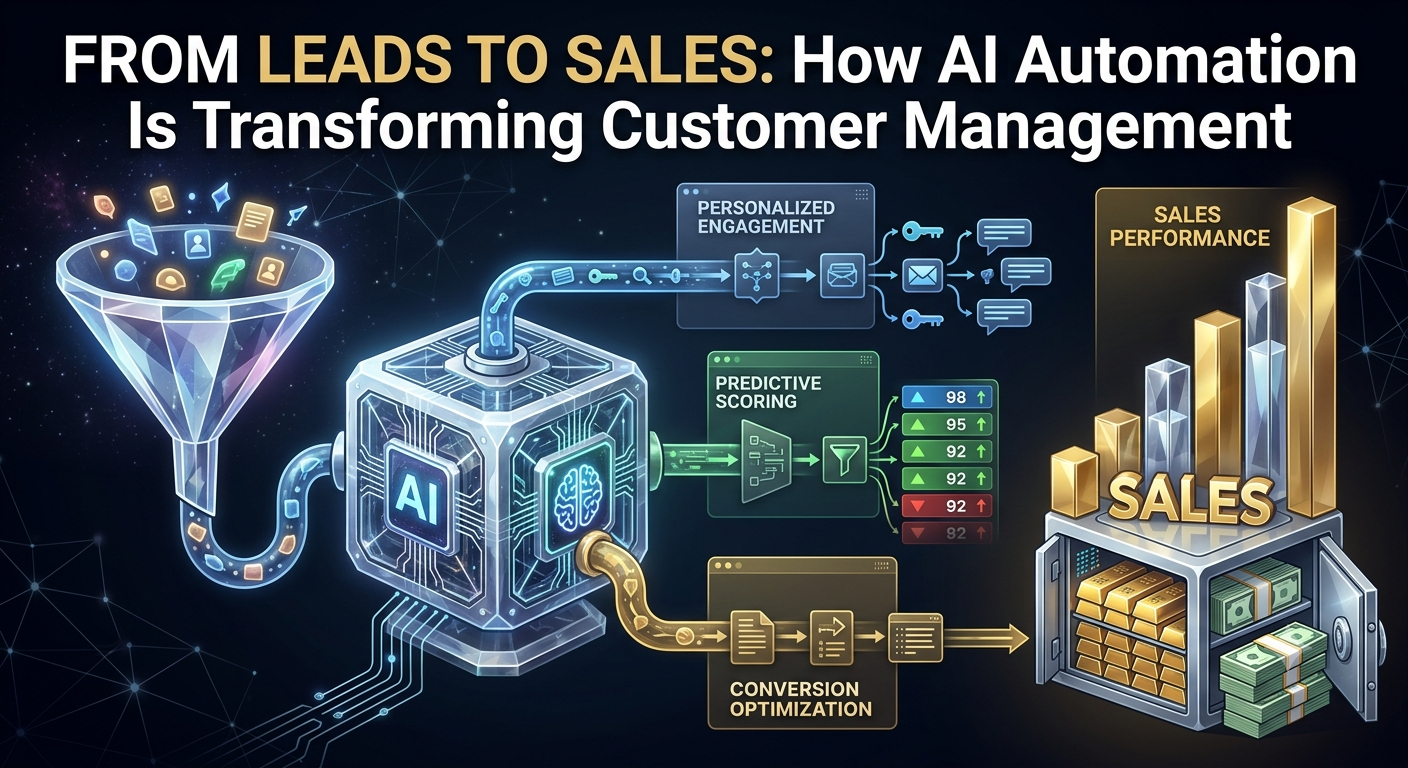
AI automation for customer management has quietly become the dividing line between businesses that grow and businesses that leak revenue. In 2026, the average company still loses the majority of its leads not because the product is wrong or the price is too high, but because nobody followed up fast enough. Salesforce data shows only about 28% of leads ever convert under manual processes, and a prospect is up to 9 times more likely to convert when you engage them within five minutes instead of an hour. That single gap, the minutes between an enquiry arriving and someone responding, is exactly where AI automation is now rewriting the rules of customer management.
This guide breaks down precisely how AI automation is transforming customer management in 2026, from the moment a lead lands to the moment it becomes a paying, repeat customer. You'll see how AI CRM systems capture and respond to every enquiry instantly, how predictive lead scoring tells your team exactly who to call first, how lead nurturing automation closes deals while you sleep, and how Indian businesses in particular can deploy WhatsApp-first, AI-powered customer management to outsell competitors three times their size. Whether you run an agency, a clinic, a retail brand, or a growing service business, this is the system turning more leads into sales with less effort.
The shift is not subtle. McKinsey reports that 88% of organizations now use AI in at least one business function, and Apollo's 2026 research found 81% of sales teams already use AI, with AI-equipped teams reporting measurably higher revenue growth than those without. The global CRM market alone is climbing from roughly $77 billion in 2025 toward $166 billion, powered overwhelmingly by AI. Translation: AI customer management is no longer an edge a few innovators enjoy. It's fast becoming the baseline, and the businesses still managing leads in spreadsheets are the ones quietly falling behind.
What Is AI Automation for Customer Management?
AI automation for customer management is the use of artificial intelligence, machine learning, and natural language processing inside your customer relationship management workflow to capture, qualify, respond to, nurture, and retain customers with little or no manual effort. Where a traditional CRM is essentially a digital filing cabinet that waits for your team to update it, an AI CRM actively works the pipeline: it reads incoming enquiries, understands intent, scores the lead, drafts a reply, updates records, schedules follow-ups, and flags the deals most likely to close, all automatically.
The simplest way to understand the change is to picture the customer journey as a funnel with three leaky stages: capturing leads, converting them to sales, and keeping them as customers. Manual customer management loses prospects at every stage, slow replies at the top, inconsistent follow-up in the middle, and no proactive retention at the bottom. AI sales automation seals those leaks. It responds in seconds, follows up relentlessly, and surfaces churn risks before they cost you. The result is the same team converting far more of the leads they already pay to generate.
The critical mindset shift for 2026 is this: AI customer management is not about replacing your salespeople. It's about removing the repetitive, low-value work, data entry, manual follow-up, chasing cold leads, that consumes 10 to 15 hours of every rep's week, so your people spend their time on the conversations that actually close deals. AI handles the volume and the speed; humans handle the relationship and the judgment. That combination is what turns more leads into sales.
From Leads to Sales: How AI Automation Works at Every Stage
The power of AI automation for customer management is that it works the entire funnel as one connected system, not three disconnected tools. Here is how it transforms each stage of turning a lead into a sale.
Stage 1: Capturing and Responding to Every Lead Instantly
The single highest-ROI move in customer management is also the simplest: respond first. Studies consistently show businesses that reply within five minutes are several times more likely to win the deal, yet most teams take hours. Lead response automation closes that gap to under 60 seconds, 24/7. The moment an enquiry arrives from your website, IndiaMART, Justdial, a Meta ad, or WhatsApp, an AI agent reads it, replies with a relevant, personalized message, and captures the contact straight into your CRM, no human required. Companies implementing this report 30 to 40% higher conversion rates on inbound leads purely from speed. A human handles one enquiry at a time; an AI agent handles fifty simultaneously, around the clock, so no lead ever goes cold again.
Stage 2: Scoring and Qualifying Leads Automatically
Not every lead is worth the same effort, and your team's biggest waste is time spent on prospects who will never buy. Predictive lead scoring solves this by analyzing each lead's behavior, source, engagement, and fit against your history of closed deals, then ranking them so your reps always work the hottest opportunities first. AI-driven lead qualification reaches 70 to 85% accuracy compared with just 30 to 40% for manual methods, and it slashes cost per qualified lead, with businesses reporting drops from $150–200 down to $40–60 as research and scoring move to automation. The effect is dramatic: a team that could manually process 500 leads a month can manage 5,000 with the same headcount, because AI does the sorting and humans do the selling.
Stage 3: Nurturing and Closing on Autopilot
Most deals aren't lost, they're forgotten. The prospect wasn't ready, the follow-up never happened, and a competitor got there first. Lead nurturing automation fixes this by running personalized, multi-channel follow-up sequences across email, SMS, and WhatsApp that adapt to how each prospect behaves. Marketing automation of this kind has been shown to lift qualified leads by up to 451% and improve sales productivity meaningfully. The AI CRM knows when a lead opens a message, clicks a link, or revisits your pricing page, and triggers the right next step, a reminder, an offer, or a hand-off to a human, at exactly the right moment. The deal that used to slip through the cracks now closes itself, and your team only steps in when the prospect is ready to buy.
Here's the core principle of AI automation for customer management: don't try to automate the whole funnel overnight. Find the single leakiest stage, usually slow lead response, automate it well, measure the lift in conversions, then expand to scoring and nurturing. Each stage you automate makes the next one more valuable, and the system compounds.
The Real ROI of AI Customer Management in 2026
The case for AI customer management isn't theory, it's measured. The most cited 2026 figure is a roughly 13-hour-per-week saving per employee on admin and follow-up, which most businesses convert into either lower costs or more selling time. One mid-market sports company that automated reporting, proposals, and lead prioritization grew total revenue 30% in nine months, lifting selling time from 40% to 68% of the workday without adding a single hire. That's the pattern AI sales automation repeats across industries: the same team, far more output.
The numbers stack up at every stage of the funnel. Predictive lead scoring and AI chatbots cut response times by up to 40% and forecast deal closure and churn with accuracy exceeding 80%, so your team stops guessing and starts prioritizing. Marketing automation drives up to 451% more qualified leads, and faster AI-powered response lifts inbound conversion by 30 to 40%. Most businesses see payback within 30 to 90 days, and for many Indian operations the payback window is just two to three months. The revenue recovered from leads you used to lose almost always dwarfs the labor cost you save, which is why lead response automation is the highest-ROI workflow in all of customer management.
AI CRM vs Traditional Customer Management
The difference between a traditional CRM and an AI CRM is the difference between a record-keeper and a co-pilot. A traditional system stores data and waits; your team has to remember to log calls, update stages, and chase follow-ups, and the moment they get busy, the pipeline goes stale. An AI-powered CRM works in the background continuously: it auto-fills records from every email and call, summarizes conversations, drafts replies, flags deals at risk, and recommends the next best action. Platforms like HubSpot (Breeze AI), Salesforce (Einstein and Agentforce), Zoho (Zia), Pipedrive, and monday CRM have all moved decisively from being databases to being intelligent sales assistants.
For business owners, the practical takeaway is that AI customer management removes the discipline problem that breaks most CRMs. The reason so many CRM rollouts fail is simple, people don't keep them updated. AI eliminates that failure point by doing the updating, the scoring, and the follow-up itself. Your CRM stops being a chore your team avoids and becomes a system that actively generates sales. That shift, from passive storage to active selling, is the heart of how AI automation is transforming customer management in 2026.
AI Agents: The 2026 Shift in Customer Management
The biggest force reshaping customer management this year is the rise of agentic AI. Traditional automation, the rigid "when X happens, do Y" model, is useful but brittle: it can only follow the exact path you program. AI agents are different. They're autonomous systems that can plan, decide, use tools, and complete multi-step tasks without constant prompting. Instead of "send this email when a form is submitted," an AI agent reads the enquiry, judges whether it's a hot lead, drafts a tailored response, updates the CRM, books the meeting, and queues the follow-up, adapting to each situation as it goes.
This is why the 2026 conversation has moved from chatbots to agents. Gartner projects that 40% of enterprise applications will include task-specific AI agents by the end of 2026, up from under 5% the year before, and over half of companies have already deployed agents in some form. For customer management, this dramatically expands what you can automate: the messy, judgment-based steps of qualifying and nurturing leads, the parts that used to require a human, can now run autonomously. That's how lean teams are converting more leads into sales than competitors with far bigger sales departments.
The Tools Powering AI Customer Management in 2026
You don't need a developer or an enterprise budget to start. The modern AI customer management stack has three layers. At the CRM layer, AI CRMs like HubSpot, Zoho (an Indian platform with built-in AI), Pipedrive, monday CRM, and Salesforce manage the pipeline and the intelligence. At the orchestration layer, no-code platforms like n8n, Make, and Zapier connect your apps and move data between them, so a WhatsApp enquiry automatically becomes a scored CRM lead with a follow-up sequence attached. And at the conversation layer, AI chatbots and voice agents handle enquiries on your website, WhatsApp, and phone lines 24/7.
The smart approach is to start small and affordable. Most of these tools, HubSpot, Zoho, Tidio, ManyChat, Make, offer free or low-cost tiers that let you prove value before spending heavily. Pick the one workflow leaking the most revenue, usually lead response automation or WhatsApp CRM automation, automate it, measure the lift in conversions, and only then upgrade. A serious small-business AI customer management stack runs a fraction of the cost of a single salesperson while handling the repetitive 80% of the work that used to bury your team.
At GInfomedia, we help businesses across India design and build AI customer management systems, from instant WhatsApp and lead-response automation to AI CRM setup, predictive lead scoring, and full nurture-to-close workflows that run on autopilot and scale as you grow.
Click Here to Chat with Us on WhatsApp and get a free AI customer management audit for your business today!
The Costly Mistakes That Sabotage AI Customer Management
The fastest way to waste money on AI customer management is to automate a broken sales process. If your follow-up is chaotic or your lead data is messy, automation just runs the chaos faster. Clean and simplify the workflow first, then automate it. The second common mistake is over-automation, removing the human touch entirely. Research shows 63% of buyers feel too much automation in the buying process reduces trust, so the winning model keeps a person in the loop for high-value conversations while AI handles speed and volume.
The third trap is "set it and forget it." AI CRM workflows need monitoring; an automation that silently breaks can send wrong information or drop leads for weeks before anyone notices. Build in alerts and review performance regularly. And finally, don't skip alignment between sales and marketing, businesses with aligned teams are 67% more efficient at closing deals. AI is a force multiplier, but only on top of a clear process. Get the process right, keep humans in the loop for nuance, and your AI automation produces durable, compounding gains instead of a pile of tools nobody trusts.
AI Customer Management for Indian Businesses: The 2026 Opportunity
For Indian businesses, the AI customer management opportunity is uniquely large and still under-contested. India has structural advantages that make it almost purpose-built for this: over 500 million WhatsApp users on one dominant channel, a UPI-powered payments backbone that turns every transaction into structured data, and government-driven digitization through GST and ONDC that rewards automated, compliant operations. WhatsApp CRM automation alone, instant auto-replies, AI lead qualification, appointment booking, and order updates, regularly delivers 3x faster response times and meaningfully higher conversion rates, exactly where Indian buyers already are.
The practical playbook for Indian SMEs is to start where money leaks. Automate lead response from IndiaMART, Justdial, and your website so no enquiry goes cold; deploy a WhatsApp AI agent so a customer messaging at 2am still gets answered and qualified; and connect it all to an AI CRM that scores leads and runs follow-up automatically. One Meesho seller cut customer response time from four hours to thirty seconds by automating 80% of replies, recovering sales that were simply being lost to silence. Costs are modest, often ₹15,000 to ₹40,000 a month for a serious stack, a fraction of hiring two or three staff, with payback typically inside two to three months. For a business in Mumbai, Pune, Bangalore, or any growing Indian market, this is the lever that lets a small team convert like a large one.
AI automation for customer management is not a one-time project, it's a repeatable revenue system. Audit your funnel, automate the leakiest stage, measure the leads you convert that you used to lose, reinvest the gains into the next stage, and keep compounding. That's how lean teams turn more leads into sales quarter after quarter, and keep widening the gap.
Your 2026 AI Customer Management Roadmap
If you take one idea from this guide, let it be this: the leads are already there, you're paying to generate them, and AI is now the most affordable way to stop losing them. The businesses converting dramatically more leads into sales didn't deploy a grand transformation. They followed a simple, repeatable path, and you can too.
Start with a one-week funnel audit: track how fast you respond to enquiries, how many leads get a proper follow-up, and how many quietly go cold. Pick the single biggest leak, almost always slow lead response, and automate just that one stage using an AI CRM, a WhatsApp chatbot, or a no-code tool like Make. Measure your conversion rate before and after. Once you have two weeks of clear data, layer in predictive lead scoring so your team always works the hottest leads first, then lead nurturing automation to close the slow burners. Measure results at the funnel stage, not vaguely, so you always know which automations are earning their keep.
The pace of change in 2026 means the cost of waiting is now higher than the cost of starting. Every week you manage customers by hand is a week your AI-equipped competitors respond faster, qualify smarter, and follow up more consistently, capturing the customers you're still letting slip away. The good news is that the entry point has never been lower. Automate one stage of your funnel this month, watch your conversions climb, and let the system compound from there. The businesses that own their markets next year are the ones building that customer management engine right now.
