
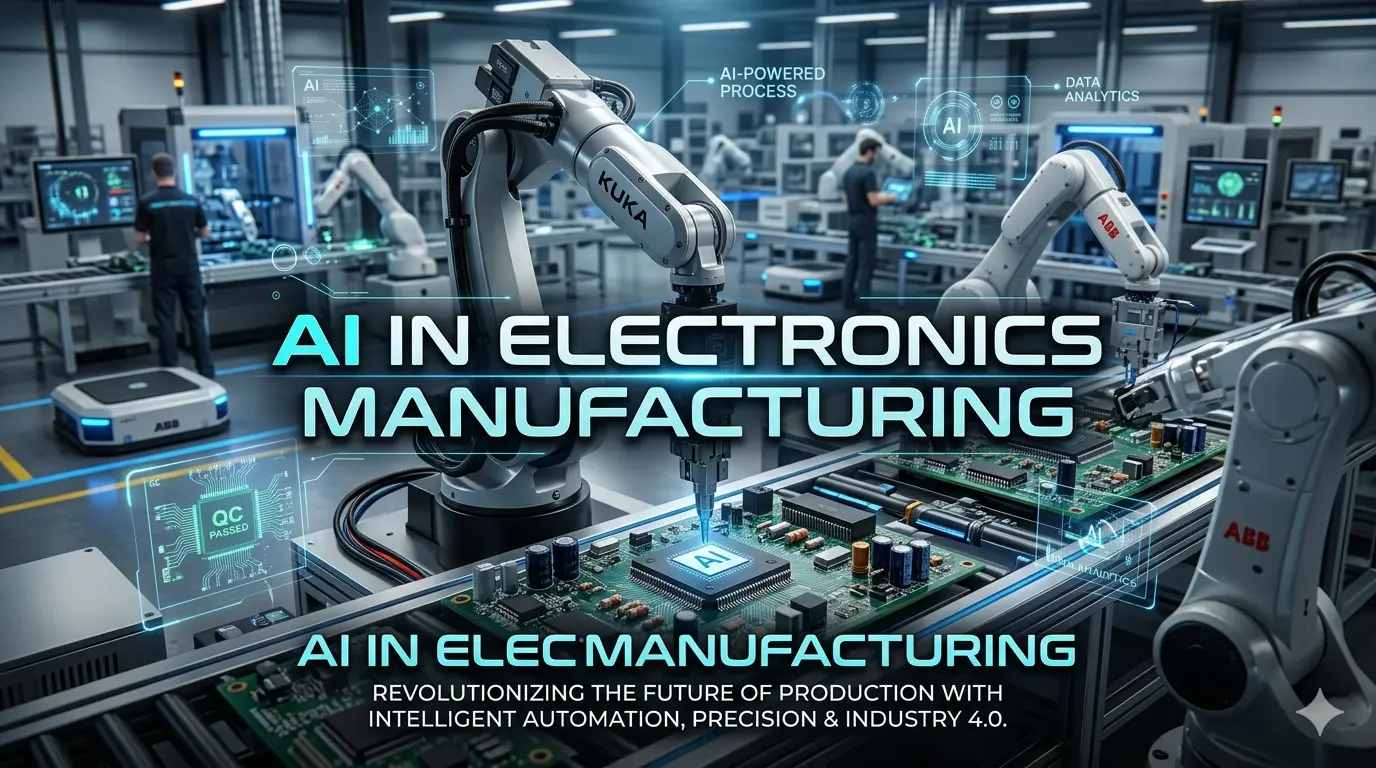
Electronics manufacturing is undergoing one of the most significant transformations in its history — and Artificial Intelligence is the engine driving it. From the earliest stages of circuit board design to the final steps of quality validation and delivery, AI is reshaping every part of the production pipeline.
The industry faces mounting pressure on multiple fronts: rising consumer demand for smarter devices, persistent labour shortages, volatile global supply chains, and the relentless push to reduce costs without sacrificing quality. In response, manufacturers worldwide are turning to AI not as an experiment, but as a core operational strategy.
Here is a complete look at how AI is redefining electronics manufacturing in 2026 — and what it means for businesses that want to stay competitive.
Why AI Has Become Non-Negotiable in Electronics Manufacturing
Today's electronics manufacturers are deploying AI technologies to accelerate design cycles, predict equipment failures before they happen, catch defects at microscopic scale, and make complex global supply chains more resilient. The result is faster time to market, lower production costs, and products that are more reliable than ever.
For any business operating in this space — whether a semiconductor fab, a PCB assembler, or an OEM — understanding where AI creates the most value is now a strategic priority, not a technical afterthought.
Here are the six most impactful areas where AI is transforming electronics manufacturing right now.
6 Ways AI Is Transforming Electronics Manufacturing in 2026
1. AI-Powered Product Design & Prototyping
The traditional product design cycle — slow, manual, and heavily dependent on individual engineering expertise — is being replaced by AI-driven generative design. Engineers can now produce and test dozens of circuit board configurations almost instantly, exploring design possibilities that human teams alone might never consider.
Digital twins and virtual prototypes allow manufacturers to simulate exactly how a product will perform under real-world conditions before a single physical prototype is built. This reduces development costs dramatically, shortens time to market, and improves product reliability from the ground up. AI also assists in materials selection, using production data to identify the most effective and cost-efficient options for each application.
2. AI in Semiconductor Manufacturing
Semiconductor fabrication is one of the most precise and complex industrial processes on earth — and AI is making it significantly faster and more accurate. Chip design tasks that once required months of expert engineering time are increasingly being automated with high precision.
AI-powered inspection systems can identify nanoscale defects on wafers with a level of accuracy that manual inspection simply cannot match. Predictive maintenance algorithms monitor fabrication equipment continuously, catching signs of impending failure before they cause costly production stoppages. The downstream benefits are substantial: higher yield rates, reduced material waste, faster testing cycles, and more accurate demand forecasting across global semiconductor supply chains.
3. Smart Factories & Intelligent Automation
AI is converting traditional manufacturing facilities into interconnected, self-optimising ecosystems. In a smart factory, production lines are monitored in real time, equipment self-corrects when performance drifts, and human workers are supported by AI systems that handle the most repetitive and error-prone tasks.
Digital twins of entire production lines allow manufacturers to test process changes in a virtual environment first, avoiding the risk and cost of experimenting on live operations. AI-enabled robotics have become increasingly adaptive — capable of handling more complex assembly tasks with greater speed and consistency. Supply chain functions benefit too, with AI improving inventory control, demand forecasting, and energy efficiency across the factory floor.
4. AI-Based Quality Control & Defect Detection
Quality control has historically been one of the most labour-intensive and inconsistent aspects of electronics manufacturing. AI is changing this fundamentally. Machine vision systems equipped with AI can scan components at production speed and flag defects — misaligned parts, bad solder joints, surface contamination — with accuracy that far exceeds human inspection.
In semiconductor fabrication and PCB assembly particularly, this translates to shorter production cycles, fewer false positives, and a significant reduction in scrap and rework costs. Manufacturers are also shifting from reactive quality corrections to predictive quality assurance — catching problems before they become production-line failures.
Our team at GInfomedia specialises in helping Indian businesses understand and adopt AI-driven digital strategies — from web presence to marketing automation.
👉 Click Here to Chat with Us on WhatsApp and get a free consultation today!
5. Predictive Maintenance & Equipment Optimisation
Unplanned equipment downtime is one of the most expensive problems in manufacturing. AI addresses this directly by continuously monitoring machine performance data and identifying early warning signs of impending failure — long before a breakdown disrupts production.
Beyond simply preventing failures, AI also optimises machine settings in real time for maximum accuracy and efficiency. Digital twins allow engineers to test and fine-tune processes virtually without touching live production lines. The cumulative impact is significant: lower maintenance costs, reduced energy consumption, safer working environments, and a measurably higher level of overall equipment reliability. By 2026, predictive maintenance powered by AI is increasingly viewed as a baseline requirement rather than a competitive advantage.
6. AI-Driven Supply Chain & Product Testing
Electronics supply chains are among the most complex in the world, spanning dozens of countries, thousands of components, and highly unpredictable demand cycles. AI brings order to this complexity through machine learning-based demand forecasting, dynamic inventory management, and real-time decision support that helps manufacturers respond quickly to global disruptions.
On the testing and validation side, AI enhances every stage. Predictive analytics and computer vision identify even subtle defects during production, cutting scrap rates and accelerating output. Digital twin technology enables virtual product validation before physical production begins, catching design flaws early when they are cheapest to fix. Continuous analysis of production data allows AI systems to optimise processes over time, driving near-zero defect rates and sustained improvements in operational efficiency.
What This Means for Your Business in 2026
AI has moved well beyond being a technology advantage in electronics manufacturing — it is now a strategic requirement. Manufacturers that adopt AI-led processes are delivering superior products, responding faster to market shifts, and building supply chains that are genuinely resilient. Those that delay are ceding ground on every dimension that matters: cost, speed, quality, and adaptability. The starting point does not have to be complex. Identify one high-impact process — quality inspection, equipment monitoring, or demand forecasting — and begin there. The compounding benefits of AI adoption become clearer with every step.