
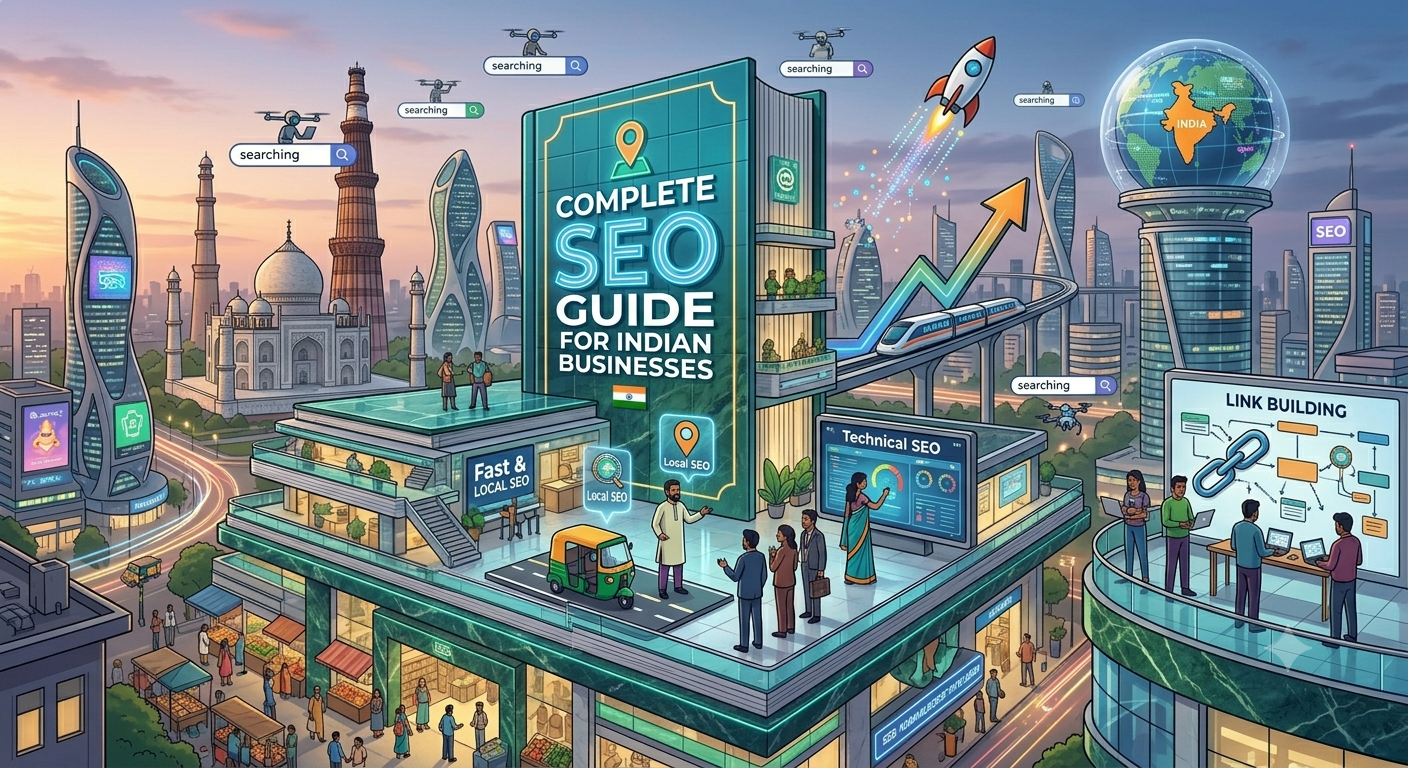
Search Engine Optimisation (SEO) for Indian businesses is the process of improving your website so it appears at the top of Google and now inside AI search tools like ChatGPT, Gemini, and Google AI Overviews when your customers search for what you sell. In 2026, that visibility is no longer optional. It is the single difference between a business that is found and one that quietly disappears below the fold.
Every day, hundreds of millions of Indians turn to Google to search for products, services, and answers from "best web designer near me" to "affordable digital marketing agency in Mumbai". The businesses that rank in the top three results win the overwhelming majority of clicks and enquiries. The ones stranded on page two get almost nothing. This complete SEO guide for Indian businesses is built to move you toward the top.
This guide covers everything that actually moves rankings in 2026: keyword research, on-page SEO, technical SEO, local SEO, content and link building, and the new disciplines of AEO and GEO that determine whether AI search engines cite your business. Whether you run a local shop, a growing startup, or an established firm, this is the roadmap to a stronger, more durable search presence.
What Is SEO and Why It Matters for Indian Businesses in 2026
SEO is how your business earns free, high-intent traffic from Google without paying for every click. Unlike paid ads, which stop the moment your budget runs out, organic rankings are earned and they compound over time which is why SEO remains the highest-ROI marketing channel for most Indian small and mid-sized businesses.
The stakes have never been higher. More than 70% of internet traffic in India is mobile, search competition is intensifying in every city and niche, and Google's algorithm now understands search intent better than ever. At the same time, roughly 6 in 10 Google searches now end without a click because users get their answer directly from an AI summary on the results page. This makes ranking high and being quoted by AI more valuable than chasing raw traffic alone.
Every search has an intent behind it, and winning SEO means matching it. The four intent types you must optimise for are: informational ("what is GST registration"), navigational ("GInfomedia website"), commercial ("best SEO agency in Mumbai"), and transactional ("hire SEO expert near me"). For most Indian businesses, the fastest revenue comes from commercial and transactional keywords, while informational content builds the authority that makes those money-keywords rank.
Here is everything an Indian business owner or marketer needs to rank on Google in 2026 the fundamentals, the local playbook, the AI-search strategy, and a 90-day action plan you can start today.
How SEO Works: The Core Pillars Every Indian Business Must Get Right
Strong SEO rests on a few core pillars working together: the right keywords, well-optimised pages, a technically healthy website, local visibility, and authoritative content. Skip any one of them and the others underperform. The three foundations below keyword research, on-page SEO, and technical SEO are where every successful campaign begins.
Keyword Research: Find What Indian Customers Actually Search
Keyword research is the practice of discovering the exact words and phrases your customers type into Google and then building pages around them. For Indian businesses, the biggest wins usually come from long-tail keywords: specific, lower-competition phrases like "affordable web hosting for startups in Pune" instead of the impossibly broad "web hosting".
Start with free tools that have reliable Indian search data: Google Keyword Planner, Google Search Console, Ubersuggest, and AnswerThePublic. Group your keywords by intent, prioritise the commercial and transactional terms that bring buyers, and note the question-style keywords ("how to", "which is best") that make excellent blog topics and feed AI answer engines.
On-Page SEO: Optimise Every Page to Rank
On-page SEO means structuring the content of each page so Google clearly understands what it is about. The essentials are simple but non-negotiable: place your focus keyword in the title tag (within the first 60 characters), write a compelling meta description of 150–160 characters, use a proper H1 → H2 → H3 heading hierarchy, keep clean, keyword-rich URLs, and add descriptive image alt text to every image.
Beyond the basics, the highest-leverage on-page move in 2026 is answer-first writing: state the direct answer to each section's question in the first one or two sentences, then expand. This is what makes your content eligible for featured snippets and AI Overviews. Use internal links to connect related pages, and make sure your most important keyword appears naturally in the opening paragraph.
Technical SEO: Site Speed, Mobile & Core Web Vitals
Technical SEO ensures Google can crawl, index, and trust your website and that real users have a fast, smooth experience. The four checks that matter most for Indian businesses are: pages that load in under 3 seconds on mobile, a fully mobile-responsive design, an active HTTPS (SSL) certificate, and a submitted XML sitemap in Google Search Console.
Google judges real-world experience through Core Web Vitals LCP (loading), INP (interactivity), and CLS (visual stability). Test your site with Google PageSpeed Insights, compress images, enable caching, and use clean code. On India's largely mobile, variable-connection internet, a fast site is not a luxury it is a direct ranking and conversion advantage.
Local SEO: How to Win Customers Near You
For any business serving a city or neighbourhood, local SEO is the single highest-ROI investment you can make and it starts with your Google Business Profile. The "map pack" of three businesses that appears at the top of local searches drives an enormous share of calls, directions, and walk-ins, especially since the vast majority of local mobile searches in India lead to an offline purchase.
Claim and fully optimise your Google Business Profile (formerly Google My Business): choose the most specific primary category, add real photos, list accurate hours, and keep your NAP (Name, Address, Phone) consistent everywhere online. Then actively collect genuine customer reviews they are one of the strongest local ranking signals and respond to every one.
Build local citations by listing your business on trusted Indian directories such as JustDial, Sulekha, and IndiaMART, and embed a Google Map on your contact page. Because WhatsApp and UPI dominate Indian commerce, add a click-to-chat WhatsApp link and ensure your business is discoverable on the apps your customers already use daily.
At GInfomedia, we help Indian businesses build fast, mobile-first, fully SEO-optimised websites and local search strategies that turn Google traffic into real enquiries.
👉 Click Here to Chat with Us on WhatsApp and get a free SEO audit of your website today!
AEO & GEO: How to Rank in AI Search, ChatGPT & Google AI Overviews
In 2026, ranking on Google is only half the job you also need to be cited by AI search engines, and that requires two new disciplines: AEO and GEO. AEO (Answer Engine Optimisation) structures your content so AI systems can extract it as a direct answer. GEO (Generative Engine Optimisation) makes your brand the trusted source that tools like ChatGPT, Perplexity, Gemini, and Google AI Overviews recommend and synthesise from.
This matters because the search landscape has shifted permanently. Google's AI Overviews now appear in a large and rapidly growing share of searches, and AI-referred traffic in India is climbing fast, with platforms like Perplexity and ChatGPT seeing explosive year-on-year growth. Crucially, AI systems still pull most of their answers from pages that already rank in the top organic results which is why strong traditional SEO is the foundation that makes AEO and GEO work.
To win AI visibility, do the following: answer the core question completely in the first two sentences of every section, use question-format headings that mirror real searches, add schema markup (Article, FAQ, HowTo, Product), include specific statistics and original insight that AI cannot generate on its own, and keep your brand details consistent across the web so AI engines recognise you as a real, trustworthy entity. Brand mentions on Reddit, YouTube, and review sites now matter as much as backlinks.
Content & Link Building: How to Build E-E-A-T and Authority
Great content is the fuel for everything else in SEO it earns the backlinks, wins the rankings, and gives AI engines something worth citing. The most effective approach for Indian businesses is the topic cluster model: one comprehensive pillar page on your core service, supported by 10–15 focused blog posts that link back to it. This signals deep, genuine expertise to Google.
Google evaluates that expertise through E-E-A-T Experience, Expertise, Authoritativeness, and Trustworthiness. In an AI-driven search world, trust has stopped being just a ranking factor and has become the primary filter AI systems use to decide which sources to surface. Demonstrate it with real author bios, case studies, client results, accurate information, and content based on first-hand experience rather than thin, generic filler.
For link building, quality beats quantity every time. A handful of relevant, authentic backlinks from respected Indian publications, industry directories, and genuine partners outperform thousands of spammy links which can actively harm you. Focus on earning links the honest way: publish content worth referencing, pursue digital PR, and build real relationships in your industry.
Common SEO Mistakes Indian Businesses Must Avoid
Most SEO failures in India come from a short list of avoidable mistakes not from bad luck or a hostile algorithm. The most damaging is keyword stuffing: cramming the same phrase unnaturally into your pages or business name. Google penalises it. Write for humans first, and let the keywords appear naturally.
The second trap is buying cheap backlinks or chasing "1000 links in a month" packages. These low-quality links create long-term risk and can trigger penalties that are slow and painful to recover from. The third is ignoring mobile and site speed on a market where most users browse on phones a slow site loses both rankings and customers.
Finally, beware anyone promising guaranteed page-one rankings in 30 days. No one controls Google's algorithm. Realistically, local SEO shows results in 2–4 months and competitive content keywords take 4–12 months. SEO is an ongoing process, not a one-time package and the businesses that commit for a full year see dramatically compounding returns.
Your 90-Day SEO Action Plan for 2026
You don't need a huge budget to start you need a clear, sequenced plan. In your first 30 days, lay the foundation: claim and fully optimise your Google Business Profile, set up Google Search Console and Analytics, fix HTTPS and mobile issues, and run a PageSpeed audit to get your site loading under three seconds.
In days 31–60, focus on content and on-page work: complete your keyword research, optimise your homepage and key service pages with proper titles, meta descriptions, and answer-first copy, and publish your first two or three intent-driven blog posts targeting long-tail keywords your customers actually search.
In days 61–90, build authority and AI visibility: add schema markup, start collecting customer reviews systematically, build local citations on JustDial, Sulekha, and IndiaMART, earn a few genuine backlinks, and structure your best content so AI engines can cite it. Then measure, refine, and keep publishing consistently.
SEO is not a passive, one-time task. It is a compounding asset that rewards consistency, quality, and patience. Indian businesses that start now and optimise for both Google and AI search will build a durable lead that competitors find very hard to close.
The Future of SEO in India: AI Search and Beyond
The future of SEO in India is not about choosing between Google and AI search it is about winning on both at once. Google still sends vastly more traffic than all AI platforms combined, which means traditional SEO fundamentals remain the bedrock. But AI search is growing faster than any channel before it, and early movers are establishing authority that will compound for years.
The winning strategy is unified: one well-built piece of content with clear headings, answer blocks, schema markup, real expertise, and cited data can rank as a blue link (SEO), appear in featured snippets (AEO), and be quoted by ChatGPT and AI Overviews (GEO) all at the same time. Treat SEO, AEO, and GEO as three layers of a single strategy, not separate budgets.
India's businesses have always adapted quickly to new digital shifts. The ones that invest in genuine quality, build trust, and optimise for how people actually search in 2026 will not just survive the AI search era they will lead it. The opportunity is real and it is open right now. The only question is whether you move quickly enough to claim it.
