
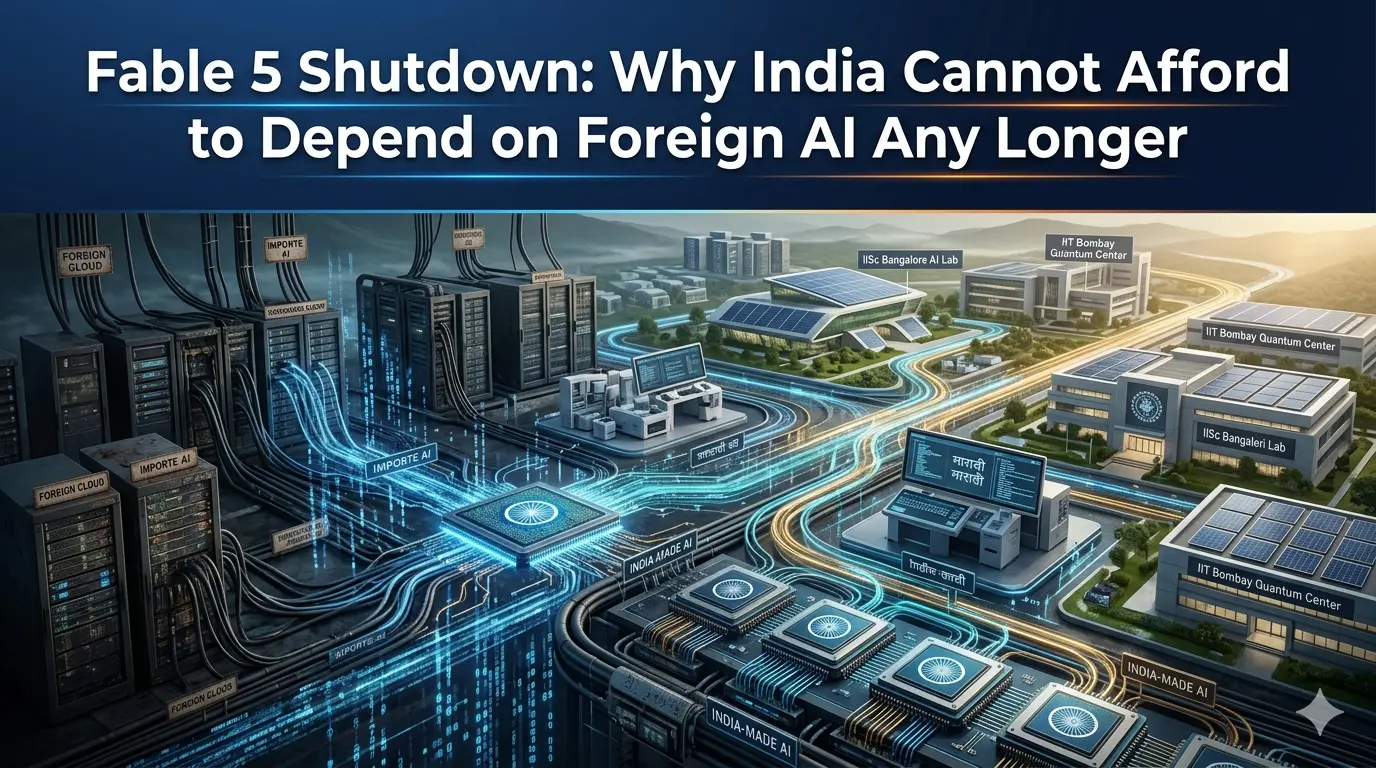
On the evening of Friday, June 12, 2026, something unprecedented happened in the global AI landscape. Anthropic — one of the world's leading AI companies — received a directive from the US government at 5:21 PM ET requiring it to immediately suspend access to its two newest and most capable models, Fable 5 and Mythos 5, for all foreign nationals worldwide.
The ban did not distinguish between countries, industries, or use cases. It applied to everyone outside the United States — including foreign nationals working inside the US, and even Anthropic's own non-American employees. For India, Anthropic's second-largest market, the timing could not have been more disruptive or more revealing.
What followed was not just a business interruption. It was a clarifying moment — one that forced India's technology leaders, policymakers, and startup founders to confront an uncomfortable truth that many had long avoided: India's AI ecosystem is built on a foundation it does not control.
What Actually Happened with Fable 5 and Mythos 5
Anthropic launched Fable 5 on June 9, 2026, to immediate acclaim. Within days, Indian developers, enterprises, and IT services firms had integrated it into production workflows. TCS had been training 50,000 employees on Anthropic's models. Infosys had active collaborations in place. Startups across Bengaluru, Hyderabad, and Pune had built critical pipelines around the platform.
Three days after launch, it was over. The US Department of Commerce, citing national security authorities, issued an export control directive ordering Anthropic to block all foreign-national access. Anthropic, unable to enforce such granular restrictions across millions of users on short notice, pulled the plug on both models globally — affecting its own international customers in the process. The company publicly disagreed with the government's assessment but had no choice but to comply.
The background remains murky. Reports suggest that jailbreak vulnerabilities in Mythos 5 — Anthropic's most powerful underlying model — were flagged as a national security concern, with some accounts indicating the issue was first raised with the White House by Amazon CEO Andy Jassy. Anthropic disputed the severity of the vulnerabilities, but the export ban stood regardless.
Here is what the Fable 5 shutdown revealed about India's AI dependence — and what the country must do about it.
How the Fable 5 Ban Hit India's Tech Sector
1. Enterprise and IT Services Were Caught Mid-Deployment
The disruption was not abstract. India's largest IT firms had already woven Anthropic's models into live client workflows. TCS, which had announced a major partnership with Anthropic just weeks before the ban, was training tens of thousands of employees on Fable 5's capabilities. Infosys had active enterprise collaborations dependent on the same platform.
When access was cut overnight, these organisations were left managing urgent rollbacks, client communications, and emergency pivots to alternative tools — all without warning, all on a weekend. The financial and reputational cost of that disruption is still being calculated. More than an operational headache, it demonstrated that India's most sophisticated technology companies had built critical dependencies on infrastructure they had no influence over.
2. Startups and Developers Faced Immediate Workflow Collapse
For India's startup ecosystem, the impact was even more acute. Thousands of early-stage companies and independent developers had integrated Fable 5 into coding assistants, customer service automation, content pipelines, and data analysis tools. Unlike large enterprises with contingency budgets and technical teams, many startups had no fallback. Their products simply stopped functioning.
Sridhar Vembu, founder of Zoho, articulated the sentiment of many in India's technology community when he wrote that the episode demonstrated technology being used as a geopolitical weapon. His prescription was direct: Indian organisations must urgently shift toward smaller open-source models — both domestic and international — and reduce their reliance on a narrow cluster of US-built frontier AI providers.
3. The Timing Exposed a Deeper Strategic Contradiction
Perhaps the most striking aspect of the Fable 5 episode was its timing. The ban arrived just days after Anthropic had announced a high-profile partnership with TCS to expand enterprise AI adoption across India — a market the company had publicly identified as a priority. That same partnership was rendered immediately complicated by the export control order.
The contradiction was not lost on India's policy community. A country cannot simultaneously be a priority market for a foreign AI company and a jurisdiction that can have its access revoked overnight. Access to frontier AI, as Kishore Lulla of Eros Innovation noted, is conditional, revocable, and ultimately governed by the national security priorities of another country. That is not a foundation on which a digital economy can be built.
At GInfomedia, we help Indian businesses build digital infrastructure that is resilient, compliant, and future-ready — with less dependence on platforms you don't control.
👉 Click Here to Chat with Us on WhatsApp and get a free digital strategy consultation today!
India's Sovereign AI Moment: What Leaders Are Saying
The Fable 5 shutdown triggered the most serious public conversation about AI sovereignty India has had. Across industry, academia, and policy circles, the message was consistent: this event must be treated as a turning point, not a temporary inconvenience.
Kishore Lulla, whose Eros LCM sovereign AI initiative is anchored at IIT Madras and recognised by India's Ministry of Electronics and Information Technology, framed it with particular clarity. India, he argued, has the data, the talent, the institutions, and the government commitment needed to build its own frontier AI capabilities. What it has lacked is urgency. The Fable 5 ban, he said, should supply that urgency. Mohandas Pai, former CFO of Infosys and a prominent voice in India's technology investment community, called for accelerated national investment in AI infrastructure and procurement policies that actively favour domestically built and controlled systems.
The emerging consensus among India's technology leadership points toward a pragmatic hybrid model: selective, cautious use of trusted global AI tools where necessary, combined with a serious, sustained effort to build sovereign AI capabilities that cannot be switched off by foreign governments.
What India — and Indian Businesses — Must Do Now
The Fable 5 episode will not be the last of its kind. As AI systems become more capable and more geopolitically significant, export controls and access restrictions will become an increasingly common feature of the international technology landscape. Indian businesses that treat this as a one-time disruption will be caught out again. The strategic response starts with an honest audit: which of your critical workflows depend on foreign AI platforms that could be restricted without notice? Where can open-source alternatives — Indian or international — replace proprietary dependencies? And where can your organisation begin building, or supporting, domestic AI capabilities that remain under Indian control? Sovereign AI is not a luxury or a policy aspiration. As June 12, 2026 made clear, it is a business continuity requirement.