
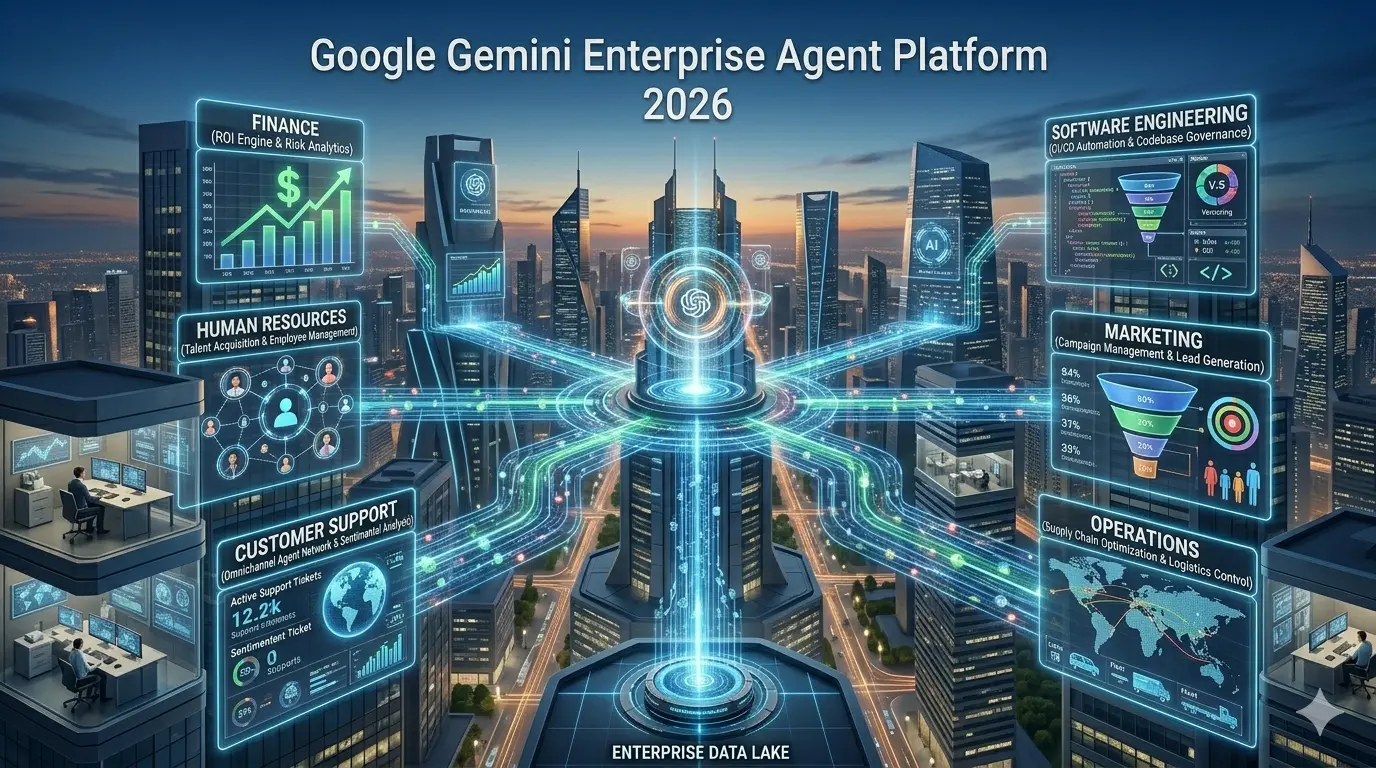
On April 22, 2026, at Google Cloud Next, Google made one of its most consequential AI infrastructure announcements since the introduction of Vertex AI. The company launched the Gemini Enterprise Agent Platform — a unified, end-to-end system purpose-built for enterprises that want to move beyond experimenting with AI to actually running autonomous agents in production, at scale, across their entire organisation.
This is not a product refresh or a rebranding exercise. The Gemini Enterprise Agent Platform is Google's full answer to one of the most pressing questions in enterprise technology today: now that AI models are powerful enough to take meaningful action on behalf of a business, what does the infrastructure need to look like for that to happen safely, reliably, and at production grade?
Google's answer is comprehensive. The platform unifies model selection, agent building, deployment, governance, and continuous optimisation under a single architecture — with every component designed around the demands of real enterprise environments. For business leaders, technology executives, and decision-makers across industries, understanding what the Gemini Enterprise Agent Platform offers — and what it demands — is now a strategic necessity.
What Is the Gemini Enterprise Agent Platform?
The Gemini Enterprise Agent Platform is the evolution of Google Cloud's Vertex AI. Rather than replacing Vertex AI's capabilities, it brings those capabilities together — model selection, model building, agent building — and adds a new layer of features specifically designed for the agentic era: agent integration, DevOps workflows, orchestration, and enterprise-grade security.
In practical terms, this means the platform serves as the single destination for technical teams who want to build AI agents that can transform their company's products, services, and internal operations. Those agents can then be delivered directly to employees through the Gemini Enterprise app, while remaining fully integrated with IT operations frameworks to ensure control and governance as usage scales.
The platform also provides access to more than 200 of the world's leading AI models through its Model Garden — including Google's own flagship models like Gemini 3.1 Pro, Gemini 3.1 Flash Image, and Gemini 4, alongside open models and third-party models including Anthropic's Claude family. This model flexibility is a meaningful design choice: Google is not betting that enterprises will only ever use one model family, and the platform is built accordingly.
Critically, Google has also announced that all future Vertex AI services and roadmap developments will be delivered exclusively through the Agent Platform, not as a standalone service. This signals a firm strategic direction: for Google Cloud customers building AI, the Agent Platform is now the only runway.
The Gemini Enterprise Agent Platform is built around four core capabilities — Build, Scale, Govern, and Optimise. Understanding each one is the key to understanding what this platform actually makes possible for a business.
Build: From Low-Code to Full-Code, in a Single Environment
Agent Studio — Visual, Low-Code Agent Creation
The first pillar of the platform is its build environment — and Google has deliberately designed it to serve developers across the full spectrum of technical sophistication. At the accessible end sits Agent Studio, a visual, low-code interface that allows teams to go from building simple prompts to deploying complex agents without writing extensive code. For business analysts, product managers, and non-developer stakeholders who understand business logic but do not write production code, Agent Studio provides a genuine pathway to participation in agent development.
When deeper customisation is required, teams can export logic directly from Agent Studio into the Agent Development Kit (ADK) — a major upgrade to Google's existing developer tooling. The ADK now processes more than six trillion tokens monthly on Gemini models, and its new graph-based framework allows developers to organise agents into networks of specialised sub-agents. Rather than one monolithic agent attempting to handle every task, complex workflows can be distributed across agents with defined, reliable logic governing how they collaborate. This architecture enables agents to solve problems of a complexity that would be impossible to handle with a single-prompt, single-model approach.
Agent Garden and Pre-Built Templates
To further accelerate the journey from idea to production, Google has introduced Agent Garden — a curated library of pre-built agent templates covering high-demand use cases including code modernisation, financial analysis, economic research, and invoice processing. For enterprises that want to deploy proven agent architectures rather than build from scratch, these templates function as battle-tested starting points that can be customised and extended to fit specific business requirements.
Additional build-stage capabilities include secure, sandboxed workspaces for agents to run commands and manage files safely without touching core systems, and multimodal streaming support that enables agents to process live audio and video in real time — opening applications in customer service, compliance monitoring, and real-time operational intelligence that were simply not practical before.
Scale: From Proof of Concept to Production, Without Compromise
A Re-Engineered Agent Runtime
The most common failure point for enterprise AI deployments is the gap between a working demonstration and a reliable production system. Google has directly addressed this with a comprehensively re-engineered Agent Runtime — the execution environment in which agents actually operate in production. The new runtime delivers sub-second cold starts and can provision new agent instances in seconds, eliminating the latency and reliability issues that have historically plagued enterprise AI deployments at scale.
More significantly, the Agent Runtime now supports long-running agents that can operate autonomously for days at a time. This is a meaningful departure from the session-based, stateless architecture that has characterised most AI deployments to date. An agent managing a multi-week sales prospecting sequence, tracking a complex regulatory compliance workflow, or coordinating a multi-step procurement process can now do so continuously — maintaining state, context, and progress across days without requiring human intervention to restart or re-brief it.
Memory Bank — Agents That Remember
Complementing the long-running runtime is the Agent Memory Bank — one of the most practically significant features of the entire platform. Memory Bank enables agents to dynamically generate and curate long-term memories from conversations and interactions. Using a new Memory Profiles system, agents can recall high-accuracy details with low latency, ensuring that context built up over weeks of interactions is never lost between sessions.
The commercial implications of persistent memory are substantial. An AI financial controller that remembers a user's specific expense submission habits can auto-submit recurring expenses without requiring manual input — a use case already live at Payhawk, which reports a reduction in submission time of more than 50%. A customer service agent that remembers a user's account history, preferences, and past issues can deliver genuinely personalised service rather than starting every interaction from scratch. Memory Bank is what transforms an AI assistant from a stateless tool into something that functions more like a knowledgeable team member.
At GInfomedia, we help Indian businesses evaluate, plan, and implement enterprise AI strategies that are practical, scalable, and aligned with their specific industry requirements.
👉 Click Here to Chat with Us on WhatsApp and get a free digital strategy consultation today!
Govern: Enterprise-Grade Control Over Every Agent You Run
Governance is where many enterprise AI platforms fall short — and where the Gemini Enterprise Agent Platform makes its most distinctive contribution. Google has built an entire governance layer specifically designed for the reality of operating a fleet of AI agents across a large organisation, where agents are interacting with sensitive data, making consequential decisions, and potentially communicating with each other in complex multi-agent architectures.
Agent Identity, Registry, and Gateway
Three capabilities sit at the centre of the governance layer. Agent Identity assigns every agent — whether built on the Agent Platform or sourced from a partner ecosystem — a unique cryptographic ID, creating a clear and auditable trail for every action taken, mapped back to defined authorisation policies. This solves one of the most significant emerging security challenges in enterprise AI: knowing exactly what each agent is doing, with what permissions, and in response to which instructions.
The Agent Registry provides a single source of truth for every internal agent, tool, and skill across the enterprise — a centralised catalogue that simplifies discovery and ensures that only governed, approved assets are available to users. The Agent Gateway functions as the operational control point for the entire agent fleet: it manages secure connectivity between agents and tools across any environment, enforces consistent security policies, and applies Model Armor protections to guard against prompt injection attacks and data leakage — two of the most significant security risks in production AI deployments.
Real-Time Threat Detection and Security Intelligence
The governance layer also includes Agent Anomaly Detection, which uses statistical models and an LLM-as-a-judge framework to flag unusual agent reasoning in real time — catching behaviour that diverges from expected patterns before it causes downstream harm. This works alongside Agent Threat Detection to provide visibility into genuinely malicious activity, such as reverse shells or connections to known bad IP addresses. A unified Agent Security dashboard, powered by Google's Security Command Center, brings threat detection and risk analysis together in a single operational view, allowing security teams to map relationships between agents, automate asset discovery, and scan for vulnerabilities across the stack.
For enterprises in regulated industries — banking, insurance, healthcare, legal services — this governance architecture is not merely a convenience. It is the prerequisite for deploying AI agents at all.
Optimise: Continuous Improvement from Testing to Production
The fourth pillar of the platform addresses the ongoing challenge of ensuring that agents actually perform as intended — not just in testing, but in the unpredictable conditions of live enterprise operations.
Agent Simulation allows teams to test agents against realistic synthetic user interactions and virtualised tools in a controlled environment before deployment. Agents are automatically scored based on task success and safety across multi-step conversations, providing a structured quality gate that catches failures before they reach production users. Agent Evaluation extends this quality assurance into live operations, continuously scoring agents against real traffic using multi-turn autoraters capable of evaluating the logic of an entire conversation rather than just a single response.
When issues are identified, Agent Optimizer provides automated remediation: rather than requiring engineers to manually dig through logs, it clusters real-world failures and automatically suggests refined instructions to improve agent accuracy. Combined with Agent Observability — which provides full visual traces of complex agent reasoning — this creates a feedback loop that makes agents progressively smarter over time without requiring constant manual intervention.
Who Is Already Using It — And What Results They Are Getting
Google launched the Gemini Enterprise Agent Platform with a strong portfolio of production deployments already live, giving business leaders concrete evidence of what the platform delivers in real operating conditions rather than controlled demonstrations.
Comcast rebuilt its Xfinity Assistant using the Agent Development Kit, moving from scripted automation to conversational generative intelligence that provides personalised troubleshooting and self-service support to customers at scale. The result, according to Comcast's CTO, is a reduction in repeat customer interactions — agents solve issues on the first contact rather than creating the need for follow-up. Color Health deployed an agent-powered Virtual Cancer Clinic that engages users to check screening eligibility, connects them to clinicians, and schedules appointments — using the scale of AI to reach more patients than a human-only service model could manage. PayPal is using the platform's Agent Payment Protocol to build trusted agent-to-agent payment flows, establishing the technical foundation for a new category of secure, autonomous commerce. L'Oréal is using the Agent Development Kit to orchestrate agents that draw on its proprietary Beauty Tech Data Platform — moving from rigid workflow automation to autonomous, outcome-oriented agent coordination at global scale.
Across these deployments, a consistent pattern emerges: the Agent Platform is enabling organisations to solve problems of a scale and complexity that existing automation and AI tools could not handle — and to do so with the governance, security, and reliability that enterprise operations require.
What This Means for Indian Businesses and Technology Teams
For India's enterprise technology market, the Gemini Enterprise Agent Platform arrives at a moment of genuine strategic importance. Indian enterprises — across BFSI, retail, IT services, manufacturing, and healthcare — are under growing competitive pressure to deploy AI that delivers measurable operational outcomes, not just AI that exists in pilot programmes and innovation labs.
The Agent Platform's architecture is well suited to the specific challenges that Indian enterprises face. The Memory Bank capability is directly relevant to customer-facing applications in a market where personalisation at scale is a competitive differentiator. The governance layer — with its cryptographic agent identities, centralised registry, and real-time threat detection — addresses the compliance and auditability requirements that India's regulated sectors increasingly impose on AI deployments. The model flexibility of the Model Garden, with support for both Google's own models and third-party models including Claude, allows Indian teams to choose the best model for each task rather than being locked into a single provider.
For India's IT services companies and AI consultancies, the platform also creates a significant new service opportunity. Enterprises that want to adopt the Gemini Enterprise Agent Platform at scale will need implementation partners with certified expertise in agent architecture, ADK development, governance configuration, and production optimisation. The firms that build those capabilities now — before the platform reaches mainstream adoption — will be strongly positioned to capture a growing share of enterprise AI services revenue.
What Your Business Should Do Right Now
The Gemini Enterprise Agent Platform is not a future roadmap item — it is available in the Google Cloud console today. For business leaders and technology decision-makers, the practical response begins with three questions. First, which of your existing business processes involve multi-step, repetitive workflows where an autonomous agent could deliver faster, more consistent outcomes than a human or a traditional automation tool? Second, which of your customer-facing or employee-facing interactions would benefit most from an AI agent that maintains context and memory across sessions, rather than starting fresh every time? And third, what governance and security requirements does your industry or regulatory environment place on AI deployments — and does your current AI infrastructure actually meet them?
The answers to those questions will define where your highest-value agent deployments are, and how urgently your organisation needs to build the capability to execute them. The Gemini Enterprise Agent Platform provides the infrastructure. The strategic decision — where to focus first, how fast to move, and how to build the internal capability to get there — is one that each organisation must make for itself. What is clear is that the window for getting ahead of competitors in enterprise agent deployment is open now, and it will not stay open indefinitely.