
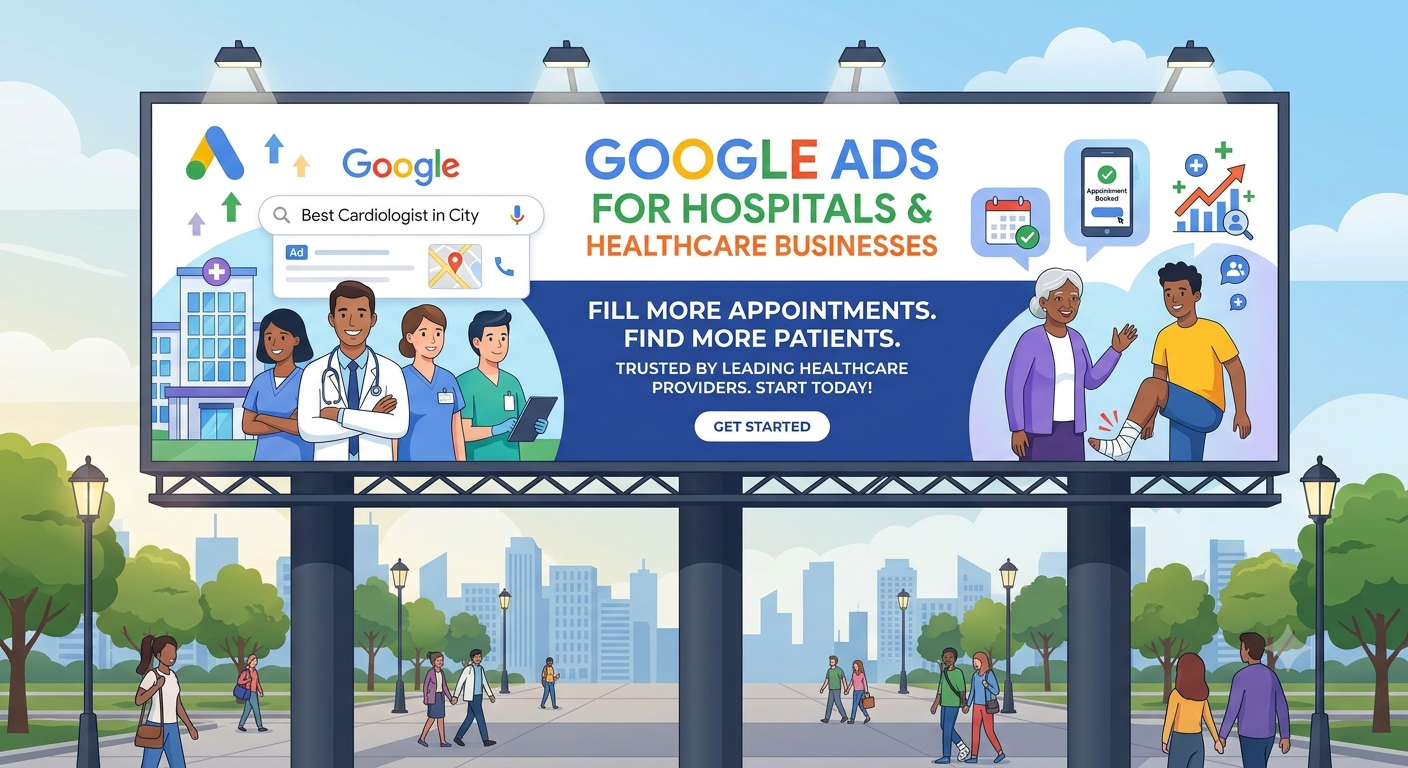
When a patient in India needs care, the journey almost always starts the same way: a search. Someone types "best cardiologist near me," "knee replacement surgery cost," "24 hour hospital in Mumbai," or "diabetologist online consultation" into Google — and in that single moment, they decide who they will trust with their health. The hospitals and clinics that appear at the top of those results capture the inquiry. Everyone else is invisible. This is exactly why Google Ads for hospitals and healthcare businesses has become one of the most important patient acquisition channels in the country.
For hospital administrators, clinic owners, diagnostic centres, and healthcare entrepreneurs, Google Ads is no longer an experimental marketing line item. Done correctly, it is the fastest, most measurable, and most cost-controllable way to put your facility in front of patients at the precise moment they are looking for treatment. Done carelessly, it quietly drains your budget on clicks that never become appointments.
This guide breaks down how Google Ads works for healthcare in India in 2026 — the keyword strategy that wins, the real costs you should expect, the NMC compliance rules you cannot afford to ignore, and the practical steps to launch campaigns that fill appointment slots rather than empty your marketing budget.
Why Google Ads Has Become Essential for Hospitals and Healthcare Businesses
The behaviour of Indian patients has fundamentally changed. With mobile internet reaching the overwhelming majority of households, the first response to a symptom, a referral, or a second opinion is no longer a phone call to a neighbour — it is a Google search. Industry data suggests the vast majority of patient journeys now begin online, and healthcare-related searches in India have been growing at a remarkable pace year over year, with mobile devices driving the bulk of that volume.
What makes Google Ads uniquely powerful for healthcare is intent. Traditional channels — newspaper inserts, hoardings, hospital directories, even most social media — reach a broad audience, the overwhelming majority of whom do not need your services right now. Google Ads is the opposite. You only pay when someone clicks, and that someone has just actively typed a query like "orthopedic hospital in Pune" or "IVF centre near me." The need already exists. Your only job is to appear and convert.
The second advantage is speed. Organic SEO and Google Business Profile optimisation are essential long-term assets, but they take months to mature. Google Ads places your hospital at the top of the results page within hours of going live. For a new department launch, a seasonal health campaign, or a facility trying to fill capacity quickly, that immediacy is invaluable. Paid search campaigns in healthcare also tend to convert meaningfully better than organic clicks, because the ad can speak directly to the searcher's intent with a clear call to action.
Here is everything hospitals, clinics, and healthcare businesses in India need to know about Google Ads in 2026 — the keyword strategy, the real costs, the compliance rules, and how to turn searches into booked appointments.
How Google Ads Works for Hospitals — The Core Structure
High-Intent Keywords vs. Informational Keywords
The single biggest factor that separates a profitable healthcare campaign from a wasteful one is keyword intent. Not all searches are equal. A query like "what causes back pain" is informational — the person is reading, not booking. A query like "spine specialist near me" or "slip disc treatment in Mumbai" is high-intent — the person is ready to act. Your advertising budget should be concentrated overwhelmingly on the second category.
For hospitals and clinics, the highest-converting keywords typically combine a specialty or treatment with a location or urgency modifier: "cardiologist in Andheri," "best hospital for heart surgery near me," "emergency hospital open now," "knee replacement surgery cost," "dermatologist appointment today." These are the searches made by patients who have moved past curiosity and into decision-making. Bidding on them puts your facility directly in the path of someone who is choosing where to go.
Informational keywords are not worthless — they have a role in awareness and content marketing — but they rarely deserve aggressive paid bidding. A patient searching "symptoms of thyroid" may be weeks away from booking anything. Pouring ad spend into that query, rather than into "thyroid specialist near me," is one of the most common and expensive mistakes hospitals make when they run Google Ads without specialist guidance.
Negative Keywords: The Budget-Saver Most Hospitals Ignore
A well-run healthcare Google Ads account is defined as much by who it excludes as by who it targets. Negative keywords are the search terms you instruct Google never to show your ads for — and they are where a huge amount of wasted budget can be recovered. Without them, a hospital advertising "cardiology" can find its ads — and its money — being spent on searches like "cardiology jobs," "cardiology course fees," "cardiology MBBS," or "free cardiology consultation."
Standard negative keywords for almost every healthcare campaign include terms like "jobs," "vacancy," "salary," "course," "syllabus," "college," "admission," "free," and "PDF." A pediatric hospital should exclude "geriatric" and "adult"; a clinic that only operates in one city should exclude the names of other cities. This discipline keeps your spend focused on genuine prospective patients and dramatically improves your cost per inquiry over time.
Landing Pages, Call Ads & Conversion Tracking
The click is only half the job. Where the patient lands determines whether that click becomes an appointment. Every healthcare ad should point to a fast-loading, mobile-first landing page that matches the search — a "knee replacement" ad should lead to a knee replacement page, not the hospital homepage. The page must carry the elements that build patient trust quickly: doctor qualifications and accreditations, clear contact options, a prominent WhatsApp or call button, genuine patient reviews, and a simple appointment form.
For urgent and high-value queries, call-only ads and call extensions are especially effective in India, where a large share of patients prefer to dial rather than fill a form. Most importantly, every campaign needs proper conversion tracking configured before launch — measuring form submissions, calls, and WhatsApp clicks. Without it, you are flying blind: you cannot tell which keywords produce patients and which only produce costs, which makes optimisation impossible.
What Google Ads Costs for Hospitals in India — and the ROI
One of the most common questions from hospital owners is simply: how much does this cost? The honest answer is that Google Ads is one of the few marketing channels where you control the spend almost entirely. Campaigns can start modestly — many clinics begin with monthly budgets in the range of a few thousand rupees and scale up as the data proves what works. Larger multi-specialty hospitals competing for high-value surgical keywords naturally invest more, because those keywords are more competitive and each acquired patient is worth more.
What matters far more than the total budget is the cost per patient inquiry, and this is where strategy makes an enormous difference. The same keyword, in the same city, can cost one hospital several times more per inquiry than another simply because of how well the account is structured, how tight the negative keyword list is, how relevant the landing page is, and how disciplined the bidding strategy is. Hospitals that move from broad, unoptimised campaigns to tightly managed ones routinely cut their cost per inquiry substantially — sometimes by more than half.
The right way to think about Google Ads spend in healthcare is not "what does a click cost" but "what does an acquired patient cost, and what is that patient worth." A single surgical patient or a long-term chronic-care relationship can be worth many thousands of rupees in lifetime value. When campaigns are tracked all the way to confirmed appointments — not just clicks — the return on a well-managed healthcare PPC account is one of the clearest in digital marketing.
Staying NMC-Compliant: The Advertising Rules Every Hospital Must Follow
Healthcare advertising in India operates under stricter rules than almost any other industry, and ignoring them is a serious risk. The relevant regulator is the National Medical Commission (NMC) — the body that replaced the former Medical Council of India — alongside the Drugs and Magic Remedies (Objectionable Advertisements) Act, and broader advertising oversight from ASCI and consumer-protection authorities. Any hospital running Google Ads must build compliance into the campaign from the very first day.
The core principles are consistent. Hospitals, nursing homes, diagnostic centres, and similar institutions are permitted to advertise factual information — the name of the institution, the type of patients treated, the facilities and specialities offered, staff qualifications, and fees. What is prohibited is self-aggrandising or misleading promotion. Ads must never promise a "guaranteed cure," "100% results," or similar claims; such language can attract penalties under the Magic Remedies Act. Individual doctors face tighter restrictions on self-promotion than institutions do, so campaigns should foreground the facility and its services rather than glorifying a named practitioner.
Beyond Indian law, Google enforces its own healthcare advertising policies. Hospitals often need to complete Google's verification before certain health-related ads can run, prescription medicines cannot be advertised by anyone other than certified pharmacies, and ad targeting cannot exploit a user's sensitive health condition. The safest and most effective healthcare ad copy is reassuring, factual, and trust-building — emphasising accreditation, experienced specialists, same-day appointments, and clear next steps, rather than hype.
At GInfomedia, we help hospitals, clinics, and healthcare businesses across India run compliant, high-converting Google Ads campaigns that turn searches into booked appointments — with full NMC-aware ad copy and transparent ROI reporting.
👉 Click Here to Chat with Us on WhatsApp and get a free healthcare PPC audit today!
Real Results: What Healthcare Google Ads Campaigns Actually Deliver
The case for Google Ads in healthcare is not theoretical — it shows up in the appointment book. Across the industry, the pattern is remarkably consistent: when a hospital pairs high-intent keywords with a conversion-focused landing page and disciplined account management, the cost per patient inquiry falls and the volume of qualified leads rises.
Consider a typical multi-specialty hospital that begins by ranking nowhere for its key procedures and relies almost entirely on referrals. After launching tightly targeted campaigns — bidding on procedure-and-location keywords, building a dedicated landing page for each major specialty, and adding call extensions for urgent queries — it begins appearing at the top for searches like "best orthopedic hospital" and "knee replacement surgery" in its city, and starts acquiring high-value surgical patients within weeks rather than months. That is the standard shape of a well-built healthcare campaign.
Diagnostic labs and clinics see similar dynamics on a smaller scale. A diagnostic centre advertising seasonal health packages, a dental clinic targeting "emergency dentist near me," or a fertility centre running campaigns around "IVF centre" queries can all generate a steady, predictable flow of inquiries that traditional marketing simply cannot match for cost-efficiency. The common thread is always the same: frontier-level targeting precision, combined with a frictionless path from click to appointment, producing measurable patient growth.
What This Means for Hospitals and Clinics Across India
India's healthcare market is enormous, fast-growing, and increasingly competitive online — and that creates a clear opportunity for facilities that move deliberately. The hospitals that win patients in 2026 will not necessarily be the largest or the oldest; they will be the ones most visible at the exact moment patients are searching, with the most trustworthy and frictionless booking experience.
For large hospital chains and corporate groups, Google Ads is a scalable patient acquisition engine that can be deployed city by city and specialty by specialty, with performance tracked down to the cost per acquisition for each service line. The strategic question is whether the campaigns are being managed with genuine healthcare expertise or simply running on autopilot — the difference in returns between the two is dramatic.
For mid-sized hospitals, single-specialty clinics, diagnostic centres, and individual practices, the opportunity is arguably even greater. A well-run local campaign lets a focused clinic compete directly with much larger players in its own neighbourhood, capturing "near me" searches and urgent queries that the big chains often manage poorly. And for healthcare facilities targeting medical tourism, Google Ads offers the ability to reach international patients searching for affordable, high-quality treatment in India — a high-value segment that paid search is uniquely suited to capture.
How to Launch a High-Performing Healthcare Google Ads Campaign
Getting started the right way matters more than getting started quickly. A healthcare Google Ads campaign that is launched carelessly can burn through a month's budget before anyone notices the leak. The practical path to a profitable campaign involves a few disciplined steps.
The first is keyword and intent mapping. Before a single rupee is spent, build a focused list of high-intent, location-specific keywords tied to the services you most want to grow, and an equally careful list of negative keywords to exclude job seekers, students, and freebie hunters. This single step determines whether your budget reaches patients or evaporates on irrelevant clicks.
The second is the landing page and conversion setup. Each major service should have its own fast, mobile-first landing page with clear trust signals, a prominent call and WhatsApp option, and a simple appointment form — and conversion tracking must be configured to measure calls, form fills, and chats before launch. Without this foundation, you cannot know what is working, and you cannot optimise.
The third is compliant ad copy and ongoing management. Write reassuring, factual ads that respect NMC and Google's healthcare policies, then treat the campaign as a living system: review search terms weekly, refine negatives, pause underperforming keywords, and reinvest in the ones that produce real appointments. Google Ads rewards consistent, data-driven management — campaigns improve month over month when someone is genuinely watching the numbers. For most hospitals, partnering with a specialist healthcare PPC team is the fastest route to that level of discipline.
Google Ads for hospitals is not a "set it and forget it" channel. It is a precision system that rewards high-intent targeting, compliant messaging, and relentless optimisation. The healthcare businesses that treat it that way build a durable, predictable pipeline of new patients.
The Bigger Picture: AI, Smart Bidding & the Future of Medical PPC
The way Google Ads works for healthcare is shifting underneath everyone's feet, and 2026 marks a clear turning point. Google's advertising platform has moved decisively toward AI-driven automation — Smart Bidding and value-based bidding strategies that no longer simply chase clicks, but use machine learning to predict which searcher is most likely to actually book an appointment. The era of manually adjusting bids on long lists of hyper-specific keywords is giving way to a model where the quality of your data and conversion signals matters more than manual tinkering.
This has two practical implications for hospitals. First, clean, accurate conversion tracking is now the single most important input into campaign performance — if you feed Google's algorithm shallow or misleading signals, it learns the wrong behaviour and wastes money; if you feed it accurate, appointment-level signals, it becomes a genuine growth engine. Second, the tightening privacy environment means healthcare advertisers must build campaigns around compliant, first-party data and educational, trust-first messaging rather than invasive targeting.
The direction of travel is unmistakable: medical PPC is becoming smarter, more automated, and more dependent on strategy and data quality than on manual effort. The hospitals and healthcare businesses that invest now — in proper tracking, compliant campaigns, and expert management — will compound that advantage as the platform grows more powerful. The opportunity to acquire patients through Google Ads has never been larger. The only real question is whether your facility will be the one appearing at the top when the next patient searches.
