
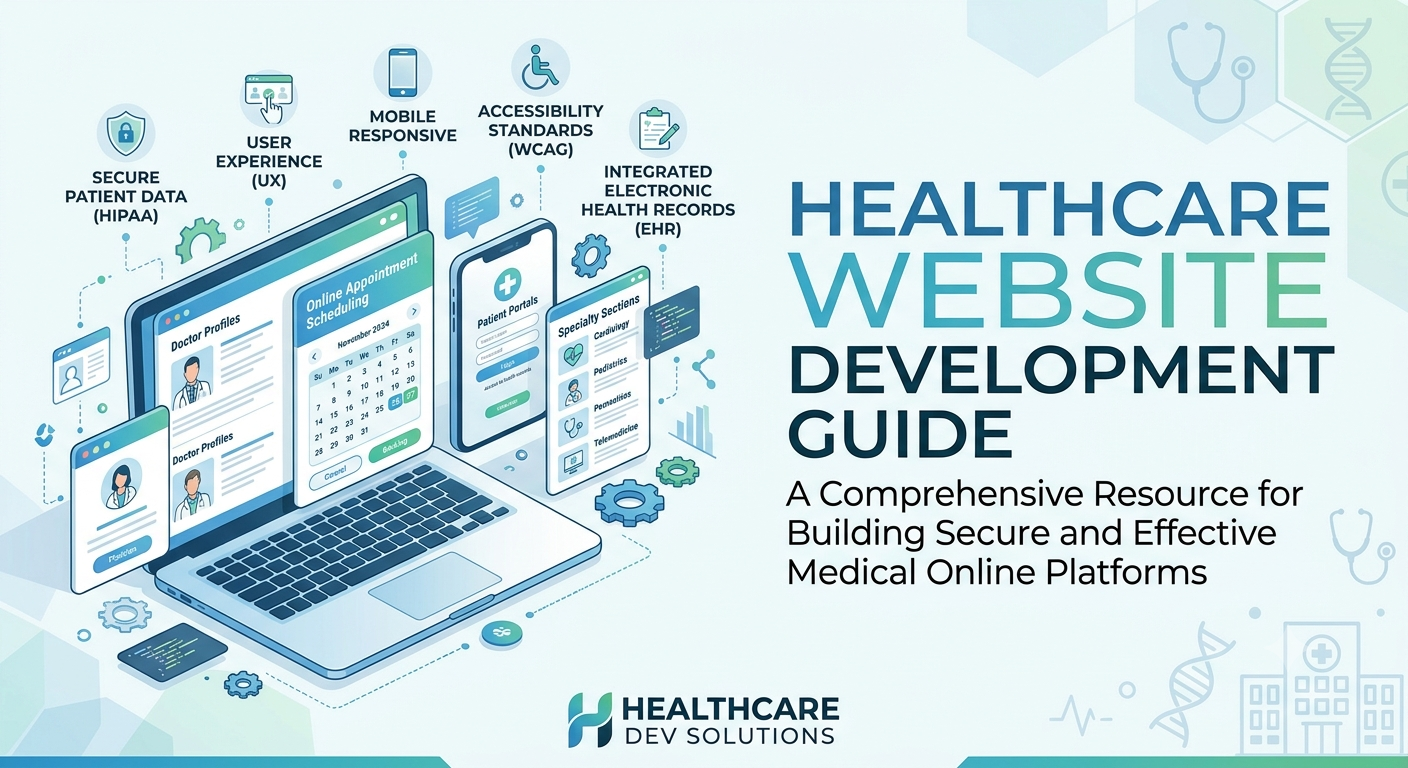
For hospitals, clinics, diagnostic centres, and healthcare startups across India, a website is no longer a digital business card — it is the front door to your practice. In 2026, the majority of patients in metros and Tier-1 cities begin their healthcare journey on Google: searching for a specialist, comparing clinics, reading reviews, and booking an appointment before they ever step through your physical doors. If your healthcare website is slow, hard to use on a phone, or simply doesn't exist, those patients are booking with a competitor instead.
This guide is a complete, practical walkthrough of healthcare website development in India — what it actually costs, the features that matter, the ABDM and DPDP Act compliance requirements you cannot ignore in 2026, how healthcare SEO brings patients to your door, and how to choose the right web development partner. Whether you run a single-doctor clinic in Mumbai or a multi-specialty hospital network, this is the reference you need before you commission a single line of code.
We've written it the way we'd brief a client: clear numbers, honest trade-offs, and no jargon for its own sake.
Why Every Hospital and Clinic in India Needs a Professional Website in 2026
Healthcare in India has gone digital faster than almost any other sector. Industry reports indicate that a large majority of patients in metros and Tier-1 cities now use digital platforms to research providers and book care, and the country's digital health market has grown into a multi-billion-dollar opportunity. The pandemic accelerated this shift by years, normalising teleconsultation, online appointment booking, and digital health records as everyday expectations rather than premium extras.
A professionally built healthcare website does three things at once. It builds trust — a credible, well-designed site reassures anxious patients that your practice is established and professional. It reduces operational load — online appointment booking, automated reminders, and self-service information take pressure off your front desk. And it generates patients — a website optimised for local search turns "best dermatologist near me" queries into actual bookings.
The cost of not having a strong website is invisible but real: every patient who can't find you, can't book you easily, or doesn't trust what they see is a patient who chose someone else. In a market where patients increasingly compare providers online before deciding, your website is often the deciding factor.
Here is everything a hospital, clinic, or healthcare business in India needs to know before building a website in 2026 — the real costs, the must-have features, the compliance rules, and how to choose the right development partner.
How Much Does Healthcare Website Development Cost in India?
This is the first question almost every clinic owner and hospital administrator asks — and the honest answer is that it depends entirely on what you build. In India, a healthcare website can cost anywhere from around ₹15,000 for a simple informational site to ₹80 lakh or more for a fully integrated hospital management platform. Most clinics and hospitals, however, land in a far more predictable middle range. Below is a realistic breakdown by project type for 2026.
Basic Clinic & Doctor Websites (₹15,000 – ₹75,000)
A basic healthcare website covers the essentials: a clean homepage, an About/Doctors page, a Services or Treatments section, a blog, and a Contact page with location and enquiry form. Usually built on a content management system like WordPress, it is fast to launch and easy to update yourself. This tier is ideal for single-doctor practices, small clinics, and new healthcare businesses that primarily need visibility and a way for patients to find and contact them. It focuses on lead capture and a professional first impression rather than complex functionality.
Corporate Hospital & Multi-Specialty Websites (₹75,000 – ₹3,00,000)
This is where a website becomes a genuine digital marketing asset rather than a brochure. At this level you get a custom design aligned to your brand, dedicated department and treatment pages, individual doctor profiles, online appointment booking, basic payment integration, conversion-focused landing pages, and a stronger SEO foundation. Mid-sized hospitals, multi-specialty clinics, diagnostic chains, and growing healthcare brands typically invest here because the site needs to support structured lead management and rank for competitive treatment-related searches.
Custom Platforms, Patient Portals & Hospital Systems (₹3,00,000 – ₹80,00,000+)
At the top end sits custom-built infrastructure: secure patient portals, telemedicine platforms with video consultations, EHR/EMR integration, hospital management system connectivity, multi-location architecture, and ABDM-compliant data exchange. A full enterprise hospital platform with electronic health records, billing, patient portals, and telemedicine can run from several lakhs to ₹60–80 lakh or more, depending on the depth of integration, compliance work, and customisation. These projects are for large hospitals and healthcare networks with long-term digital expansion plans.
Beyond the build itself, budget for ongoing costs that many vendors don't mention upfront: hosting (typically ₹10,000–₹30,000 per year), domain renewal, security and compliance hardening, and SEO and digital marketing (which can range from ₹30,000 to ₹1 lakh per month depending on competition). A trustworthy agency will give you a scope-based estimate after understanding your requirements — not a vague single number before asking a single question.
Must-Have Features of a Healthcare Website
The features you choose are the single biggest driver of both cost and patient satisfaction. A few are now considered non-negotiable for any serious healthcare website in India.
Online Appointment Booking & Patient Portal
Patients in 2026 expect to book appointments the same way they book a cab or a table — instantly, online, at any hour. A well-built booking system reduces no-shows through automated reminders, lightens the load on your front desk, and measurably increases conversions. A patient portal goes further, letting patients view reports, access prescriptions, and securely message providers, which dramatically improves the experience for repeat visits and chronic-care patients.
Doctor Profiles, Departments & Treatment Pages
Detailed, well-written treatment and department pages are not just informational — they are your primary SEO engine. When a patient searches for a specific condition or procedure, it's these pages that compete for the ranking. Strong doctor profiles, complete with credentials, specialisations, and experience, build the trust signals that both patients and search engines reward. Thin, 300-word service pages no longer rank; comprehensive pages with FAQs, process explanations, and clear next steps do.
Telemedicine & Teleconsultation Integration
Virtual care is now a mainstream expectation, not a niche add-on. Integrating teleconsultation — secure video, scheduling, and digital prescriptions — extends your reach beyond your immediate geography and serves patients who can't easily travel. Done correctly, telemedicine functionality must align with the Telemedicine Practice Guidelines and capture patient consent properly, which makes the implementation more involved than a simple video plugin.
Other features worth planning for include mobile-first responsive design (the overwhelming majority of healthcare searches happen on phones), fast loading speed, WhatsApp integration for patient communication, multilingual support for India's diverse patient base, and clear, prominent calls to action like "Book an Appointment" on every key page.
At GInfomedia, we build fast, secure, SEO-ready healthcare websites for hospitals, clinics, and healthcare brands across India — with appointment booking, patient-friendly design, and compliance built in from day one.
👉 Click Here to Chat with Us on WhatsApp and get a free website strategy consultation today!
ABDM & DPDP Act Compliance: The Non-Negotiables for 2026
This is the area most clinics underestimate — and the one that carries the highest risk. Any healthcare website in India that collects or handles patient data now operates inside a real regulatory framework. Treating compliance as a final-stage checkbox rather than a design principle is the single most expensive mistake healthcare projects make, because retrofitting it after the build can cost more than the original development.
Ayushman Bharat Digital Mission (ABDM) Readiness
ABDM is the Government of India's initiative, run by the National Health Authority, to build a unified, interoperable digital health ecosystem. It connects patients, providers, and payers through building blocks like the ABHA health ID, the Health Facility Registry, the Health Professional Registry, and a consent-based Health Information Exchange. While ABDM is voluntary for many providers today, it is rapidly becoming a practical requirement — government-empanelled hospitals are increasingly mandated to adopt it, insurers are moving towards ABDM-linked digital records for cashless claims, and patients with hundreds of millions of ABHA IDs issued increasingly expect digital health records. Building ABDM-readiness into your platform now future-proofs it and makes your services discoverable across the national health network.
DPDP Act 2023 & Patient Data Privacy
The Digital Personal Data Protection (DPDP) Act, 2023 fundamentally changed how patient information must be handled in India. Health data — medical histories, diagnoses, prescriptions, lab results — is treated as high-risk because a breach can cause real harm to patients. The Act requires clear, informed, and revocable patient consent before collecting or sharing data, secure-by-design architecture, and breach notification obligations, with significant financial penalties for serious failures. For a healthcare website, this means consent management, encryption, access controls, and audit logging cannot be afterthoughts — they must be part of the architecture from the first line of code. A privacy-first build is not just legal protection; it is the foundation of patient trust.
Healthcare SEO: How Patients Actually Find You on Google
A beautiful website that no one can find is a wasted investment. Healthcare SEO is the discipline of making your site easy for both patients and search engines to discover, understand, and trust — and in healthcare, Google holds content to a higher standard because it falls under "Your Money or Your Life" topics. That means your rankings depend not just on keywords, but on demonstrated expertise, accurate information, and trust signals.
For Indian healthcare providers, local SEO is where the real patient acquisition happens. The goal isn't to rank nationally for "best cardiologist" — it's to own searches like "diabetologist in Andheri" or "best dental clinic near me" for patients in your actual catchment area. That requires a fully built-out Google Business Profile with accurate service listings, photos, and a steady flow of recent reviews; consistent name, address, and phone details across the web; and location-specific landing pages that match patient intent.
On the content side, the pages that win answer real patient questions clearly and completely. Search behaviour is increasingly answer-driven and shaped by AI overviews, so structuring content around the questions patients actually ask — with concise, direct answers followed by depth — is what gets your practice surfaced and cited. Combined with fast loading speed, mobile-first design, and medical schema markup that helps search engines understand your content, this is what moves a healthcare site from page five to page one.
How to Choose the Right Healthcare Web Development Agency
Healthcare web projects demand more than design skills — they require technical expertise, regulatory awareness, and long-term support. Choosing the wrong partner is how clinics end up with sites that look good in a demo but fail in the real world. A few questions separate a capable agency from a risky one.
Ask whether they understand healthcare-specific requirements: ABDM-readiness, DPDP compliance, secure patient data handling, and integration with systems like EHR or hospital management software. Generalist agencies often treat these as add-ons rather than foundations. Ask about their SEO approach — a site without local search optimisation won't deliver patients regardless of how it looks. Ask to see real healthcare work and measurable outcomes, not just portfolios of pretty homepages. And be wary of any vendor offering a fixed price before asking detailed questions about your scope; in healthcare web development, a price without a conversation is a red flag.
Crucially, look for a partner who plans for the long term. A healthcare website is not a one-time build — it needs ongoing security updates, content additions, performance monitoring, and SEO maintenance. The right agency stays with you as your practice grows, rather than disappearing after launch.
A healthcare website is a long-term asset, not a one-off expense. The clinics and hospitals that invest in a secure, compliant, SEO-ready site — and a partner who supports it over time — are the ones that consistently win patients online.
Timeline: How Long Does It Take to Build a Healthcare Website?
Timelines in healthcare web development are almost always longer than equivalent projects in other sectors, because compliance setup and integrations constrain the schedule. A realistic 2026 picture looks like this: a basic clinic or doctor website can be ready in roughly three to four weeks. A more advanced site with appointment booking and a patient portal typically takes six to ten weeks. Complex hospital platforms involving EHR integration, telemedicine, and ABDM connectivity can take ten to twelve weeks or considerably longer.
The factors that extend timelines are predictable: compliance architecture (encryption, consent flows, and access controls must be in place before patient data touches the system), integration work with third-party systems whose certification processes you don't control, and thorough testing with clinical and front-desk stakeholders. Building the right way from the start is what prevents the far more expensive scenario of reworking a non-compliant or insecure site after launch.
The Bigger Picture: Your Website Is Your Practice's Digital Heartbeat
Healthcare in India is in the middle of a digital transformation that is reshaping how patients find, choose, and engage with providers. ABDM is building the national infrastructure, the DPDP Act is raising the bar on trust and data protection, and patient expectations — for online booking, teleconsultation, and instant information — are now firmly mainstream. A modern healthcare website sits at the centre of all of this.
The good news is that this is a navigable, well-understood path. The clinics and hospitals that treat their website as a strategic asset — built for speed, trust, compliance, and search visibility — are the ones consistently turning online searches into booked patients. The ones that treat it as an afterthought quietly lose those patients to competitors who didn't.
The question for any healthcare provider in India is no longer whether to invest in a professional website. It's whether you'll build it correctly, with the compliance and SEO foundations that 2026 demands — or pay more later to fix what was done in a hurry. Build it right, and your website becomes the most reliable patient-acquisition engine your practice has.
