
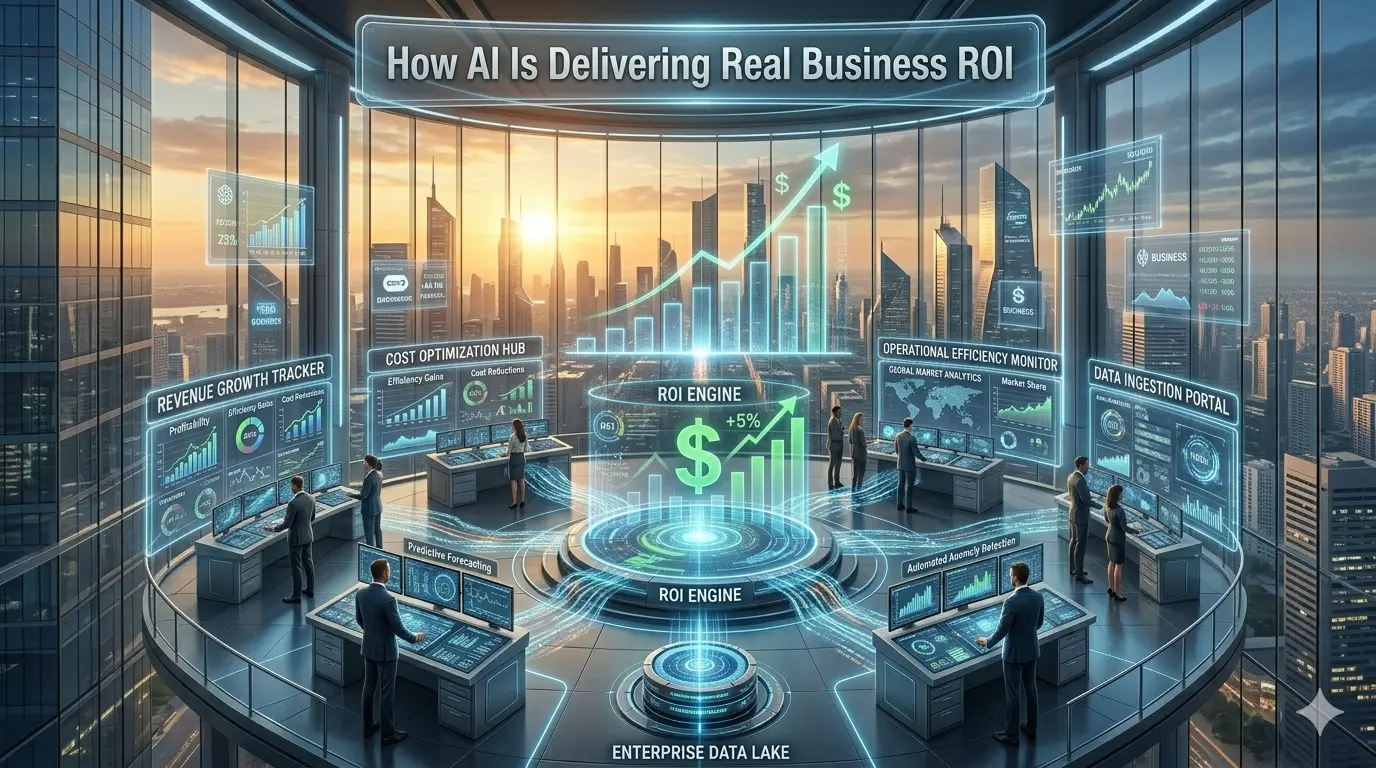
Moving Past the Hype to Quantifiable AI Gains
For the past few years, artificial intelligence has dominated enterprise boardrooms, yet many business leaders still struggle to point to precise bottom-line impact. That dynamic is changing rapidly. Banking giant HSBC recently highlighted this transition, projecting more than $100 million in financial gains stemming directly from its partnership and deployment of Google Cloud's advanced AI tools.
This massive return on investment underscores a vital shift in corporate technology: enterprise AI is moving out of experimental sandboxes and proving itself as a massive engine for structural cost-reductions and operational acceleration.
The lesson for modern businesses is clear: AI is no longer a luxury tool for simple productivity gains—it is an enterprise infrastructure lever that drives measurable, multi-million dollar business performance.
The Anatomy of a $100M AI Integration Strategy
HSBC's massive efficiency projections aren't built on a single chatbot application. Instead, the global banking institution integrated Google Cloud's AI suite across multiple highly complex, text-heavy, and high-stakes financial operations.
By moving computing workloads onto flexible cloud-native AI pipelines, the bank succeeded in automating specialized labor-intensive functions. The rollout focused heavily on processing unstructured data, reducing regulatory response time, and eliminating friction across international operational verticals.
Key Areas Driving Enterprise AI ROI
The financial success observed in banking frameworks offers an actionable blueprint for scaling enterprises looking to maximize their automation budgets.
1. Intelligent Financial Document Processing
Large organizations spend thousands of hours manually reviewing thousands of legal briefs, structured commercial loan applications, and international trade contracts. Advanced AI engines read, structure, and flag irregularities within these documents in seconds, reducing turnaround times from days to minutes.
2. Automated Anti-Money Laundering (AML) & Risk Audits
Financial regulatory compliance requires constant oversight. Instead of running basic keyword scripts, next-generation deep learning networks identify complex fraudulent patterns across millions of daily historical transactions, slashing false positives and allowing risk teams to act instantly on credible threats.
The highest business ROI from AI isn't found in replacing human workers, but in supercharging specialized staff by automating the initial text parsing, data structuring, and routine analysis phases.
3. Accelerating Internal Developer Workflows
By leveraging code generation platforms, software engineering teams can migrate legacy software repositories and deploy cloud infrastructure upgrades significantly faster. This minimizes organizational tech debt and frees up technical talent to focus on core product innovation.
4. Unifying Fragmented Corporate Data silos
One of the largest hurdles for enterprise analytics is siloed information. Modern vector search technologies allow business analysts to naturally query across separate, decentralized databases, immediately surfacing critical consumer insights that would typically require writing complex database scripts.
Deploying AI Securely within Enterprise Guardrails
To pull off financial transformations at this scale, safety and data integrity cannot be compromised. Highly regulated environments mandate that any implementation of corporate-level AI tools adheres to absolute strict security boundaries:
- Encrypted Private Sandboxes: Ensuring that all proprietary corporate records and consumer data fields remain locked away from public base model training loops.
- Verifiable Audit Trails: Keeping comprehensive computational logs of all decision steps and operational pathways taken by automated infrastructure.
- Human-in-the-Loop Safeguards: Incorporating human review touchpoints for highly sensitive final transactions, ensuring absolute security and regulatory alignment.
The Road Ahead: Transitioning to Value-Driven Automation
HSBC's milestone demonstrates that the true maturity of artificial intelligence is judged purely by its fiscal and operational impact. For mid-sized to enterprise-level businesses, the challenge is shifting from general experimentation to executing precise use cases aimed squarely at core internal bottlenecks.
As enterprise cloud tools become more accessible, the competitive advantage will belongs to businesses that build integrated data architectures capable of letting AI do what it does best: parsing data, optimizing workflows, and maximizing operational velocity.
At GInfomedia, we help Indian businesses evaluate, plan, and implement enterprise AI strategies that are practical, scalable, and aligned with their specific industry requirements.
👉 Click Here to Chat with Us on WhatsApp and get a free digital strategy consultation today!