
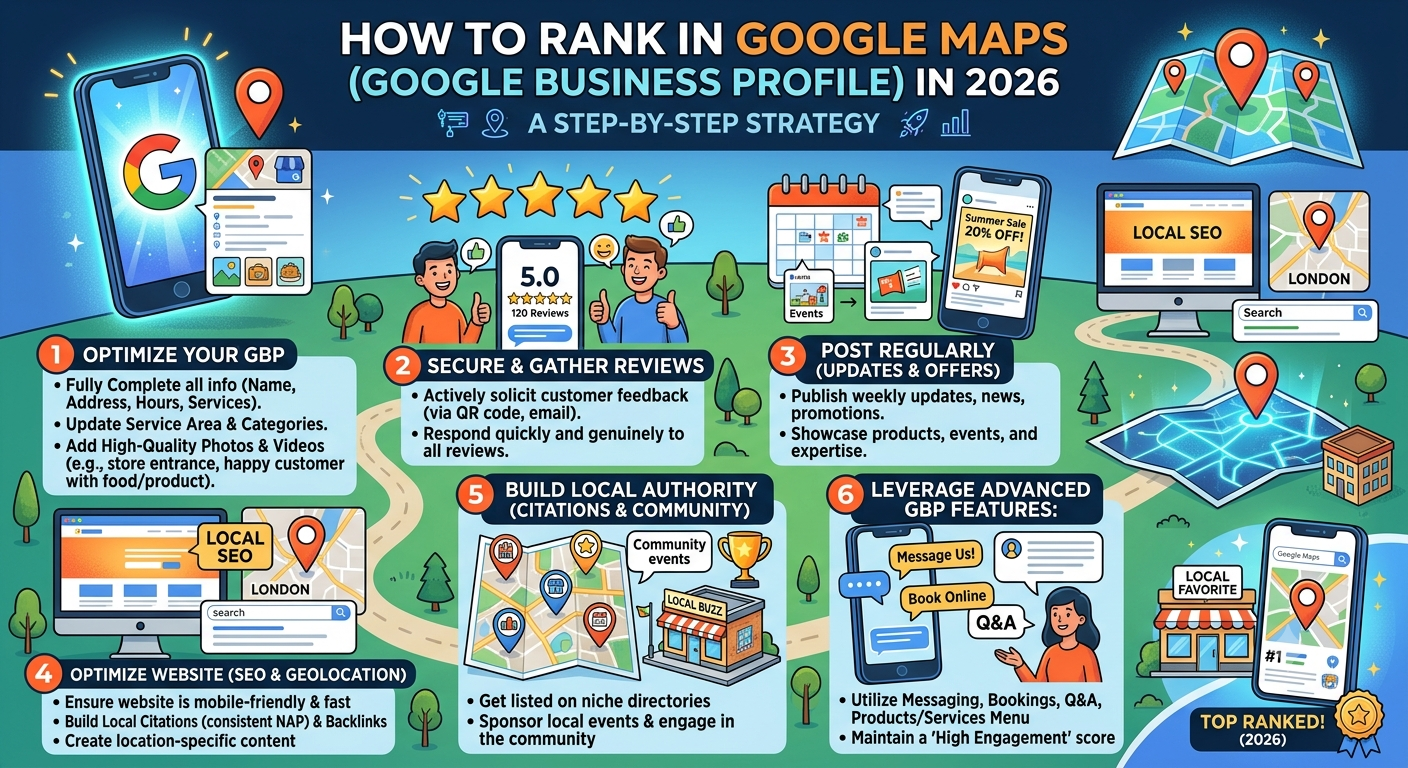
For any local business, one question decides where the customers go: how to rank in Google Maps. When someone nearby searches for what you sell, the top three results — the local 3-pack — capture nearly half of all clicks. If your Google Business Profile isn't in that pack, a thinner competitor down the road is quietly taking the customers who were looking for you.
The good news: Google Maps SEO rewards the businesses that put in the work, not the ones with the biggest budgets. A modest shop with a fully optimized Google Business Profile (formerly Google My Business), steady Google reviews, and consistent local signals can outrank far larger brands. In 2026, with AI-powered results reshaping search, getting this right matters more than ever.
This guide breaks down exactly how to rank in Google Maps in 2026 — the real ranking factors, a step-by-step Google Business Profile checklist, the off-page local SEO signals that build authority, and the mistakes that quietly tank your visibility. Let's get into it.
How to Rank in Google Maps: The Quick Answer
To rank higher on Google Maps, fully optimize and verify your Google Business Profile, pick the most accurate primary category, keep your NAP (name, address, phone) identical everywhere online, earn a steady flow of genuine Google reviews, and reinforce it all with a fast, locally optimized website. Do those consistently and you give your business its best shot at the local 3-pack.
There's no shortcut and no way to pay Google for a better spot. Google Maps ranking comes down to three things the algorithm measures — relevance, distance, and prominence — and your job is to maximize the two you actually control: relevance and prominence. In moderate-competition markets, a fully optimized profile with 20+ reviews can break into the map pack within 30–90 days.
How Google Maps Ranking Works in 2026: The Factors That Matter
According to Google's own documentation and the Whitespark 2026 Local Search Ranking Factors report, here are the signals that actually decide how you rank in Google Maps.
1. Relevance
Relevance is how well your Google Business Profile matches what someone is searching for. Google reads your primary category, secondary categories, business description, services, and the keywords naturally present in your profile. A "Family Dentist" who selects that exact category — instead of just "Dentist" — and describes their services in specific, customer-friendly language will out-match a vaguely set-up competitor every time.
2. Distance (Proximity)
Distance — or proximity — is how close your business is to the searcher or to the location in their query. Since Google's Vicinity update, proximity carries even more weight. You can't move your business, but you can keep your address pin accurate, define a precise service area if you have no storefront, and build strong relevance and prominence to compensate when a searcher is slightly farther away.
3. Prominence
Prominence is how well-known and trusted Google considers your business to be. It's driven by your review volume and rating, the quality and consistency of your local citations, the backlinks pointing to your website, and your overall organic authority. This is where most of your local SEO effort pays off, because prominence is the factor you can grow the most over time.
4. Reviews & Ratings
Google reviews are one of the strongest Google Maps ranking factors you control. What matters most in 2026 isn't just the total — it's review velocity: a steady 2–3 fresh reviews per week beats a stale pile of old ones. Aim for a 4.5+ rating, encourage detailed text reviews (ideally mentioning your service and city), and reply to every review within 24–48 hours to signal an active, trusted listing.
5. Photos, Posts & Engagement
Profiles that stay active out-rank static ones. Upload fresh, high-quality photos regularly (exterior, interior, products, team), publish Google Posts with updates and offers, and keep your hours accurate. These behavioral signals — clicks, calls, and direction requests — tell Google your Google Business Profile is a living asset, which directly supports your Google Maps ranking.
6. AI Overviews & AI Citations
Search has changed. In 2026, being recommended by AI engines like ChatGPT and Gemini has become the new backlink — a powerful prominence signal. AI tools pull from structured data, keyword-rich reviews, and authoritative local mentions. Adding LocalBusiness schema markup to your site and earning mentions from local news and directories helps you become the answer when customers ask AI for a recommendation.
How to Optimize Your Google Business Profile (Step-by-Step)
Your Google Business Profile is the single most important asset for ranking in Google Maps — eight of the top ten ranking factors come straight from it. Start by claiming and fully verifying your profile at business.google.com, because unverified listings get far less visibility. Then choose the most precise primary category and add every relevant secondary category.
Next, complete every field: write a keyword-rich 750-character description, fill out your Services (and Products if you sell retail) with specific, genuinely descriptive entries, set accurate hours, and use a local-area-code phone number. Critically, keep your NAP — name, address, phone — 100% identical across your website and every directory. One important warning: never stuff keywords or your city into your business name field. It violates Google's guidelines and is a common trigger for listing suspensions.
Off-Page Local SEO: Citations, Reviews & Backlinks
Once your profile is dialed in, build the off-page signals that prove prominence. Create consistent local citations on directories like Justdial, Yelp, Bing Places, Apple Maps, and industry-specific sites — every listing must show the exact same NAP. Earn local backlinks from regional blogs, chambers of commerce, sponsorships, and especially local news outlets, which carry heavy authority for both Google and AI engines.
Reinforce everything with a fast, mobile-friendly website that targets location-specific keywords (think "emergency plumber in Mumbai" rather than just "plumbing services"). Embed a Google Map on your contact page, add LocalBusiness schema, and build dedicated location pages for each area you serve. Your website and your Google Business Profile reinforce each other — strong on-page local SEO lifts your map pack position too.
The businesses that win the local 3-pack in 2026 treat their Google Business Profile as a living marketing channel — not a one-time setup. Consistency beats intensity every single time.
At GInfomedia, we help Indian businesses fully optimize their Google Business Profile, fix citations, build reviews, and dominate local SEO — so nearby customers find you first.
👉 Click Here to Chat with Us on WhatsApp and get a free Google Maps ranking audit today!
Common Mistakes That Hurt Your Google Maps Ranking
Many businesses stall not because they did too little, but because they made avoidable errors. The most damaging mistakes in Google Maps SEO are keyword stuffing in your business name (a suspension risk), inconsistent NAP across platforms, an incomplete profile with missing services or categories, outdated contact info, and buying fake reviews — which Google's 2026 algorithm detects and penalizes, often setting your rankings back by months.
The other silent killer is treating your profile as "done." A listing with no fresh photos, no Google Posts, and unanswered reviews looks abandoned next to an active competitor. Local SEO is like watering a plant — stop, and your rankings slowly fade. Stay consistent, stay genuine, and keep the profile alive.
Final Thoughts: Your 2026 Google Maps Ranking Plan
Learning how to rank in Google Maps isn't about a secret trick — it's about doing the fundamentals better and more consistently than the business next door. Optimize and verify your Google Business Profile, nail your primary category and NAP consistency, build a steady stream of authentic Google reviews, and reinforce it with strong local citations, backlinks, and an optimized website. Do that, and the local 3-pack becomes a constant source of high-intent customers. Start now, measure your map pack position monthly, and let the top spot compound into real growth.
