
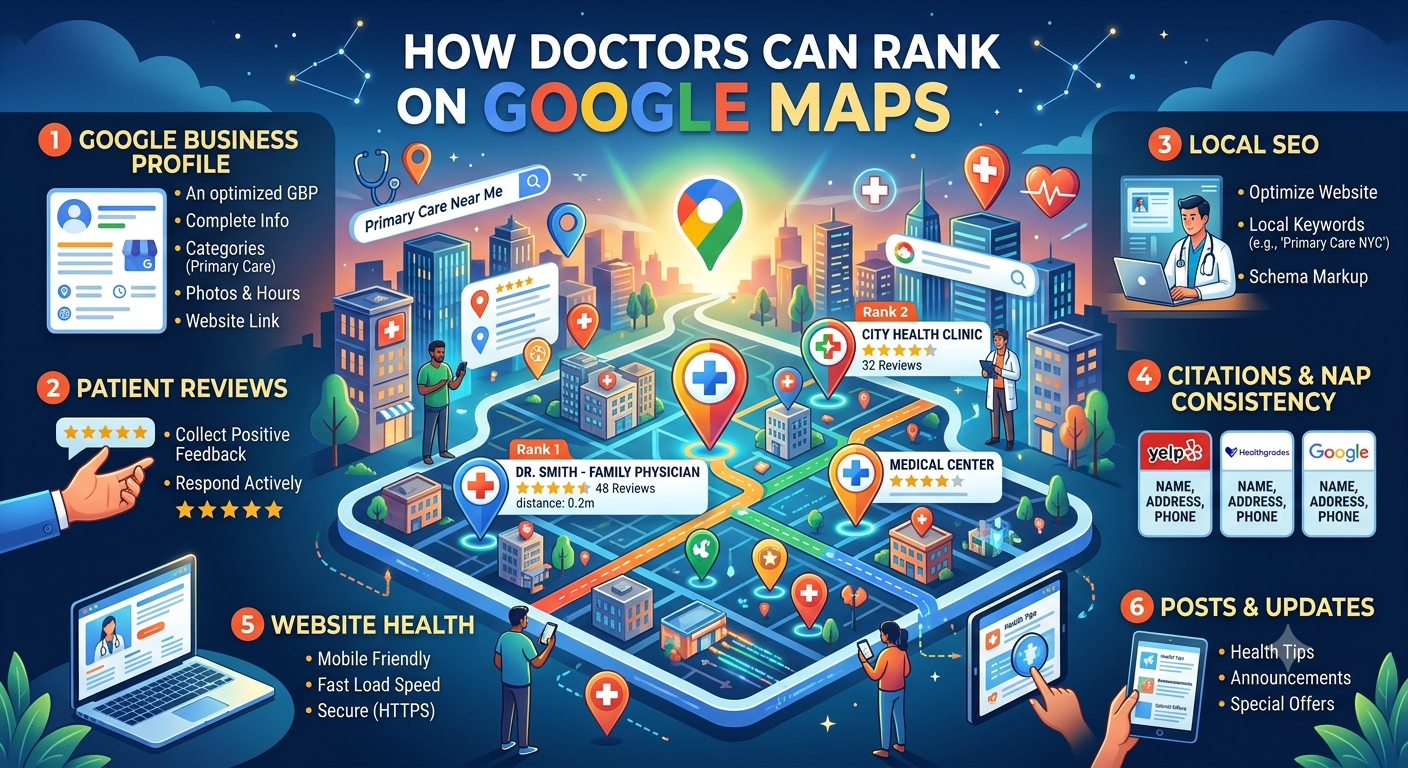
When someone in your city wakes up with chest pain, a feverish child, or a tooth that will not stop aching, they no longer ask a neighbour for a recommendation. They pick up their phone and type "doctor near me" or "best clinic near me" into Google. Within seconds, Google shows them a map with three highlighted listings — the local pack — and the overwhelming majority of those patients call, get directions, or book from one of those three results. If your clinic is not among them, you are effectively invisible at the exact moment a patient is ready to walk through a door.
This is why learning how doctors can rank on Google Maps has become one of the highest-return skills in healthcare marketing. Local SEO for doctors is not a vanity exercise or a "nice to have" — it is the channel that decides whether high-intent local patients find you or your competitor down the road. And the encouraging part is that ranking on Google Maps is not about luck or a big advertising budget. It is about understanding what Google rewards and giving it to them, consistently.
This guide breaks down exactly how Google decides which doctors and clinics appear on Maps, the practical steps to climb into the local 3-pack, and the India-specific tactics — from Practo and JustDial to WhatsApp booking — that help clinics here win local search in 2026.
Why Google Maps Is Now the Front Door to Every Clinic
The patient journey has fundamentally changed. The vast majority of people searching for healthcare today begin with a location-based query, and what they see first is not a website or a directory — it is Google Maps. The three listings in the local pack sit above the regular organic results, which means a clinic ranked there captures attention before a patient ever scrolls.
These "near me" searches carry extremely high intent. A person searching "paediatrician near me" or "best dermatologist in Mumbai" is not casually browsing — they are ready to act, often within the same day. That makes Google Maps one of the highest-converting marketing channels available to any doctor, because it puts your clinic in front of patients at the precise moment of decision.
There is another reason Maps matters so much: it levels the playing field. A small single-doctor clinic with a well-optimised Google Business Profile can outrank a large hospital for a local search, because Maps rewards relevance and proximity, not just brand size. Smart local visibility is one of the main reasons smaller practices now compete successfully with bigger institutions without spending heavily on advertising.
How Google Decides Which Doctors Rank on Maps
The Three Ranking Factors: Relevance, Distance, and Prominence
According to Google's own guidance, local rankings come down to three core pillars, and every tactic in this guide ultimately strengthens one or more of them.
Relevance is how well your profile matches what the patient searched for. If someone looks for "skin specialist" and your profile clearly signals that you are a dermatologist — through your category, services, and description — Google sees you as a strong match. Distance is how close your clinic is to the searcher or to the area they specified; this is partly outside your control, but accurate location data ensures Google places you correctly. Prominence is how well-known and trusted your practice appears, measured through reviews, profile completeness, activity, and mentions across the web. Prominence is where most of your effort pays off, because it is the factor you can most directly improve.
Choosing the Right Medical Category
Your primary category is one of the single most powerful ranking signals on Google Maps, and it is also one of the most commonly mishandled. The rule is simple: be specific, not generic. A profile set to "Cardiologist" will consistently outrank one set to the vague "Doctor" for heart-related searches. "Dermatologist," "Paediatrician," "Orthopedic Surgeon," "Dental Clinic" — choose the most precise category that describes what you actually do most.
You can then add up to nine secondary categories for the other services you genuinely offer. A family practice might add "Women's Health Clinic" or "Vaccination Centre," for example. The key word is genuinely — only add categories for services you really provide. Google can suppress or penalise profiles that use misleading categories to grab unrelated searches, so accuracy here protects your rankings rather than risking them.
NAP Consistency: Why Your Clinic Details Must Match Everywhere
NAP stands for Name, Address, and Phone number, and consistency across the web is one of the quietest but most decisive ranking factors in local SEO for doctors. Google cross-checks your details against your website, your Google Business Profile, and every directory you appear on. When everything matches exactly, Google trusts that your clinic is real and well-established. When details conflict, that trust — and your ranking — erodes.
The inconsistencies are usually small and easy to miss. "Dr. Sharma Clinic" on your website but "Sharma Medical Centre" on JustDial. "Shop 4, MG Road" in one place and "Shop No. 4, M.G. Rd" in another. A landline on Google but a mobile number on Practo. Each mismatch is a small dose of doubt for the algorithm. Auditing and cleaning up these citations so your NAP is identical everywhere is one of the fastest, highest-ROI fixes most clinics can make.
Your Google Business Profile: The Single Most Powerful Ranking Asset
If you do nothing else from this guide, do this. Your Google Business Profile (formerly Google My Business) is the foundation of every Google Maps ranking, and for most doctors it drives more new patients than their website, social media, and paid ads combined. Best of all, it is completely free — the only investment is time and consistency.
Start by claiming and fully verifying your profile at business.google.com. Unverified listings get dramatically less visibility, and verification (usually by video or postcard for healthcare) is what unlocks reviews, insights, and full control of your information. Once verified, the goal is completeness: fill in every single field. An empty field is a missed ranking signal and a missed reason for a patient to choose you.
Pay particular attention to your business description. You have around 750 characters — use them to describe your specialty, experience, and the conditions you treat in natural, patient-friendly language, weaving in your city and core services without stuffing keywords. Add accurate hours including holiday and emergency timings, list your services in detail, and turn on relevant attributes such as wheelchair access, languages spoken, and appointment booking. The more complete and accurate your profile, the stronger the trust signals you send to Google — and the higher you climb.
The clinics that dominate the local pack are rarely the biggest — they are the ones with the most complete, most active, and most consistent Google Business Profile. Completeness and consistency beat budget every single time.
Patient Reviews: The Strongest Trust and Ranking Signal
After your profile itself, patient reviews are the most powerful lever you have. They influence ranking on four dimensions at once: how many reviews you have, your average rating, how recent they are, and how often you respond. Listings with a healthy, steady flow of reviews consistently generate far more patient enquiries than comparable profiles with few or none — and Google reads that engagement as proof of prominence.
The healthiest approach is steady, organic velocity rather than a sudden burst. Build a simple habit into your clinic: at the end of a positive consultation, the front desk politely invites the patient to share their experience on Google, ideally with a QR code at reception or a follow-up message containing a direct review link. A consistent trickle of genuine reviews every week signals an active, trusted practice far more effectively than fifty reviews appearing overnight.
Responding to reviews matters just as much as collecting them. Thank patients warmly for positive feedback and address criticism calmly and professionally. One important caution for doctors: never confirm clinical details, the nature of treatment, or even whether someone was your patient in a public reply — patient privacy and professional ethics come first. A safe, effective response thanks the reviewer for their feedback and invites them to get in touch privately to resolve any concern. Keep reviews genuine and patient-led, avoid offering any inducement for them, and stay within the advertising and ethics norms that apply to medical practitioners. Authenticity protects both your licence and your rankings.
Photos, Posts, and Q&A: Keeping Your Profile Active
Google strongly favours profiles that look alive. A listing that has not been touched in a year reads as inactive to both the algorithm and to patients; one that is regularly updated signals an engaged, trustworthy practice. Three habits keep your profile active and continuously feeding ranking signals.
First, photos. Upload real, high-quality images of your clinic exterior, reception, consultation rooms, equipment, and team — not generic stock photos. Profiles with authentic photos earn significantly more direction requests and clicks, because patients want to know what to expect before they visit. Refresh them periodically so the profile keeps signalling activity.
Second, Google Posts. Publishing a short post even once or twice a week keeps your profile fresh and surfaces directly in search results. For a clinic, this might be a seasonal health tip ("Monsoon raises the risk of dengue — book a consultation if fever and body pain persist"), a service update, a new facility, or a patient-education snippet. These small, consistent updates compound into stronger visibility over time.
Third, the Questions & Answers section. Patients ask things like whether you accept insurance, whether an appointment is required, which languages you speak, or whether you offer emergency services. Seed and answer these common questions yourself so accurate information is visible immediately — it improves both your relevance to searches and a patient's confidence in choosing you.
At GInfomedia, we help doctors and clinics across India optimise their Google Business Profile, clean up citations, and build a steady review engine — so you rank for the "near me" searches that bring in real patients.
👉 Click Here to Chat with Us on WhatsApp and get a free local SEO audit for your clinic today!
Local SEO for Indian Clinics: Practo, JustDial, and WhatsApp
The fundamentals of Google Maps ranking are the same everywhere, but Indian clinics have a few additional levers that materially improve local visibility. The first is the directory landscape. Beyond Google, your practice should have consistent, accurate listings on the platforms Indian patients actually use — Practo, JustDial, Lybrate, Sulekha, and Bing Places among them. Each consistent citation reinforces your NAP and adds another trust signal Google can verify, while each inconsistent one quietly works against you.
The second is WhatsApp. For a large share of Indian patients, WhatsApp is the preferred way to enquire and book. Adding a WhatsApp booking or enquiry link to your Google Business Profile and website removes friction at exactly the moment a patient is ready to act, lifting your conversion from "found you on Maps" to "booked an appointment." Many of the highest-performing clinic profiles in India pair their Maps listing with a one-tap WhatsApp path to the front desk.
The third is local and linguistic relevance. Set the "languages spoken" attribute honestly, reference your locality and neighbourhood naturally in your description and posts, and tailor seasonal content to the local health calendar. A profile that clearly speaks to its city and community reads as far more relevant to Google than a generic one — and far more reassuring to the patient deciding whether you are the right doctor for them.
Your Website's Role: Location Pages, Schema, and Speed
A common myth is that Google Maps works without a website. It mostly does for the listing itself — but in 2026, Google still checks your website to validate and reinforce what your profile claims, and a strong site lifts your local rankings rather than being optional. Three website factors do the heavy lifting for local SEO for doctors.
The first is location and service content. Your website should clearly state your city and service area throughout, and if you serve multiple areas or run more than one clinic, each location deserves its own dedicated page with unique content — never a duplicated template. These pages give Google concrete local signals to connect your practice to the searches you want to win, and they help you rank for "[specialty] in [area]" queries beyond the map pack itself.
The second is structured data, or schema markup. Adding LocalBusiness, MedicalClinic, and Physician schema to your site helps search engines understand precisely what your practice is, where it operates, your hours, and your specialties. It is invisible to patients but highly legible to Google, and it can unlock richer search results that improve your click-through rate.
The third is speed and mobile experience. Almost every "doctor near me" search happens on a phone, often urgently. A fast-loading, genuinely mobile-friendly website builds patient confidence and supports your rankings; a slow or clumsy one quietly loses patients who bounce before they ever see your number. Page speed and mobile usability are not technical luxuries — for a clinic, they are part of patient acquisition.
The Bigger Picture: Ranking in AI Search and Beyond
The way patients find doctors is broadening again. Alongside the traditional map pack and organic results, a growing share of people now ask AI assistants — ChatGPT, Gemini, Perplexity, and Google's AI summaries — to recommend a provider. Crucially, these systems lean on the very same foundations that Google Maps already rewards: a complete and consistent profile, genuine reviews, clear credentials, and trustworthy content. Healthcare sits in Google's most demanding quality category, where experience, expertise, authority, and trust are the minimum entry requirement, not a bonus.
The practical takeaway is reassuring: there is no separate playbook for AI search. The clinics that build durable medical visibility do it by being genuinely trustworthy — accurate categories, consistent details, real photos, ethical reviews, and clear, patient-focused content. Get those right and you become the kind of practice that both Google Maps and AI assistants are confident recommending.
Ranking on Google Maps is not a one-time project; it is a habit. Claim and complete your profile, fix your NAP everywhere, build a steady stream of genuine reviews, keep the profile active with photos and posts, and support it with a fast, location-rich website. Most clinics that commit to this see meaningful movement within three to six months. The patients searching for a doctor in your area are already there, ready to book. The only question is whether they will find you — or the clinic that optimised first.
