
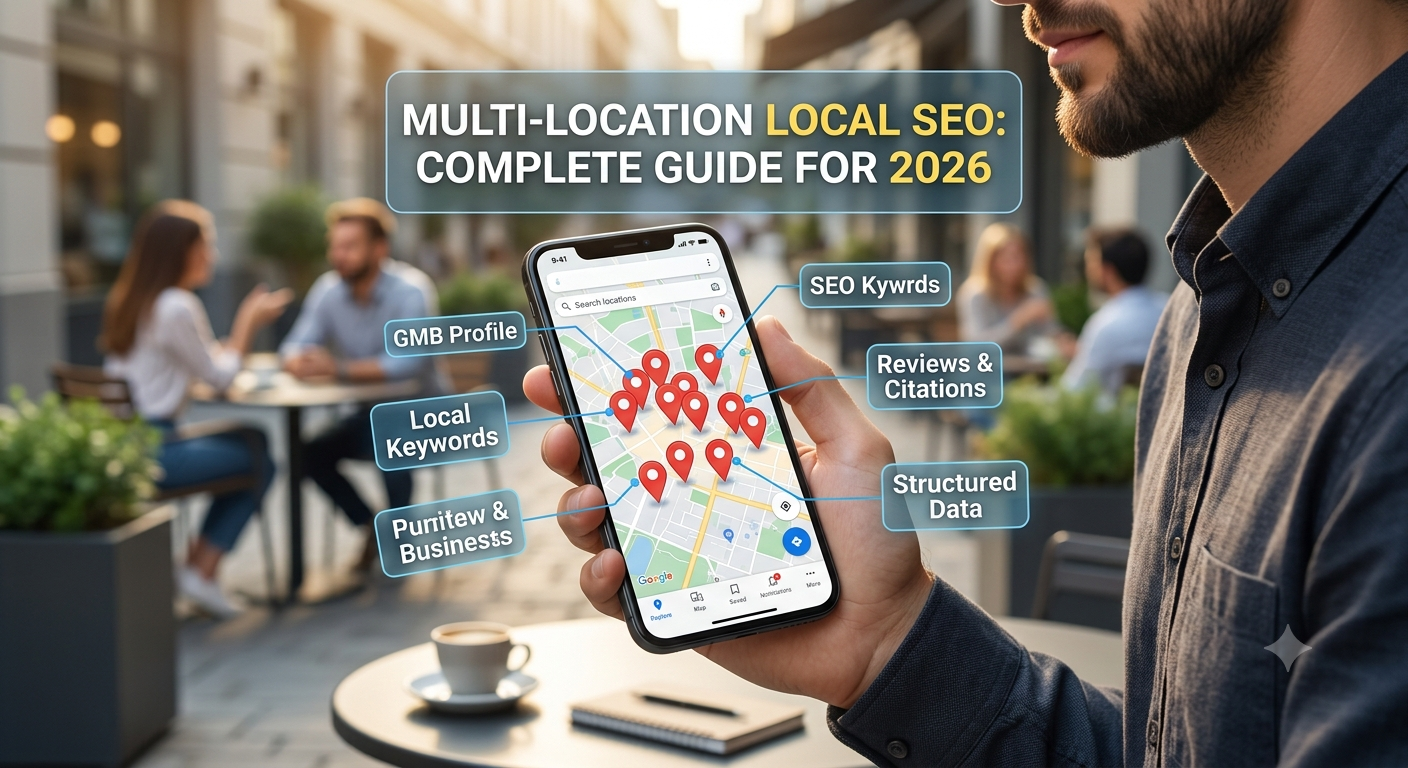
Local SEO for multi-location businesses has quietly become one of the hardest problems in digital marketing. When you ran a single store, search engine optimization was a laser beam: one address, one Google Business Profile, one set of keywords. The moment you open a second, fifth or fiftieth branch, that laser has to become a floodlight that covers every city you serve without losing intensity in any of them. Most brands try to scale by duplicating one location page and swapping the city name. In 2026, that approach does not just underperform, it actively suppresses your rankings.
This complete guide breaks down exactly how multi-location SEO works today: how Google decides which of your branches appears in the local pack, how to optimize Google Business Profiles and location pages at scale, how to keep your data consistent across the web, and how to win the new battleground of AI-powered "near me" search. Whether you run a chain of clinics, a retail group, a franchise, or a service business operating across several Indian cities, the principles below are the foundation of being found in every market you operate in.
The opportunity is significant. Studies consistently show that the local 3-pack, the three map-pinned results above the organic listings, captures the lion's share of clicks for location-based queries, while the majority of "near me" searches come from mobile users with high purchase intent who often visit a business within 24 hours. If your branches are not ranking, you are not just losing traffic, you are handing ready-to-buy customers to competitors.
What Is Multi-Location Local SEO, and Why It's Different in 2026
Multi-location local SEO (also called SEO for multiple locations) is the practice of optimizing your online presence so that each individual branch ranks in local search results, Google Maps, and AI-generated answers for its own city or service area. The critical word is each. Google does not rank your brand as a whole and then distribute that authority evenly across your branches. It evaluates every location as its own digital entity, with its own Google Business Profile, its own reviews, its own citations, and its own local relevance.
This is what makes it fundamentally different from single-location SEO. A corporate website with strong domain authority does not automatically push that strength down to your branch in Pune or your outlet in Bandra. Each location has to build its own local trust over time. One branch can dominate its map pack while another in the same brand stays invisible, not because the product is different, but because the local signals are.
The 2026 shift is that local search has become smarter. Google now leans heavily on three things beyond basic proximity: how well it understands your business as a real, consistent entity; how strongly each location sends matching trust signals across the web; and how real users behave when they see your listing. Behavioral signals such as click-through rate, calls, direction requests, and engagement now influence visibility as much as the technical checklist most businesses obsess over.
How Google Ranks Local Businesses in 2026
Proximity, Relevance and Prominence
Google's local algorithm rests on three pillars, and understanding them is the foundation of any serious multi-location SEO strategy. Proximity is how close your branch is to the searcher, something you can't change, but which you can support with pinpoint-accurate location data. Relevance is how well your profile and pages match what the person is searching for, which you control through categories, services, and location-specific keywords. Prominence is how well-known and trusted your business is, built from links, citations, reviews, and overall web presence.
For multi-location brands, prominence is the hardest pillar to scale, because it has to be earned location by location. There is no shortcut that lets a strong head-office reputation carry every branch into the top three. The brands that win treat each branch as a small business that deserves its own authority-building effort.
Google Business Profile Optimization at Scale
Google Business Profile (GBP) optimization remains the single most important lever in local SEO for multiple locations. Without properly configured profiles, your branches simply will not appear on Google Maps or in the local pack. Every physical location needs its own verified profile, with a unique local phone number, the exact same legal business name across all listings, accurate hours, the correct primary category, and real photos of that specific branch, not the same stock image cloned across ten cities, which Google's image recognition can detect and penalize.
At scale, the work is ongoing, not one-time. Profiles that go quiet for 30 days or more lose visible momentum. Posting weekly, refreshing photos, keeping services current, and responding to every review keeps each location looking active to Google. For brands managing ten or more branches, Google's Business Profile API and "Business Group" dashboards let you manage updates centrally while still allowing each location to be personalized, the central-control, local-execution model that separates scalable programs from chaotic ones.
Why Each Location Needs Its Own Authority
The most common reason multi-location SEO fails is that brands apply single-site thinking to a multi-site reality. They build one website, duplicate a handful of pages, and hope Google figures out the rest. It rarely does. When Google sees mismatched phone numbers, slightly different business names, or outdated addresses across the web, its confidence in the entity drops, and the result is not a dramatic overnight crash but something worse: rankings that never stabilize. Building genuine, independent authority for each branch is the only durable fix.
Building Location Pages That Actually Rank
One of the costliest mistakes multi-location businesses make is creating near-identical location pages, the same paragraph with only the city name swapped. This produces thin, duplicate content that Google has little reason to rank, and it triggers internal competition between your own pages. Every location page needs genuinely unique content: a description of the specific neighborhood, nearby landmarks, services that branch actually offers, the local team, community involvement, and reviews from customers in that area.
Structure matters as much as content. Use clean, descriptive URLs like /mumbai-andheri/ or /pune-kothrud/ rather than a single catch-all /locations page. Integrate location-specific keywords naturally, such as "[service] in [city]" and "[city] [industry]", into the title tag, H1, and meta description. Implement LocalBusiness schema (structured data) on every location page so search engines and AI systems can read the name, address, phone, hours, and geo-coordinates without ambiguity. For larger brands, a hub-and-spoke model works well: a city-level hub page (for example, "Gyms in Mumbai") linking out to individual branch pages like "Andheri Gym" and "Bandra Gym", creating a web of relevance instead of a pile of disconnected pages.
Here is the core principle of local SEO for multi-location businesses: treat every branch as its own business deserving dedicated attention, while keeping your brand consistent across all of them. Copy-paste pages don't scale, systems do.
NAP Consistency and Citation Management
NAP consistency, keeping your Name, Address, and Phone number identical everywhere they appear, is a foundational ranking signal that quietly makes or breaks multi-location campaigns. A single mismatch ("Main St" on Yelp versus "Main Street" on Bing, or two different phone numbers across directories) reduces Google's confidence in that location and can suppress its local pack visibility. Google cross-references your details across the entire web, so conflicting data sends conflicting signals.
Citations are mentions of your business NAP on external sites and directories, and they validate that each branch is a legitimate, real-world player in its community. In the Indian market that means accurate, consistent listings on the platforms customers actually use, such as Google, Justdial, Bing Places, Apple Maps, and industry-specific directories, alongside structured tools like BrightLocal, Moz Local, or Yext that push consistent data to hundreds of directories and flag discrepancies. Citations also degrade over time as branches move or numbers change, so a quarterly NAP audit across all locations should be built into your workflow, not treated as a one-off cleanup.
A related trap is keyword cannibalization, when multiple location pages or profiles target the same keywords and compete against each other. Each page should own a distinct, non-overlapping set of geo-targeted terms tied to its specific area, so your own branches strengthen rather than dilute one another.
Reviews and Behavioral Signals: The Trust Layer
Reviews are among the most direct signals Google uses to evaluate a local business, and they routinely let a branch with fewer but fresher reviews outrank a competitor with a larger but stale review count. What matters is not just volume but review velocity and recency. A steady stream of recent, authentic reviews signals that the location is active and trusted. Surveys repeatedly find that the vast majority of consumers trust online reviews nearly as much as a personal recommendation, and moving from a mediocre rating toward five stars measurably lifts click-through.
For multi-location brands, the rule is that aggregate ratings mean nothing if one branch sits at 3.2 stars. Each location needs its own review-acquisition strategy: ask while the experience is fresh, respond to every review professionally, and never buy or filter reviews, which risks penalties. Reviews also generate natural keyword relevance, because customers describe your services in their own words. Layered on top of reviews are the behavioral signals Google increasingly weighs, such as how many people click your listing over a competitor's, call, request directions, or stay engaged. Listings that earn those interactions are far harder to outrank, even when a rival's checklist looks identical on paper.
At GInfomedia, we help multi-location and growing businesses across India rank in the local pack with Google Business Profile management, location-page strategy, NAP cleanup, and review systems that scale across every city you serve.
Click Here to Chat with Us on WhatsApp and get a free local SEO audit for your locations today!
Winning in AI Search and "Near Me" Queries (GEO)
The biggest change reshaping local SEO for multi-location businesses in 2026 is the rise of AI-driven search. Google's AI Overviews, AI-enhanced local packs, and assistants like ChatGPT now answer many local queries directly, often without a click. Industry data suggests a large share of searches now end without anyone visiting a website, which means more of your conversions happen inside Google's ecosystem, on your profile, in the map pack, or in an AI summary, than ever before.
This is where GEO (Generative Engine Optimization) meets local SEO. AI systems form an "opinion" of each branch by reading its Google Business Profile, review sentiment, structured website content, citations, and FAQs. Local queries are also becoming far more conversational and specific. A user might ask for "an affordable family dentist near me that's open late and takes walk-ins." To be cited in those answers, your location pages should answer real questions directly, use natural language and long-tail "near me" phrasing, and carry well-maintained, crawlable, structured content. The same disciplines that earn traditional rankings, accurate entity data, fresh reviews, consistent citations, are exactly what make a branch quotable to AI.
Multi-Location SEO for Indian Businesses
For Indian businesses, the multi-location opportunity is enormous and still under-contested. Most local competitors are still making the copy-paste mistake, which means a brand that moves deliberately can capture the local pack in city after city. The fundamentals are the same, but a few India-specific priorities stand out: claim and optimize Justdial alongside Google Business Profile, keep your NAP consistent across both Google and Indian directories, and lead with mobile, because the overwhelming majority of local and "near me" searches in India happen on phones, where page speed and a clean, tappable layout directly affect both rankings and conversions.
City and neighborhood granularity is the unlock. In a metro like Mumbai, a single "Mumbai" page is far weaker than dedicated pages and profiles for Andheri, Bandra, Thane, and Navi Mumbai, each with its own local landmarks, language nuances, and reviews. Brands operating across Mumbai, Pune, Bangalore, Delhi, and beyond should build a city-hub structure, earn local backlinks from nearby community sites and local press, and treat each branch as a boots-on-the-ground local player rather than a satellite of head office. That precision is exactly what both Google and AI search now reward.
Local SEO for multiple locations is not a checklist you complete once. It's a repeatable system, consistent profiles, unique location pages, clean citations, and standardized review processes, that scales whether you run five branches or five hundred.
Your 2026 Multi-Location SEO Action Plan
If you take one idea from this guide, let it be this: sustainable multi-location SEO comes from building a system, not from "doing more SEO." The brands that scale predictably are the ones where every new branch plugs into a defined structure: clear site architecture, consistent Google Business Profile management, governed NAP and citation data, unique location-page content, and a standardized review process, rather than depending on manual, one-off effort each time they expand.
Start with the foundation and work outward: verify and fully complete a Google Business Profile for every location; build or rewrite each location page with genuinely unique, locally relevant content and LocalBusiness schema; run a brand-wide NAP and citation audit to eliminate inconsistencies; launch a per-location review system focused on recency; then layer in local link building and AI-search optimization. Measure at the location level, not just the domain level, and track local keyword positions, GBP views and actions, organic traffic per page, and review velocity branch by branch.
Local search in 2026 rewards precision, consistency, and patience. Your customers are searching right now, in every area you serve, and a growing share of them will never scroll past the local pack. The businesses that treat each location as worthy of real investment, and build the system to deliver it at scale, are the ones that will own their markets in the year ahead.
