
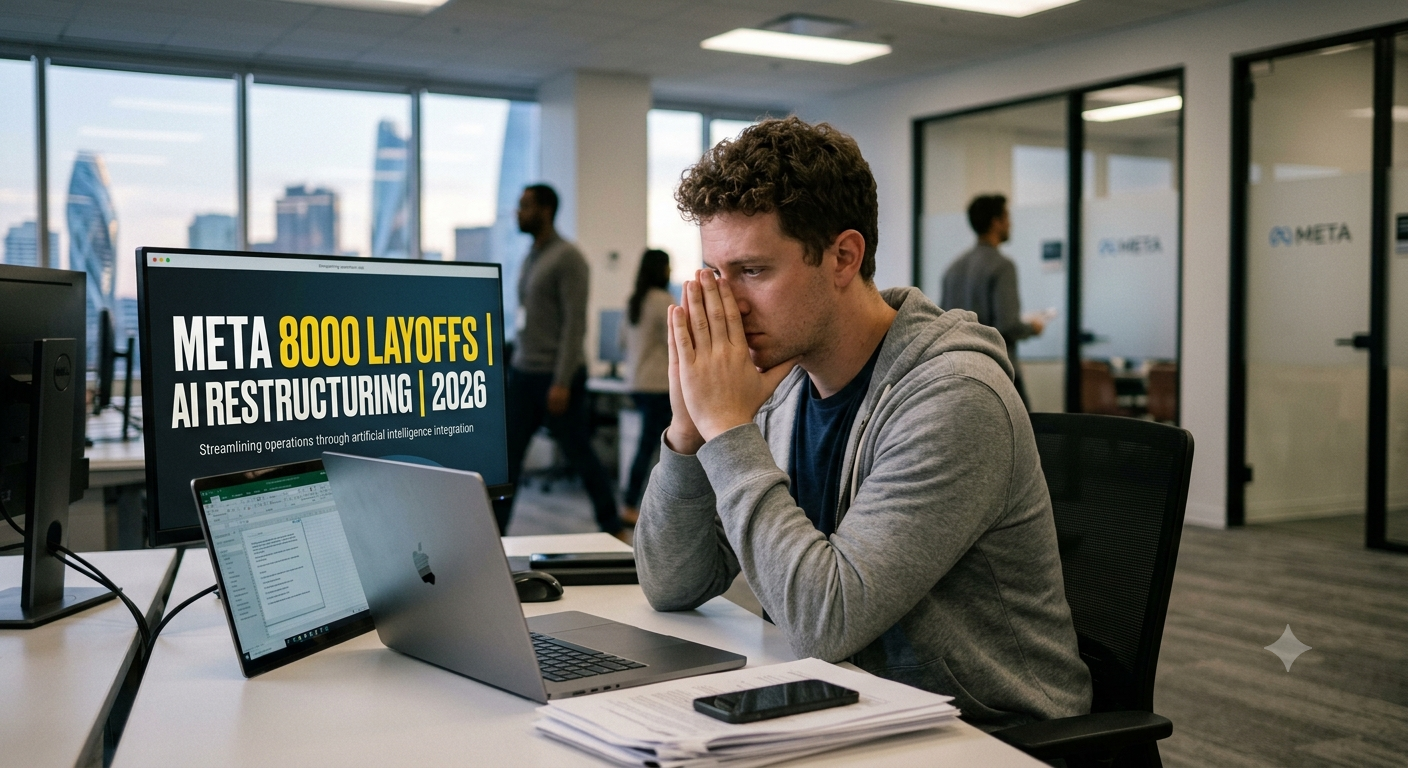
On Wednesday, May 20, 2026, Meta began notifying roughly 8,000 employees — about 10% of its global workforce — that their jobs were being eliminated. It was the first and largest wave of a sweeping companywide restructuring that the parent of Facebook, Instagram and WhatsApp has framed as essential to fund and accelerate its push into artificial intelligence.
This was not an ordinary round of cost-cutting. Alongside the layoffs, Meta moved approximately 7,000 more employees into newly created AI-focused teams. Taken together, the layoffs and reassignments touched nearly one-fifth of a workforce that stood at just under 80,000 people at the end of March. It is the most significant reorganization Meta has undertaken since CEO Mark Zuckerberg's 2022–2023 "Year of Efficiency," and it tells a much bigger story about where Big Tech — and the jobs inside it — are headed.
Here’s a clear, fact-checked breakdown of what happened, who was affected, why Meta did it, and what it signals for workers and businesses everywhere.
What Actually Happened: Meta's 8,000 Job Cuts
Meta first signaled the cuts in an internal memo in late April 2026, describing them as a way to sharpen operations and free up resources for higher-priority spending — chiefly AI. The cuts were carried out on May 20. Employees in Singapore were the first to be notified, with layoff emails arriving at 4 a.m. local time, followed by staff in the U.K. and the U.S. as their own mornings began. Meta asked its North American employees to work from home that day.
Company spokesperson Erica Sackin confirmed that affected employees had been notified. Chief People Officer Janelle Gale communicated the broader plan internally, which paired the layoffs with the large-scale internal transfers. Beyond the people who lost their jobs, Meta also cancelled thousands of open roles it had been recruiting for — effectively shrinking future headcount as well.
To put the scale in context: this was Meta's biggest companywide reduction since 2022–2023, when the "Year of Efficiency" eliminated roughly 21,000 positions. Reports earlier in the year suggested the 2026 restructuring could eventually reach as much as 20% of the company across multiple phases, though Meta called those larger projections speculative.
The headline is "8,000 layoffs," but the real story is a workforce being rebuilt around AI — with winners, losers, and a great deal of internal friction.
Inside the AI Restructuring: 7,000 Reassigned
1. Where the 7,000 Employees Went
Separate from the layoffs, Meta redirected around 7,000 workers into newly created AI-focused teams, including units reported as Applied AI Engineering, an Agent Transformation Accelerator group, and a Central Analytics team. The largest of these, Applied AI Engineering, was assembled to support Meta's AI researchers and improve its models, and reportedly grew to roughly 6,500 engineers and product managers.
The reorganization sits under Meta Superintelligence Labs, the AI structure led by Chief AI Officer Alexandr Wang, with teams reshaped into smaller, AI-centric "pods." The stated goal was speed: flatter teams, faster decisions, and more responsibility concentrated in individual contributors — in some units reportedly at a striking 50-to-1 ratio of staff to managers.
2. The "Draftee" Revolt Inside Applied AI
The reassignment did not land smoothly. Many engineers moved into the Applied AI unit were given a stark choice — accept the transfer or leave the company — with no option to move elsewhere internally. Some began calling themselves "draftees." According to reporting based on a WIRED investigation, employees described work that felt menial compared with their previous software-engineering roles: generating coding puzzles and other material used to train and evaluate Meta's frontier AI models.
Morale problems spilled into public view. During one livestreamed internal presentation, an employee reportedly hijacked the session to insult a senior AI executive. Chief Product Officer Chris Cox described the preceding months inside the company as "brutal." In the same period, Meta moved to rein in internal AI usage after staff burned through enormous volumes of compute chasing an internal leaderboard — prompting CTO Andrew Bosworth to remind employees that activity is not the same as impact.
3. Zuckerberg Admits "Mistakes"
On June 12, 2026, Mark Zuckerberg sent an internal memo offering a rare public-facing admission. He acknowledged that, given the complexity of the changes, Meta had "made mistakes and will almost certainly make more." Crucially, he told employees he does not expect any further company-wide layoffs for the rest of 2026, and pledged to try to find new internal roles for staff who had been reassigned to model-training work.
The memo came with conciliatory gestures: bigger budgets for team offsites and events, the return of assigned desks in many offices, reduced manager-to-employee ratios, and a company-wide hackathon planned for July to accelerate work on Meta's latest AI models. Notably, it stopped short of changing the join-or-quit transfer policy or rethinking whether highly paid engineers are the right people for annotation-style tasks.
The Meta shake-up is a preview of how fast AI is reshaping every industry. At GInfomedia, we help Indian businesses adopt AI smartly — cutting costs, automating workflows, and building a digital presence that stays resilient through disruption.
👉 Click Here to Chat with Us on WhatsApp and get a free AI & digital strategy consultation today!
Why Meta Is Cutting Jobs to Spend on AI
The logic behind the restructuring is money and momentum. Meta has told investors it expects 2026 capital expenditures of between $125 billion and $145 billion — more than double what it spent in 2025 — with much of that pouring into AI data centers, chips, and talent. Trimming traditional roles while redirecting thousands of employees toward AI is how Meta is funding that bet.
There is also competitive pressure. Despite spending heavily and luring researchers with outsized pay packages, Meta is widely seen as trailing rivals such as OpenAI, Anthropic and Google in the frontier-AI race. The restructuring is an attempt to close that gap by concentrating people, compute, and decision-making around AI as the single lens for nearly every major decision at the company.
It also arrives during a rough stretch for Meta more broadly — including a retreat from heavy metaverse spending, high-profile legal battles, and investor jitters about the sheer scale of its AI outlay. The workforce overhaul is, in effect, Meta reshaping itself to survive and compete in an AI-defined decade.
The Bigger Picture: A Big Tech Pattern
Meta is not acting alone. Across the technology sector, 2026 has brought a wave of AI-driven restructuring. Tens of thousands of roles have been eliminated across dozens of companies in the first part of the year, with firms ranging from enterprise software giants to smaller players all citing the same justification: shift spending and headcount away from traditional roles and toward AI. The methods differ — some abrupt, some voluntary, Meta's phased — but the direction is consistent.
That makes the Meta story a useful bellwether. It shows both the promise that companies see in AI and the very real human and organizational costs of moving this fast: forced reassignments, morale crises, and leaders publicly conceding that not every decision worked. For anyone trying to understand how AI is reshaping work, Meta's 2026 is a case study in real time.
What It Means for Workers and Businesses
For employees, the lesson is that even record-profit companies are reorganizing around AI, and that "your job exists" and "your job stays the same" are no longer the same statement. Skills that complement AI — building with it, evaluating it, deploying it into real workflows — are becoming the safest ground. For businesses, especially smaller ones, the takeaway is different but related: the tools that triggered Meta's upheaval are now cheap and accessible enough that any company can use them to automate, cut costs, and compete. The organizations that thrive in this next phase won’t be the ones with the most staff — they’ll be the ones that pair the right people with the right AI. Meta's 8,000-job restructuring isn't just a tech-industry headline; it's an early, very visible signal of how work itself is being rebuilt.
