
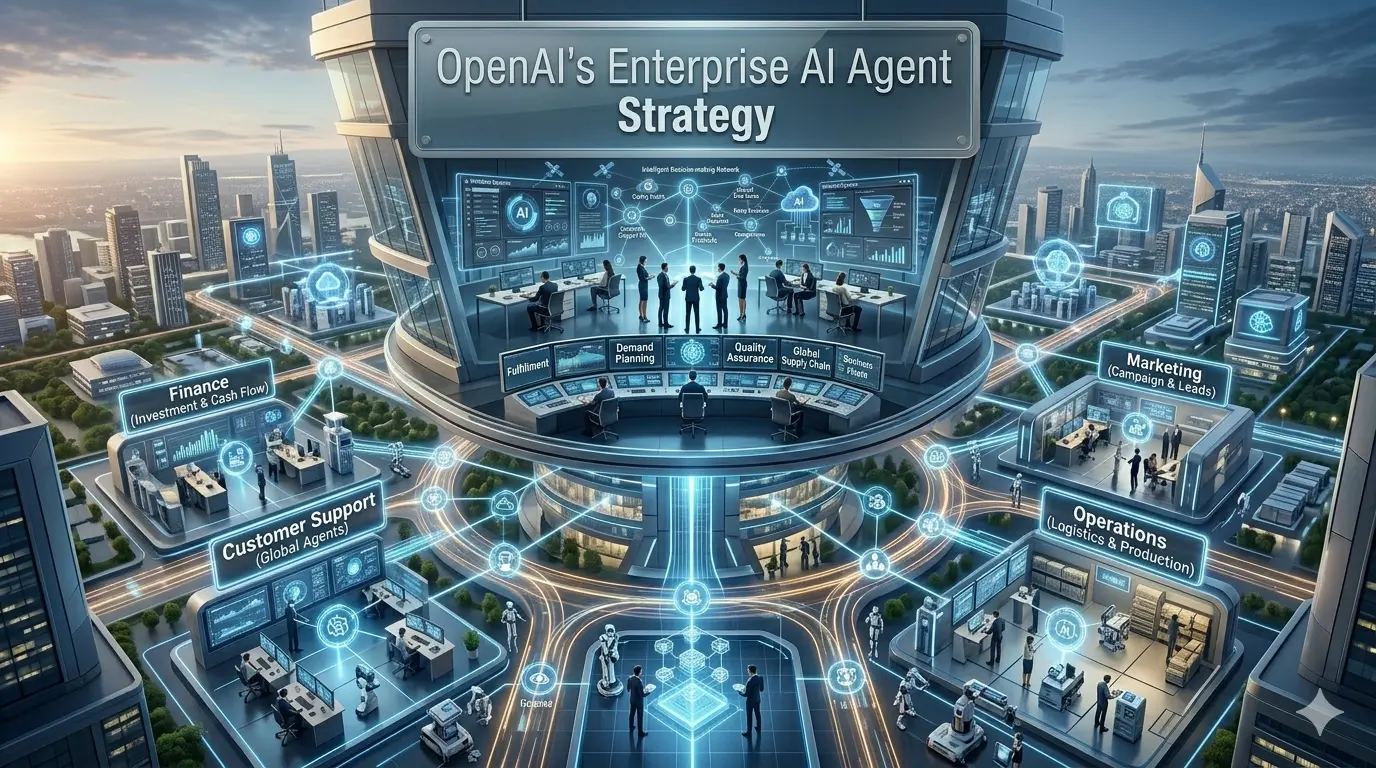
The Evolution of OpenAI's Enterprise Strategy
The corporate landscape is shifting from passive generative AI tools toward highly autonomous ecosystems. OpenAI is actively transitioning from providing conversational chatbots like ChatGPT to developing comprehensive enterprise AI agents capable of executing complex business processes with minimal human intervention.
This paradigm shift underscores a broader industry movement where artificial intelligence stops acting merely as an assistant and begins operating as an independent execution layer within legacy technology stacks.
To accelerate this vision, OpenAI has focused on bolstering its core code generation and software development capabilities, recognizing that true enterprise autonomy requires AI that can interact flawlessly with complex software infrastructure.
For organizations looking to deploy modern automation, understanding this shift is crucial. True competitive advantage no longer comes from simply generating text, but from connecting AI directly to operational business systems.
The Ona Acquisition: Boosting Codex Capabilities
A key indicator of OpenAI's technical direction is its focus on expanding the capabilities of OpenAI Codex—the underlying system that powers advanced programming and software interaction interfaces. Strategic moves, including engineering talent acquisitions such as the integration of the Ona team, highlight OpenAI's commitment to making agents more proficient at technical workflows.
By absorbing specialized expertise in software architecture, compiler design, and automation interfaces, OpenAI aims to enhance Codex to:
- Generate highly stable, execution-ready code directly inside secure enterprise firewalls.
- Navigate, read, and manipulate massive, proprietary corporate codebases.
- Minimize API connection failures when navigating complex cloud software.
- Accelerate the deployment of native digital tools designed specifically for internal business operations.
This technical foundation ensures that enterprise agents aren't just summarizing documents, but are actively integrating with database layers, enterprise resource planning (ERP) systems, and cloud architecture.
How Enterprise AI Agents Transform Workflows
Unlike standard Large Language Models (LLMs) that rely on user-triggered prompts for every action, enterprise AI agents function using goal-oriented autonomy. Businesses provide the objective, and the agent determines the step-by-step logic required to achieve it.
1. Autonomous Software Engineering & DevOps
Backed by an upgraded Codex framework, AI agents can continuously monitor corporate code repositories. They can identify system errors, draft optimization patches, test code variants, and securely deploy updates to cloud infrastructure, reducing development strain on human engineering teams.
2. Cross-Application System Syncing
Traditional enterprise automation relies heavily on rigid, manual API integrations. Advanced AI agents can interact with software interfaces much like a human employee would—logging into legacy software, extracting unstructured data, and updating customer relational databases seamlessly without specialized API middleware.
The value of AI modern tools scales exponentially when they shift from independent tools to integrated infrastructure. Integrating autonomous systems into daily corporate workflows can drastically minimize organizational friction.
3. Dynamic Business Analytics
Instead of manually configuring data visualization platforms, teams can instruct an agent to evaluate operational trends. The agent can construct its own analytical data queries, scan distributed databases, and compile multi-layered executive summaries in real-time.
4. Supply Chain & Operational Logistics
AI agents can continuously assess warehouse data, project fluctuating market demands, communicate autonomously with supplier interfaces to negotiate automated purchase orders, and handle inventory optimization without manual clerical delays.
Addressing Enterprise Guardrails and Security
Deploying fully autonomous software layers across enterprise ecosystems brings vital security, privacy, and compliance obligations. OpenAI's enterprise strategy addresses these corporate necessities through rigorous control structures:
- Zero Data Retention: Ensuring proprietary enterprise data inputs and software structures are never used for base model training.
- Customized Action Boundaries: Setting explicit operational constraints that prevent agents from executing unauthorized transactions or modifications.
- Comprehensive Log Compliance: Generating immutable audit trails tracking every computational choice and execution phase the agent completes.
The Road Ahead: Building Autonomous Infrastructure
The race toward enterprise AI agents marks the next maturity phase for corporate digital transformation. AI is evolving from a standalone point solution into standard business infrastructure, mirroring the historical emergence of enterprise cloud platforms.
For forward-thinking enterprises, the focus must shift from assessing AI's basic capabilities to actively architecting the systemic integration loops where autonomous agents can drive measurable velocity and efficiency gains.
At GInfomedia, we help Indian businesses evaluate, plan, and implement enterprise AI strategies that are practical, scalable, and aligned with their specific industry requirements.
👉 Click Here to Chat with Us on WhatsApp and get a free digital strategy consultation today!