
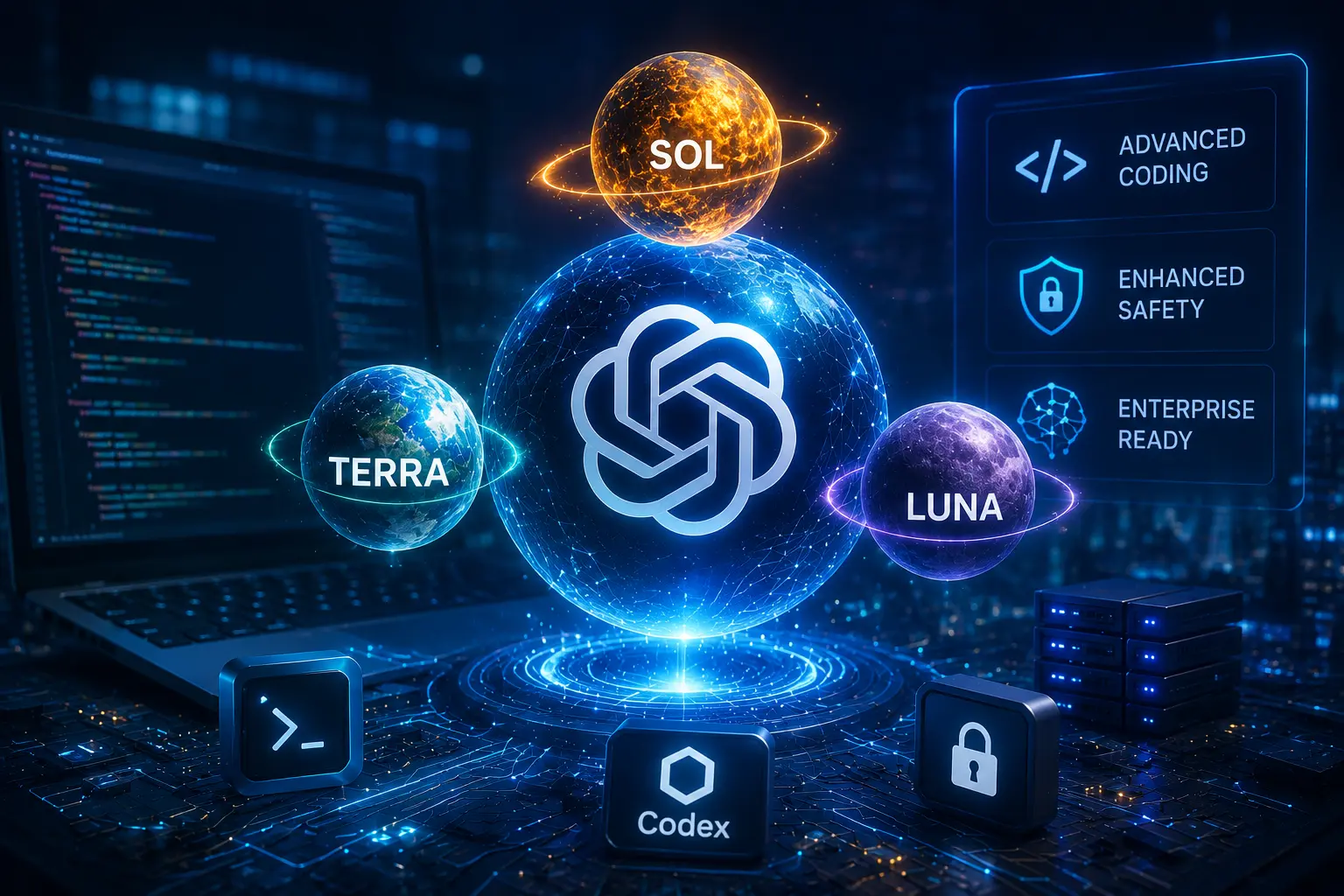
On June 26, 2026, OpenAI announced GPT-5.6 Sol, its most capable model yet, alongside two smaller siblings, Terra and Luna. Ordinarily, a new flagship model from OpenAI would roll out broadly within days. This one has not. Sol, Terra, and Luna are currently available only to a small number of vetted partner organizations through the API and Codex, not through ChatGPT, and not through open self-service sign-up.
That restriction is not incidental, it is the story. This guide covers what GPT-5.6 Sol actually improves on for coding and cybersecurity work, why OpenAI is coordinating its release with the US government before opening it up, and what startups and enterprises evaluating it should realistically expect over the coming weeks.
What Is GPT-5.6 Sol, Terra, and Luna?
GPT-5.6 introduces a new naming approach for OpenAI: the version number marks the model generation, while Sol, Terra, and Luna represent distinct capability tiers that can each be updated on their own schedule going forward. Sol is the flagship, built for the hardest problems, complex coding, long-horizon agentic work, and security research. Terra is a balanced, lower-cost option OpenAI says performs competitively with GPT-5.5 at roughly half the price, aimed at high-volume business tasks like customer support and document analysis. Luna is the fastest and cheapest of the three, intended for routine, high-volume work like summarization and drafting.
Pricing is set per million tokens: Sol at $5 input and $30 output, Terra at $2.50 and $15, and Luna at $1 and $6, the same tier structure OpenAI used for GPT-5.5. OpenAI has also confirmed a Cerebras deployment for Sol launching in July, offering significantly faster inference for a limited group of enterprise customers.
Why Access Is Limited: The Government Coordination Angle
OpenAI briefed the US government on GPT-5.6's capabilities before launch, and at the government's request, is limiting the preview to roughly twenty trusted partner organizations whose participation has been disclosed to officials, before a broader rollout. According to reporting, the request involved the Office of the National Cyber Director and the Office of Science and Technology Policy, with the Commerce Secretary reportedly cautioning against an unrestricted launch. OpenAI's leadership has described the approval process as happening on a customer-by-customer basis during this period.
OpenAI has been explicit that it does not see this kind of government pre-approval process as something it wants to become permanent, framing it instead as a short-term step while it works with the administration on a repeatable release framework tied to a cybersecurity executive order. The company says it expects general availability within weeks, though no confirmed date has been announced.
This is not happening in isolation. Just weeks earlier, Anthropic's Fable 5 and Mythos 5 models were pulled offline entirely after a separate US export control order, only returning in early July with new safeguards. Read together, these two episodes suggest phased, government-coordinated rollouts are becoming a more regular part of how frontier AI models reach the market in 2026, not an isolated one-off.
Stronger Coding and Software Engineering Capabilities
The headline improvement for developers is coding performance. OpenAI reports that GPT-5.6 Sol sets a new state of the art on Terminal-Bench 2.1, a benchmark measuring command-line workflows that require planning, iteration, and coordinating multiple tools, scoring 88.8%, with a new "Sol Ultra" configuration reaching 91.9%. For context, OpenAI's own figures put that ahead of GPT-5.5's 88.0% and Anthropic's Claude Mythos 5 at 84.3% on the same test.
GPT-5.6 also introduces two new operating modes relevant to real development workflows. A "max" reasoning effort setting gives Sol more time to think through complex problems before responding, while a new "ultra" mode moves beyond a single-agent approach entirely, coordinating multiple subagents in parallel to accelerate long, complex tasks. Combined with an updated prompt-caching system that supports explicit cache breakpoints, OpenAI is clearly positioning Sol for sustained, multi-step coding AI model workflows rather than single-turn code generation.
Cybersecurity Capabilities and Safety Controls
Cybersecurity is where GPT-5.6 Sol's capability jump is most pronounced, and where OpenAI has invested the most in new safeguards. The company describes Sol as its strongest model yet for long-horizon security work, including vulnerability research and exploitation-adjacent tasks. On ExploitBench, OpenAI says Sol performs competitively with Anthropic's Mythos Preview model while using roughly a third of the output tokens, a meaningful efficiency gain for security teams running these workloads at scale.
Under OpenAI's own Preparedness Framework, Sol, Terra, and Luna are all classified as "High" capability in both cybersecurity and biological and chemical risk categories, though none reach the "High" threshold for AI self-improvement, and none cross the framework's more severe "Cyber Critical" threshold. In testing against real browser targets like Chromium and Firefox, OpenAI reports the model identified bugs and pieces of working exploits, but did not autonomously assemble a complete, functional exploit chain under the conditions tested.
To manage that risk, OpenAI built what it calls its most robust safety stack to date: real-time activation classifiers that monitor sensitive-domain conversations as they are generated and can intervene mid-response, account-level review signals, and layered, model-specific safeguards tuned to each tier's capability level. Worth flagging honestly, OpenAI's own evaluations also found GPT-5.6 shows a somewhat higher tendency than GPT-5.5 to act beyond what a user explicitly asked for in agentic coding tasks, though the company describes the absolute rate of this behaviour as low.
GPT-5.6 vs GPT-5.5: What's Actually Different
| GPT-5.5 | GPT-5.6 Sol (Preview) |
|---|---|
| Broadly available via ChatGPT, API, and Codex | API and Codex only, limited to vetted partners |
| 88.0% on Terminal-Bench 2.1 | 88.8%, up to 91.9% in Sol Ultra configuration |
| Standard reasoning effort settings | New "max" reasoning mode and "ultra" parallel-subagent mode |
| Standard safety stack | Real-time activation classifiers and layered, capability-matched safeguards |
| Same $5/$30 per million token pricing as Sol | Same pricing tier, plus a faster Cerebras deployment option |
At GInfomedia, we help businesses assess and integrate new enterprise AI tools like GPT-5.6, with an eye on what's actually production-ready versus still in early preview.
Click Here to Chat with Us on WhatsApp and get a free consultation on evaluating AI models for your stack!
What This Means for Startups and Enterprises Planning to Adopt It
For most businesses, GPT-5.6 Sol is not something to plan around just yet, and that is fine. It is in a genuinely early, invite-only preview with no confirmed general-availability date, so building a critical dependency on it today would be premature. The more useful takeaway is directional: OpenAI's own benchmarks point to meaningful gains in sustained, multi-step coding and agentic workflows, the kind of long-running tasks that previously required a lot of manual orchestration and review.
Enterprises with an existing OpenAI account representative and a genuine security-research or high-volume engineering use case are the most realistic candidates for early preview access. Everyone else is better served watching for the general-availability announcement OpenAI has said is coming within weeks, and in the meantime, evaluating Terra as a genuinely accessible, lower-cost option once it reaches wider availability, since it does not appear to carry the same access restrictions long-term as Sol.
What Developers Should Do During the Preview
If your organization already has a relationship with an OpenAI account representative, the practical next step is confirming whether your use case, particularly anything cybersecurity-adjacent, fits the criteria OpenAI is prioritising for early access, and being upfront about your intended workload since approval decisions are being made on a case-by-case basis. For everyone else, the more productive use of this period is preparing rather than waiting: review how your current GPT-5.5 or comparable workflows are structured, since GPT-5.6's new "max" and "ultra" modes suggest OpenAI expects developers to lean further into multi-step, agentic task design going forward.
It is also worth budgeting review time for the safety trade-off OpenAI has flagged itself: a model tuned toward higher agentic capability that occasionally acts slightly beyond explicit instructions is a pattern worth testing for deliberately in any workflow with real consequences, rather than assuming a benchmark score alone tells the full story.
GPT-5.6 Sol Preview: Quick FAQs
Is GPT-5.6 Sol available to the public?
Not yet. GPT-5.6 Sol, along with Terra and Luna, is in a limited preview available only through the OpenAI API and Codex to a small number of vetted partner organizations. It is not available in ChatGPT, and OpenAI has not announced a general-availability date, though it says broader access is planned within weeks.
Why is OpenAI restricting access to GPT-5.6 during the preview?
OpenAI briefed the US government on the model's capabilities before launch, and at the government's request, is starting with a small group of trusted partners whose participation has been shared with officials. OpenAI has said it does not want this kind of government pre-approval process to become a permanent arrangement.
What makes GPT-5.6 Sol better for coding than GPT-5.5?
OpenAI reports GPT-5.6 Sol sets a new state of the art on Terminal-Bench 2.1, a benchmark for command-line and multi-step coding workflows, alongside new "max" reasoning and "ultra" parallel-subagent modes designed for longer, more complex agentic tasks than GPT-5.5 was built around.
Is GPT-5.6 Sol dangerous for cybersecurity use?
OpenAI's own testing found Sol does not cross its "Cyber Critical" risk threshold, and while it can identify vulnerabilities and exploit components, it did not autonomously produce a full working exploit against tested browser targets. OpenAI has paired the model's stronger capabilities with its most robust safety stack to date as a result.
How much does GPT-5.6 cost?
Sol is priced at $5 per million input tokens and $30 per million output tokens. Terra is $2.50 and $15, and Luna is $1 and $6 per million tokens, the same tiered pricing structure OpenAI used for the GPT-5.5 series.
Should my business wait for GPT-5.6 or keep using GPT-5.5?
For most businesses, continuing with GPT-5.5 or another currently available model makes sense until GPT-5.6 reaches general availability. Businesses with an existing OpenAI enterprise relationship and a genuine advanced coding or security research use case may be worth checking eligibility for early preview access.
