
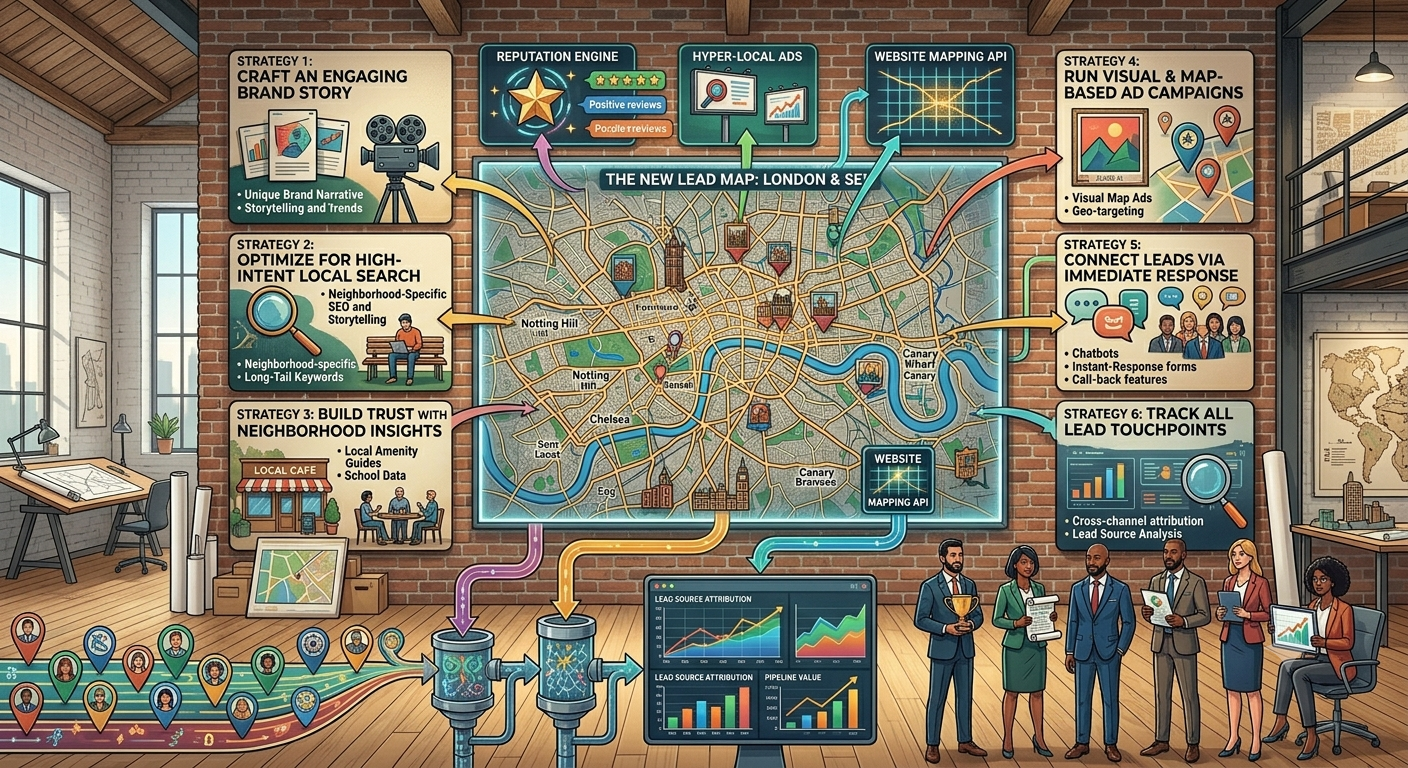
Ask any builder, broker, or real estate agent in India where their next deal is coming from, and most will still mention the same tired sources: property portals, cold calls, hoardings, and referrals. Yet the moment a serious buyer hears about a new project or decides to look for a home, they do one thing first — they pull out their phone and search on Google. And increasingly, what they tap on is not a portal listing or a paid ad. It is the little map with three businesses pinned to it. That is Google Maps, and in 2026 it has quietly become one of the highest-intent, lowest-cost lead generation channels in real estate.
This is not theory. Industry data consistently shows that the vast majority of homebuyers begin their property search online, and that local searches — the "near me" and "in my city" queries — drive a disproportionate share of the leads agents actually close. The people searching on Google Maps are not browsing for entertainment. They are ready to call, message, or book a site visit. For a real estate business, that is the most valuable kind of attention there is.
The problem is that most real estate companies have never been taught how to turn Google Maps into a predictable lead engine. They claim a listing, fill in half the details, and forget about it. This guide fixes that. Here is exactly how real estate companies can generate more leads using Google Maps — the strategy, the setup, and the steps that move you into the spots buyers actually click.
Why Google Maps Is the Most Powerful Lead Source for Real Estate in 2026
Real estate is a hyperlocal business. Nobody searches for a home "somewhere in the country" — they search for a 2BHK in a specific suburb, a plot near a specific road, or the best builder in a specific city. Google Maps is built precisely for that kind of location-anchored intent, which makes it a natural fit for property. When someone searches "flats near me," "real estate agent in [your area]," or "property dealer near me," Google answers with a map and a short list of local businesses before it shows anything else.
That placement matters enormously. Study after study has found that the top three businesses shown in the Google Maps results — often called the Local Pack, Map Pack, or Local 3-Pack — capture the overwhelming majority of clicks, with estimates frequently landing around the 90% mark. If your real estate business is not in those top three, you are effectively invisible to the buyers with the strongest intent in your market, no matter how good your properties are.
There is another reason Google Maps deserves focused attention: it generates leads that often skip your website entirely. A buyer can see your business, read your reviews, and tap "Call" or message you on WhatsApp directly from the map — before they ever visit a portal or fill out a form. For real estate, where speed of response is everything, that direct line from search to phone call is exactly the kind of warm lead that converts.
Here is everything real estate companies, builders, and agents need to know about generating more leads using Google Maps — the strategy, the setup, and how to engage with it the right way.
How Google Maps Lead Generation Actually Works
The Google Map Pack: Where 90% of Clicks Go
When a buyer searches a local property query, Google splits the results into two competitions. The first is the Map Pack — those three highlighted businesses pinned to the map at the top of the page. The second is the regular blue-link results below it. For real estate, the Map Pack is where the real action is, because it sits above almost everything else and because it carries the trust signals buyers care about: distance, ratings, reviews, and a one-tap call button.
Winning a spot in the Map Pack is not about luck or about paying Google. It is about convincing Google's ranking system that your business is the most relevant, most trustworthy, and most active real estate option for that specific search in that specific area. That is a competition you can win deliberately — and most of your competitors are not even trying.
The strategic implication for real estate firms is significant. A builder or agency that starts optimising for the Map Pack now — completing their profile, gathering reviews, and publishing local content — will build a position that compounds. Competitors who wait until the channel is crowded will find it far harder to dislodge a business that already owns the top three spots in its area.
Google Business Profile: Your Free Real Estate Storefront
Everything you do on Google Maps runs through one asset: your Google Business Profile. This is the listing that appears when someone finds you on Maps, and it is completely free. Note the name carefully — Google retired the old "Google My Business" (GMB) branding, and the product is now officially called Google Business Profile (GBP). Many agents still search for and refer to "Google My Business," so it helps to know both names mean the same thing.
Think of your Business Profile as a shopfront on the busiest street in your city — except the street is Google, and the rent is zero. It is where buyers form their first impression of your firm, read what past clients say, see your photos, and decide whether to contact you or your competitor down the road. A complete, active, well-reviewed profile can pull in a steady stream of inbound enquiries every month without a single rupee spent on ads.
The mistake most real estate businesses make is treating the profile as a one-time setup. They claim it, type in a phone number, and walk away. Google rewards the opposite behaviour: profiles that are fully filled out, regularly updated with posts and photos, and steadily accumulating fresh reviews. That ongoing activity is a ranking signal in itself.
The Three Signals Google Uses to Rank You
Google decides who appears in the Map Pack using three core factors: relevance, distance, and prominence. Relevance is how well your business matches what the searcher is looking for — driven by your business category, services, and the keywords in your profile and on your website. Distance is how close you are to the searcher or to the area they named. Prominence is how well-known and trusted your business is, measured largely through reviews, ratings, citations, and the strength of your overall web presence.
Here is the part most agents miss: you cannot change your office location, but you have enormous control over relevance and prominence. A business slightly further away can — and routinely does — outrank a closer competitor simply because it has more genuine reviews, a more complete profile, and stronger local signals across the web. Trust beats proximity more often than people assume.
This is why Google Maps lead generation is not a "set it and forget it" task. It is the steady accumulation of relevance and trust signals: the right categories, consistent business information, real reviews from real clients, fresh photos of your projects, and a website that reinforces all of it. Get those right, and the rankings — and the leads — follow.
Setting Up Your Google Business Profile the Right Way
Most real estate profiles underperform not because of a clever competitor, but because of basic gaps in their own setup. Getting the foundations right is the single highest-return action a real estate business can take, and it costs nothing but attention to detail.
Start with the essentials done properly. Claim or create your profile, verify it with a genuine office address rather than a P.O. box, and fill in every single field — incomplete profiles rank lower, full stop. Set your primary category accurately as "Real Estate Agency," "Real Estate Agent," or "Property Developer" depending on your business, then add relevant secondary categories. Define your service areas precisely: if you work across specific suburbs or sectors, list them, rather than naming an entire state and hoping for the best.
Then comes the detail that quietly drives rankings: consistency of your business information across the web. Your Name, Address, and Phone number — what marketers call NAP — must match exactly everywhere your business appears, from your website to property portals to directories. Google cross-references this information across hundreds of sources, and inconsistencies erode the trust you are trying to build. Pick one format for your business name and address and stick to it religiously.
Finally, make the profile work as a sales tool. Add high-quality photos of your projects, completed homes, and team. Use the posts feature to announce new launches and offers. Most importantly for the Indian market, enable the messaging and call features so buyers can reach you on WhatsApp or by phone directly from Maps — the instant, low-friction contact that property buyers respond to far better than a contact form they have to fill out and wait on.
Local SEO: Ranking for the Searches Buyers Actually Use
Your Google Business Profile does not rank in isolation. It works hand in hand with your website and your broader local SEO, and the two reinforce each other. To win on Maps, your website needs to speak the same hyperlocal language that buyers type into Google — and that is where most real estate firms aim far too broadly.
Generic terms like "real estate agent" or "flats for sale" are expensive to compete on and attract people who are just browsing. The leads worth winning come from specific, intent-rich phrases: "2BHK flats in [your area]," "ready-to-move apartments in [your city]," "best real estate developer in [your locality]," or "plots near [landmark]." These are the exact words a buyer types when they are close to making a decision — and they face far less competition than the broad head terms everyone else is fighting over.
To capture those searches, build dedicated, genuinely useful pages for each area and project you serve, rather than one thin "Areas We Serve" page. A strong neighbourhood or project page covers local pricing, connectivity, amenities, and answers the real questions buyers ask. Supporting blog content — market updates, buying guides, "best areas to invest in [city]" pieces — turns your site into the local authority Google wants to surface, and gives you new entry points for buyers to discover you.
Two technical pieces complete the picture. First, reviews: actively ask every closing client for a Google review, and encourage them to mention the locality and the type of transaction, because those specific words become signals Google uses to match you to future searches. Second, local business schema markup on your website — a small piece of code that confirms your office location and service area to Google — which strengthens the connection between your site and your Maps listing.
At GInfomedia, we help real estate builders, brokers, and agents in India set up and optimise their Google Maps presence, Google Business Profile, and local SEO — so high-intent buyers find you first.
👉 Click Here to Chat with Us on WhatsApp and get a free real estate lead generation strategy consultation today!
Real Results: What Google Maps Lead Generation Delivers
The case for Google Maps is not aspirational — it is measurable. Real estate businesses that take their local presence seriously report a consistent pattern of inbound enquiries that simply did not exist when they relied on portals and referrals alone.
A well-maintained Google Business Profile routinely produces dozens of inbound leads a month for active agents — calls, direction requests, and messages that arrive at no per-lead cost. These are not cold lists scraped from somewhere; they are buyers who searched, found you, read your reviews, and chose to reach out. In the Indian market specifically, where the majority of property buyers begin their search online before ever speaking to a developer or broker, being absent from local search means handing those buyers straight to a competitor.
The economics are what make this so compelling. Portal leads are shared with multiple agents and cost money for every enquiry. Paid ads stop the moment your budget runs out. A strong Maps presence, by contrast, is an asset you own — it keeps generating exclusive leads month after month, and its cost per lead falls over time rather than rising. For a builder marketing a project or an agency building a long-term brand in a city, that compounding return is hard to match anywhere else.
The pattern across firms that win with this channel is consistent: a complete and active profile, a steady flow of genuine reviews, hyperlocal content on the website, and fast response to every enquiry. None of it requires a frontier budget. It requires doing the unglamorous fundamentals better and more consistently than the competition.
What This Means for Builders, Brokers & Agents in India
India's real estate market is uniquely suited to Google Maps lead generation — but only for the firms that move deliberately. The opportunity is real, and so is the competition, which is still soft enough in most cities that early movers can lock in dominant positions.
For large developers and established agencies, the question is whether they will treat their Google presence as a serious channel or as a forgotten listing. Firms with multiple projects across a city should be running optimised profiles and dedicated local pages for each one — "2BHK flats in Kharadi," "luxury apartments in Bandra," "plots near the Ring Road" — capturing high-intent searches that broad portal listings never will. The infrastructure to win is already within reach; what is usually missing is the decision to prioritise it.
For mid-sized brokers and independent agents, Google Maps is arguably the great equaliser. You do not need a massive ad budget to outrank a bigger competitor — you need a more complete profile, more genuine reviews, and more useful local content. An agent who systematically gathers reviews after every closing and answers buyer questions on their site can occupy the Map Pack in their micro-market and generate a steady stream of exclusive leads that no portal subscription can deliver.
For India's property buyers, the behaviour is already locked in. They Google the project, they read the reviews, and they message on WhatsApp before they ever walk into a sales office. The real estate businesses that show up cleanly at that exact moment — with a strong profile, real reviews, and an instant way to make contact — are the ones that win the enquiry. Everyone else is paying to reach buyers who have already chosen someone more visible.
Your Step-by-Step Google Maps Lead Generation Plan
Turning all of this into leads does not require a complex campaign. It requires working through a clear sequence and then maintaining it. Here is the practical plan any real estate business can follow.
First, claim and fully optimise your Google Business Profile. Verify your real office address, set the correct primary and secondary categories, define your exact service areas, and fill in every field — description, hours, services, and high-quality photos of your projects. Enable call and message buttons so buyers can reach you instantly. This single step puts you ahead of the majority of competitors who never bother to complete their profile.
Second, build a review engine. Reviews are the strongest prominence signal you have, so make collecting them a fixed part of your process. Ask every satisfied client at closing, send a direct review link or QR code, and encourage them to mention the locality and transaction type in their words. Respond to every review, positive or negative — it signals to Google that your business is active and professional.
Third, align your website with local search. Create dedicated pages for each area and project, target hyperlocal keywords buyers actually use, publish helpful market content, ensure your NAP details match everywhere, and add local business schema. This is the work that connects your website to your Maps listing and lifts both. Then maintain the rhythm — fresh posts, new photos, new reviews, and quick responses — because in local search, consistent activity is what holds a top position.
Google Maps lead generation is not a passive listing. It is an asset that rewards a complete profile, genuine reviews, hyperlocal content, and fast follow-up. The real estate businesses that work the fundamentals consistently build a durable, compounding source of high-intent leads.
The Bigger Picture: Local Visibility Is the New Lead Engine
The way buyers find property has fundamentally shifted, and the real estate businesses that recognise it early will own their markets. The era of simply paying for portal listings and waiting for the phone to ring is giving way to a model where local visibility — being the trusted, well-reviewed, easy-to-contact business at the exact moment of search — is what separates the firms that win from the firms that chase.
Google Maps sits at the centre of that shift. It is where high-intent buyers go first, it favours the businesses that earn trust over those that simply spend, and it rewards consistency over budget. For builders, brokers, and agents willing to do the fundamentals well, it offers something rare in modern marketing: an exclusive, compounding lead source that costs nothing per enquiry and gets stronger the longer you invest in it.
The question is not whether the opportunity is real. With buyers searching locally before every decision, it clearly is. The question is whether your real estate business will claim its place in the Map Pack before a competitor does — because in local search, the top three spots are the whole game, and they are still up for grabs in most Indian cities right now.
