
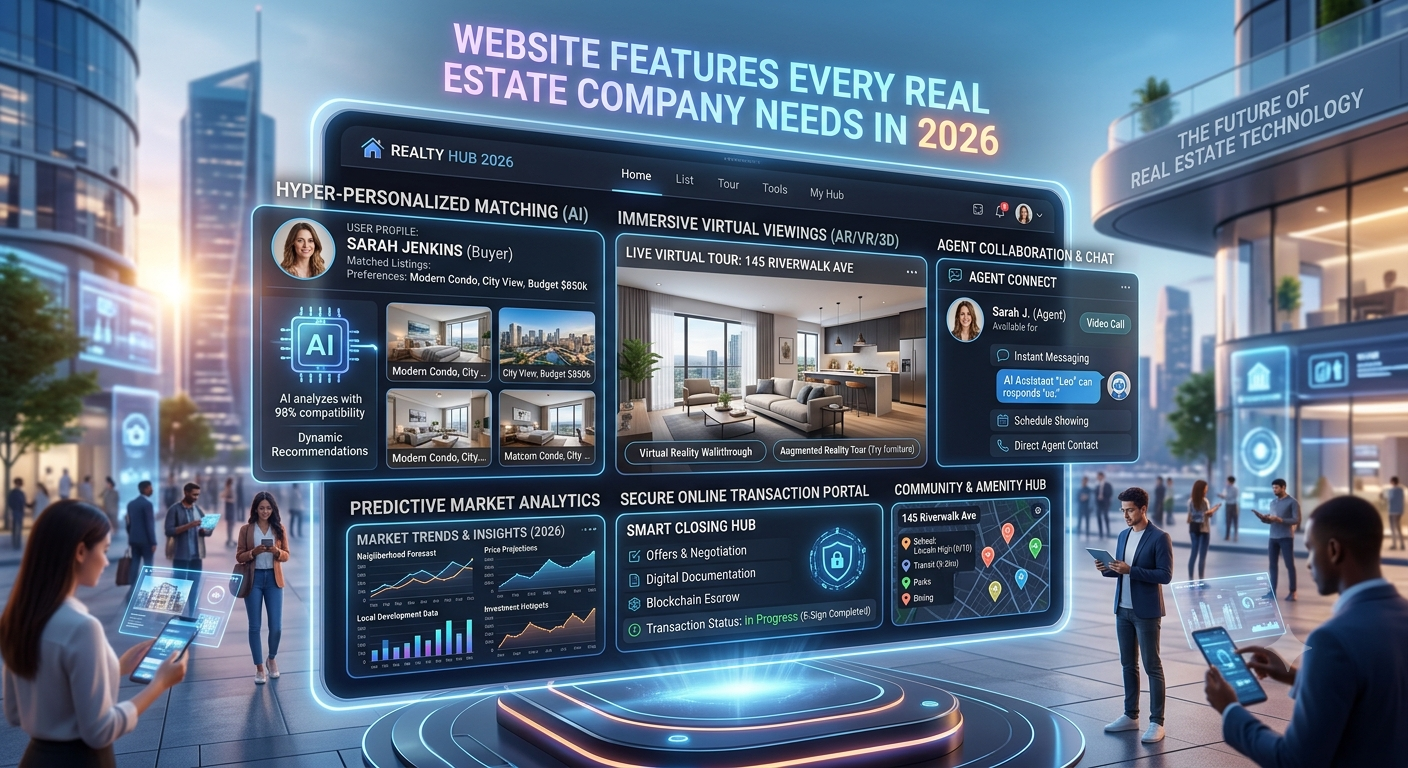
The way Indians buy property has changed permanently. A buyer looking for a 2BHK in Pune, a luxury apartment in Mumbai, or commercial space in Bangalore no longer begins with a phone call or a walk-in — they begin with Google. By the time they contact a builder, broker, or developer, they have usually already browsed listings, watched a virtual tour, compared three or four projects, and formed a firm opinion. Industry data indicates that well over three-quarters of property searches in India now start online, and the majority of that traffic comes from mobile phones.
In that environment, a real estate company's website is no longer a digital brochure or a box to tick. It is the single most important sales asset the business owns — the place where trust is won or lost in the first few seconds, where leads are captured around the clock, and where a brand either looks credible and modern or dated and forgettable.
The problem is that most real estate websites were built for a different era. They show a handful of photos, a phone number, and a generic enquiry form — and then their owners wonder why the leads keep going to competitors. The property websites winning in 2026 are built around a specific set of features that match how modern buyers actually search, evaluate, and decide.
This guide breaks down exactly which website features every real estate company needs in 2026 — the discovery tools, lead-generation mechanisms, trust signals, AI capabilities, and India-specific essentials that separate a high-performing property website from an expensive online business card.
Why Your Real Estate Website Is Now Your Most Important Sales Asset
Research consistently shows that a visitor forms an opinion about a business within a fraction of a second of landing on its site — long before they read a single word. In real estate, where aesthetics and trust are everything, that first impression decides whether a buyer stays to explore your projects or bounces straight back to a competitor. A cluttered, slow, or dated website actively works against you.
The shift to mobile makes this even more critical. With the large majority of property searches in India now happening on smartphones, Google's mobile-first indexing means your mobile experience directly determines your search rankings. A site that takes more than a few seconds to load on a phone loses a significant share of its visitors before the homepage even appears.
There is also the simple reality of competition. Every serious builder, brokerage, and property developer is now online, all chasing the same pool of digitally-savvy buyers. The companies that consistently generate quality enquiries are not necessarily the ones with the biggest projects — they are the ones whose websites load fast, look trustworthy, and make it effortless to search, shortlist, and enquire. Your website is, in effect, a salesperson that works 24 hours a day, seven days a week. The only question is how well it has been equipped to do that job.
Here is everything Indian real estate companies, builders, brokers, and developers need to know about the website features that win leads in 2026 — what to build, why it matters, and where to start.
The Must-Have Real Estate Website Features for 2026
A high-performing property website is built in layers. At its foundation are the features that let buyers discover the right property. On top of that sit the mechanisms that turn anonymous visitors into named leads, and the trust signals that convince those leads you are worth contacting. The strongest real estate websites get all three layers right — here is what each one demands.
Property Search, Smart Filters and Listing Pages
Buyers come to a real estate website to look at properties, so property discovery has to be effortless. A prominent search bar belongs front and centre on the homepage, backed by advanced filters that let users narrow results by location, budget, configuration (1BHK, 2BHK, 3BHK), property type, possession status, and amenities. Google Maps and geolocation integration lets buyers explore listings by locality — a feature Indian buyers increasingly expect.
Equally important are the individual listing pages. Each property should have its own clean, SEO-friendly URL and a rich detail page: high-quality photos, carpet and built-up area, price, floor plans, amenities, location highlights, and a clear call to action. Pages like these are what get indexed by Google and what convince a buyer to enquire. Adding a shortlist or saved-search feature — where users can bookmark properties and receive alerts when new matching listings go live — turns a one-time visitor into a repeat one and quietly captures their contact details in the process.
Lead Capture: Forms, WhatsApp and EMI Calculators
An engaging website is only valuable if it converts. The most effective lead-generation features are simple and offer something in return. Short enquiry forms, prominent click-to-call buttons, and “request a callback” options should appear throughout the site, not just on a buried contact page. The golden rule is to keep forms short and the value obvious — a downloadable price list, a project brochure, or a site-visit booking works far better than a blank “get in touch” box.
For the Indian market specifically, two features are close to non-negotiable. The first is a WhatsApp enquiry button: buyers here overwhelmingly prefer to message rather than fill long forms, and a one-tap WhatsApp link dramatically increases enquiry rates. The second is an EMI or affordability calculator. Buyers want to know what a property will cost them every month before they call, and a calculator keeps them engaged on your site while subtly qualifying them as serious leads.
Trust Builders: Virtual Tours, Reviews and RERA
Real estate is a high-trust, high-value purchase, so your website has to actively prove credibility. Immersive media is now an expectation rather than a luxury: 360° virtual tours, drone footage, and video walkthroughs let remote and out-of-city buyers experience a property without a site visit, and they keep visitors engaged far longer than static photos alone. Pair these with genuine social proof — client testimonials, a gallery of completed and delivered projects, and links to Google reviews.
For Indian developers, displaying RERA registration numbers prominently is both a compliance requirement and a powerful trust signal — buyers have learned to look for it, and its absence raises red flags. Round out the trust layer with the practical essentials: an SSL certificate across the whole site, encrypted and spam-protected enquiry forms, and a well-written About or team page that puts a human face to the brand. These features answer the unspoken question every buyer has: can I trust this company with one of the biggest financial decisions of my life?
AI and Automation: The Features Defining 2026
The clearest divide between a 2026-ready real estate website and a dated one is intelligent automation. AI chatbots now handle the first conversation with a visitor — answering questions about price, availability, and location at any hour, qualifying the lead, and routing serious enquiries to a human agent. Implemented well, a chatbot turns your website from a static catalogue into a responsive assistant that never sleeps and never lets a midnight enquiry slip away.
Beyond chat, AI-driven property recommendation engines analyse a visitor's browsing behaviour and surface the most relevant listings automatically, much like the portals do. The other half of the automation story is CRM integration: every lead captured through a form, chatbot, or WhatsApp message should flow automatically into a CRM, trigger follow-up reminders, and ensure no prospect falls through the cracks. For a busy sales team, this combination of AI qualification and automated lead management is the difference between chasing cold contacts and closing warm ones.
At GInfomedia, we build fast, SEO-optimised, conversion-focused real estate websites for Indian builders, brokers, and developers — complete with property search, WhatsApp leads, EMI calculators, and AI features.
👉 Click Here to Chat with Us on WhatsApp and get a free real estate website strategy consultation today!
Speed, Mobile and SEO: The Features Google Rewards
You can have the best listings in the city, but if Google can't rank your site, buyers will never find them. That makes technical and SEO features just as essential as the visible ones. Mobile-first, fully responsive design is the foundation — every image, button, and filter has to adapt perfectly to a smartphone screen, because that is where the majority of your audience is searching from.
Speed is the next ranking lever. Real estate sites are image-heavy by nature, so optimised images, clean code, and good hosting are needed to keep load times under a few seconds and pass Google's Core Web Vitals. On the content side, SEO-friendly URLs, structured data markup, and a blog platform are what let your individual listing pages, locality pages, and market-update articles get indexed and rank.
The biggest organic-traffic opportunity for real estate companies is hyper-local content. Dedicated neighbourhood and locality landing pages — with honest overviews, price trends, and embedded filtered listings — become long-term SEO assets that capture searches portals can't easily dominate. Combined with a Google Business Profile and consistent local SEO, these pages help you climb the rankings for the location-based searches buyers actually type.
What These Features Actually Deliver
These features are not cosmetic — each one maps to a measurable business outcome, and the industry data makes the case clearly. Search engine optimisation alone drives roughly half of all website traffic for real estate businesses, which means the SEO and content features above are effectively your largest source of free, compounding leads.
The conversion features pull their weight too. Saved searches and listing alerts bring buyers back to your site repeatedly, keeping you top of mind until they are ready to act. Short, well-placed lead forms and WhatsApp buttons consistently rank among the highest-converting tools on any property site. And because the large majority of traffic now arrives on mobile, the mobile-first and speed features directly reduce bounce rates — every additional second of load time on a phone quietly costs you a share of your visitors.
The pattern across all of it is consistent: modern features matched to real buyer behaviour produce more enquiries, more repeat visits, and lower acquisition costs. A website built on these principles stops being an expense and starts behaving like your most reliable lead-generation channel.
What Indian Real Estate Companies Specifically Need
India's property market has its own rules, and a website built for a Western audience will quietly under-perform here. A few features matter far more in the Indian context than generic “best practice” lists suggest, and getting them right is what gives local companies an edge.
RERA compliance comes first: displaying project registration numbers is both a legal expectation and a trust signal Indian buyers now actively look for. WhatsApp-first communication is the second — for most Indian buyers, a WhatsApp button converts better than any contact form. Regional and multilingual support widens your reach considerably, especially for developers selling across states. And if you want to monetise a portal or offer featured listings, payment integration with Razorpay, UPI, and other India-first gateways is essential rather than optional.
Finally, there is the question of competing with the giants. You will rarely out-spend portals like 99acres or MagicBricks on advertising, but you can out-rank them on specific, local searches. Building dedicated city and locality landing pages — for Mumbai, Pune, Bangalore, Hyderabad, Delhi NCR, Ahmedabad, and the micro-markets within them — lets your own-brand website capture high-intent buyers for the exact areas where you sell. That hyper-local SEO advantage is something the big portals, with their generic national pages, simply cannot replicate.
How to Prioritise These Features for Your Website
Seeing the full feature list can feel overwhelming, but you don't need everything on day one. The smart approach is to start with a strong minimum viable website and layer in advanced features as the business grows. The non-negotiable launch essentials are: fast, mobile-first design; a property search with filters; clean individual listing pages; clear lead-capture forms; a WhatsApp enquiry button; and solid on-page SEO. Get these right and you already have a website that out-performs most of your competitors.
Once that foundation is live and generating enquiries, the second wave adds depth: virtual tours and video, an AI chatbot, CRM integration and automated follow-ups, an EMI calculator, and a growing library of locality pages and blog content for organic traffic. Building in this order means your site starts paying for itself before you invest in the more advanced layers.
Throughout, measure what matters — track which pages rank, which features generate enquiries, and where visitors drop off — and use that data to decide what to build next. And because real estate websites combine genuine technical complexity with industry-specific needs, working with a development partner who understands both property buyer behaviour and SEO will get you there faster than a generic template ever could.
A real estate website in 2026 is not a passive online brochure. It is a structured lead-generation system, and the companies that invest in the right features — search, trust, automation, and local SEO — build a durable advantage in their market.
The Bigger Picture: Your Website as a 24/7 Sales Engine
The era of treating a website as a digital business card is over. In 2026, the real estate website is the heart of the business — a sales engine that qualifies leads while the team sleeps, builds trust before the first phone call, and compounds in value every month as its content ranks and its database grows.
This is also why ownership matters. Listings on a portal disappear the moment you stop paying, but a well-built website you own is an asset that appreciates: the SEO authority you build, the locality pages you publish, and the leads you capture all belong to you and keep working long after the initial investment. For Indian real estate companies competing in one of the world's fastest-growing and most crowded property markets, that durable, owned, conversion-focused presence is the strongest foundation a brand can build.
The features in this guide are not a wish list — they are the new baseline. The buyers are already online, already on mobile, and already comparing you to the competition. The only real question is whether your website is built to win them, or built to hand them to someone else.
