
For hospitals, clinics, and individual doctors in India, the way patients find care has fundamentally changed. The patient journey no longer starts at the reception desk or with a word-of-mouth referral — it starts on Google. When someone types "best orthopaedic doctor near me," "skin clinic in [city]," or "knee pain treatment," the practices that appear at the top of the results win the appointment. The ones buried on page two are, for all practical purposes, invisible. This is exactly the gap that SEO for hospitals and clinics is designed to close.
The numbers make the case bluntly. Over 70% of Indian patients now research online before choosing a doctor or hospital, and more than 90% never click past the first page of search results. Whether your facility shows up in those first few results — in Google's local map pack, in organic listings, and increasingly in AI-generated answers — directly determines how many new patients walk through your door each month.
This guide breaks down healthcare SEO in plain terms: what it is, why it works differently for medical websites than for any other industry, and the specific, practical steps a hospital, clinic, or doctor in India can take to rank higher on Google and convert that visibility into real patient bookings.
Why SEO Has Become Essential for Hospitals and Clinics in India
India's healthcare market has gone digital-first faster than almost anyone predicted. Affordable smartphones, cheap mobile data, and a generation of patients comfortable searching for symptoms and providers online have combined to make Google the front door of nearly every clinic and hospital in the country. Before a patient calls your reception, they have usually already searched, compared, and read reviews — often on their phone, often late at night.
For healthcare providers, this is both a threat and an enormous opportunity. The threat: if a competing hospital or clinic ranks above you for the searches your future patients are making, those patients quietly become their patients instead. The opportunity: unlike paid advertising, where visibility stops the moment you stop paying, SEO builds a durable, compounding asset. Once your pages rank, they keep attracting high-intent patients month after month at a steadily falling cost per acquisition.
What makes medical SEO especially valuable is the quality of the traffic. Someone searching "paediatrician in Andheri" or "IVF clinic in Pune" is not casually browsing — they are actively looking to book care, often urgently. SEO captures these patients at the exact moment of intent and routes them to the practice that has earned the most visible, trustworthy presence on Google.
Here is everything hospitals, clinics, and doctors in India need to know about healthcare SEO — how Google ranks medical sites, the tactics that actually move the needle, and how to turn organic search into a steady stream of new patient appointments.
How Healthcare SEO Works: The Core Pillars
On-Page, Technical, and Local SEO
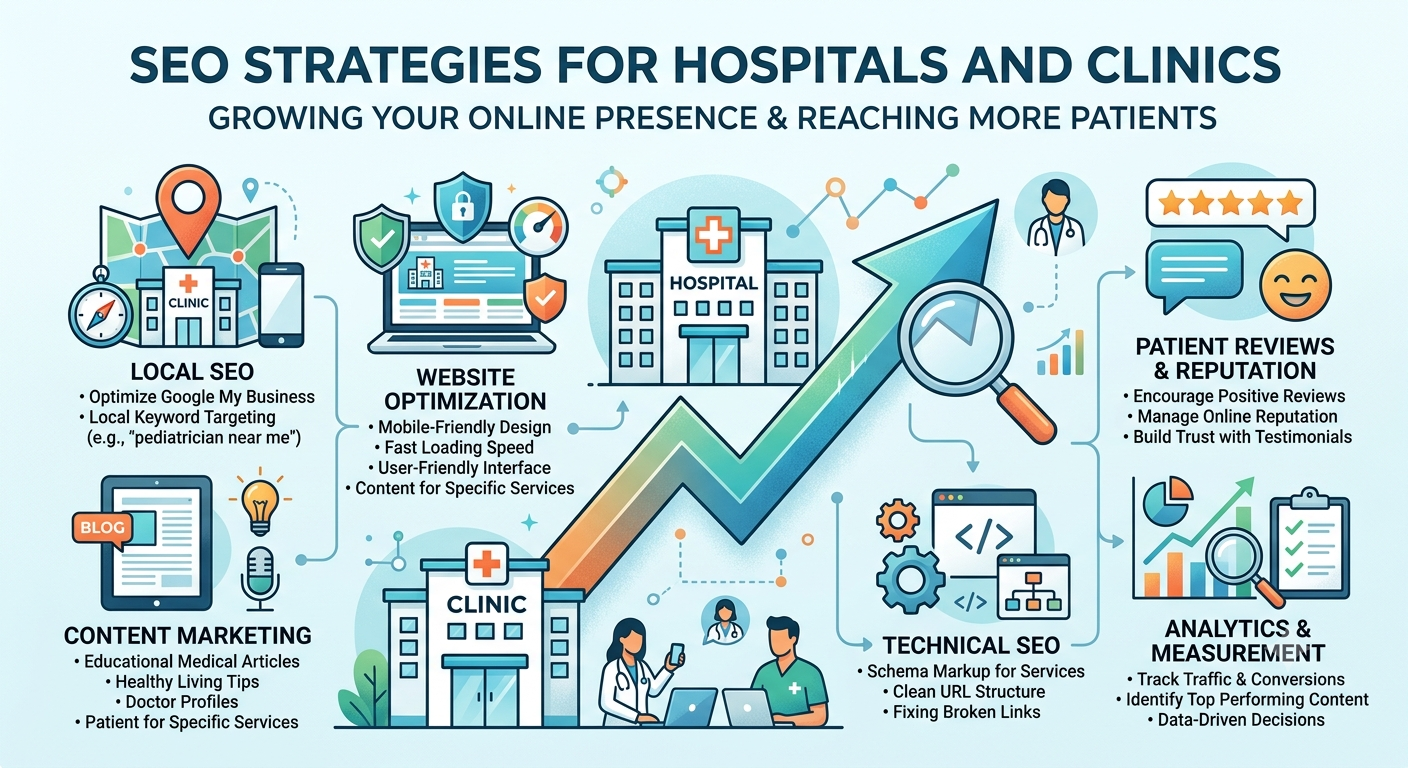
Effective SEO for hospitals and clinics rests on three connected pillars, and a site needs all three working together to rank reliably. On-page SEO covers everything on the page itself: optimised title tags and meta descriptions, a clear heading structure, content written around the terms patients actually search, descriptive image alt text, and smart internal linking between your specialty pages, doctor profiles, and service pages.
Technical SEO is the foundation underneath. It covers site speed and Core Web Vitals, mobile responsiveness (most healthcare searches in India happen on phones), secure HTTPS, a clean crawlable site architecture, and an absence of indexing errors that quietly block your pages from appearing on Google at all. A beautifully written page cannot rank if search engines struggle to crawl, render, or load it.
Local SEO ties it together for any practice that serves patients in a physical location. It is the difference between a clinic that appears in the Google map pack for "dermatologist near me" and one that does not. For hospitals and clinics, local SEO is usually the single highest-return channel, because location-based medical searches convert almost directly into booked appointments.
E-E-A-T and YMYL: Why Google Holds Medical Sites to a Higher Standard
Healthcare is what Google classifies as a "Your Money or Your Life" (YMYL) topic — content that can affect a person's health, safety, or wellbeing. Because the stakes are high, Google applies far stricter quality standards to medical websites than to most other industries. This is where many hospital and clinic websites quietly lose ground to competitors.
The standard Google uses is E-E-A-T: Experience, Expertise, Authoritativeness, and Trustworthiness. In practice, this means your content should be written or reviewed by qualified medical professionals, your doctor profile pages should clearly display credentials, qualifications, and specialisations, and your claims should be accurate and responsible. Thin, generic, or anonymous health content rarely ranks for competitive medical terms — a credentialled, detailed page almost always beats it.
For Indian healthcare providers, this is genuinely good news. A practice with real, qualified doctors and a track record of patient care has exactly the authority signals Google is looking for. The job of healthcare SEO is to make those signals visible and machine-readable so search engines can recognise and reward them.
Medical Schema and Structured Data
Structured data — also called medical schema markup — is code added to your pages that tells search engines exactly what each page contains. Implemented in JSON-LD format, Physician schema can describe a doctor's credentials, specialisations, and hospital affiliation; MedicalClinic or Hospital schema can define each location with its address, phone number, hours, and services; and FAQ or service schema can describe the treatments you offer.
This matters more than ever in 2026. Well-structured data not only helps you earn rich results and knowledge panels in traditional Google Search — it is also how AI assistants like Google's AI Overviews, ChatGPT, and Gemini understand and surface your practice when patients ask them health questions. Schema is one of the most underused technical SEO levers in Indian healthcare, which makes it a real competitive advantage for the practices that adopt it early.
Local SEO for Doctors: Winning the "Near Me" Search
If a hospital or clinic could fix only one thing, local SEO would be it. The vast majority of high-intent medical searches carry local intent — "near me," a city name, or a neighbourhood — and these searches convert into appointments at a far higher rate than broad informational queries. Winning local search is the fastest, most reliable way to grow patient volume from organic channels.
The cornerstone of local SEO is a fully optimised Google Business Profile (formerly Google My Business). That means complete and accurate information — practice name, address, phone number, working hours, and services — plus high-quality photos, the correct categories, and consistent details across every directory your practice appears in. A well-maintained profile is what gets your clinic into the coveted local map pack at the top of the results.
Patient reviews are the other half of the equation. Around 84% of patients say they trust online reviews as much as a personal recommendation, and review quantity, quality, and recency are strong local ranking signals. A systematic, ethical process for inviting satisfied patients to leave reviews — and responding to every review professionally — compounds into higher rankings and higher click-through rates over time.
At GInfomedia, we help hospitals, clinics, and doctors across India build healthcare-focused SEO that attracts real, high-intent patients — local SEO, medical content, Google Business Profile optimisation, and technical fixes that actually move rankings.
👉 Click Here to Chat with Us on WhatsApp and get a free healthcare SEO consultation today!
Keyword Strategy for Hospitals and Clinics
Keyword research is the foundation of every healthcare SEO campaign — it determines which patients you reach and at what stage of their decision. The most effective strategy targets a deliberate mix of keyword types rather than chasing only the highest-volume terms, which are usually dominated by national health portals and aggregators.
Broad, short-tail terms like "dermatologist" or "cardiology hospital" carry huge search volume but intense competition. The smarter play for most clinics is long-tail, intent-rich keywords — phrases like "best endocrinologist in Bangalore," "LASIK eye surgery cost in Mumbai," or "child specialist near me." These have more defined intent, lower competition, and convert far better because the searcher is closer to booking.
A complete keyword map blends several categories: service-based keywords (the treatments and procedures you offer), condition and symptom keywords (how patients describe their problem in their own words), specialty keywords (your departments and consultants), and location keywords (your city, area, and "near me" variations). Building dedicated, well-optimised pages for each high-value combination of specialty and location is one of the most powerful patient-acquisition assets a healthcare website can own.
Crucially, keyword strategy should reflect how patients search, not how clinicians speak. Patients use everyday language and symptoms — "burning urine treatment," "back pain doctor" — while clinicians use technical terms. Mapping both, and writing content that meets patients in their own words while demonstrating clinical authority, is what separates pages that rank from pages that don't.
Real Results: What Healthcare SEO Delivers
Healthcare SEO is not an abstract marketing exercise — it produces measurable, compounding business outcomes when executed properly. The pattern across well-run campaigns is consistent: a technically sound, locally optimised, authority-rich medical website steadily climbs the rankings and converts that visibility into a reliable flow of patient inquiries.
In practical terms, most healthcare practices begin to see meaningful improvements in Google visibility within roughly three months of disciplined work, with significant increases in patient inquiries from organic search typically arriving between six and nine months. SEO is a medium-term investment that becomes more valuable over time, not an overnight switch — but unlike paid ads, the visibility it builds does not disappear when the spending stops.
The downstream effects extend well beyond rankings. Clinics that invest in local SEO and reputation management commonly report doubled online appointment bookings, more direct calls from their Google Business Profile, and a steady reduction in their dependence on referrals and paid advertising. For a hospital, the same approach scaled across departments, specialties, and locations turns organic search into a primary, cost-efficient patient-acquisition channel.
The common thread is that SEO performance and clinical credibility reinforce each other. The same signals that convince Google your site deserves to rank — qualified authors, detailed credentials, accurate content, genuine reviews — are the same signals that convince a patient to trust you with their care.
What This Means for India's Healthcare Providers
India's healthcare SEO opportunity is real, but so is the competition — and the practices that move deliberately will capture a lasting advantage over those that wait for the market to mature. The right strategy looks different depending on the size and type of provider.
Large multi-specialty hospitals already have the scale, the departments, and the location footprint that healthcare SEO rewards. Their challenge is usually organisational: treating SEO as a serious, ongoing growth channel rather than an afterthought, and building out optimised content across every specialty, consultant, and location instead of relying on a thin corporate website. Done well, enterprise healthcare SEO can dominate search for an entire city's worth of medical queries.
For single-specialty clinics and individual doctors — dermatologists, dentists, physiotherapists, IVF centres, orthopaedic surgeons, paediatricians, and the like — the opportunity is even sharper. Local SEO, a strong Google Business Profile, specialty-specific landing pages, and a steady stream of patient reviews can establish a clinic as the obvious first choice in its catchment area, often outranking far larger competitors for the searches that matter most locally.
Diagnostic centres, dental chains, wellness clinics, and health-tech platforms each have their own patient search patterns, and the most effective approach is always tailored to the specialty's unique patient journey and local competition. There is no one-size-fits-all template in medical SEO — but the underlying principles of authority, local relevance, and technical discoverability apply across every category of provider.
How to Get Started with Healthcare SEO
For a hospital or clinic ready to take SEO seriously, the work proceeds across a few parallel tracks — and the earlier you begin, the sooner the compounding benefits arrive.
The first step is a technical and on-page audit. Before chasing rankings, fix the foundations: crawl errors, slow load times, mobile usability problems, missing or duplicate title tags and meta descriptions, and absent schema markup. These issues quietly cap your visibility no matter how good your content is, so resolving them first ensures every later effort actually pays off.
The second is local SEO and reputation. Claim and fully optimise your Google Business Profile, ensure your name, address, and phone number are consistent everywhere online, list your practice in trusted Indian healthcare directories, and put a steady, ethical review-generation process in place. For most clinics, this track delivers the fastest and most direct increase in patient inquiries.
The third is content and authority. Build out optimised pages for each specialty, service, procedure, and location, and publish patient-focused content — treatment guides, condition explainers, and FAQs — that answers the questions patients are actually searching for. Crucially, ensure this content is created or reviewed by qualified medical professionals and carries clear author credentials, so it meets Google's E-E-A-T standards for medical content and earns lasting authority.
Healthcare SEO is not a passive, one-time project. It is an ongoing system that rewards technical discipline, local relevance, genuine medical authority, and consistent measurement. Hospitals and clinics that engage strategically build a durable lead in the most valuable channel in healthcare marketing today.
The Future: AI Search, Voice, and Answer Engine Optimization
The way patients search is changing again, and forward-looking healthcare providers are already adapting. A growing share of patients now ask questions of AI assistants — Google's AI Overviews, ChatGPT, Gemini — and voice assistants on their phones, rather than scanning a traditional list of blue links. This shift is giving rise to Answer Engine Optimization (AEO): the practice of structuring your content and data so that AI systems cite and recommend your practice when patients ask health questions.
The encouraging reality is that AEO and strong SEO rest on the same foundations. The authority signals that win traditional rankings — credentialled content, detailed E-E-A-T signals, clean structured data, and genuine reviews — are precisely the signals AI systems use to decide which sources to trust and surface. Practices that have done the SEO fundamentals well are naturally positioned to win in AI-driven search too. Adding clear medical schema and conversational, question-based content tuned for voice search further strengthens that position.
India's healthcare sector is in the early innings of this transition, which is exactly why the timing matters. The hospitals, clinics, and doctors who build genuine search authority now — across Google, local map results, and AI answers alike — will be the ones patients find first for years to come. The opportunity is clearly real. The only real question is whether your practice will move quickly enough to claim it before a competitor does.
