
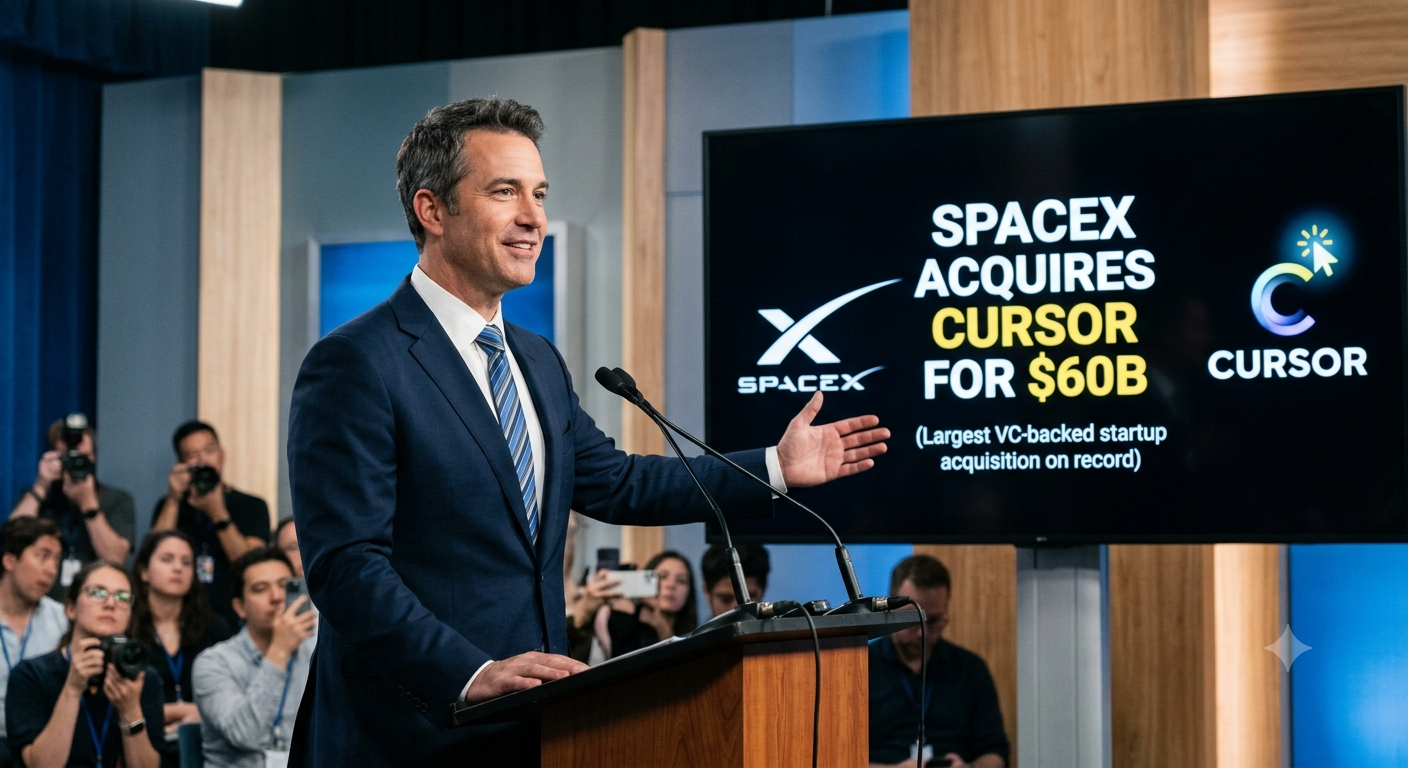
On Tuesday, June 16, 2026, Elon Musk's SpaceX confirmed it would acquire Anysphere — the San Francisco startup behind the wildly popular AI coding assistant Cursor — for $60 billion in an all-stock deal. The transaction is, by every available measure, the largest acquisition of a venture-backed startup ever recorded, and it landed just four days after SpaceX completed the biggest initial public offering in stock market history.
The scale alone is staggering. A four-year-old software company, founded by a handful of MIT graduates, is being absorbed for a sum larger than the market capitalisation of most companies in the S&P 500. But the more revealing story is not the price tag — it is why Musk was willing to pay it, how he paid it, and what the deal signals about the brutal, fast-moving war for control of AI-powered software development.
This is the deal that redrew the competitive map of enterprise AI overnight. Here is everything you need to know about the SpaceX–Cursor acquisition: what happened, why it happened, and what it means for developers, founders, and the broader technology industry.
What Happened: Inside the $60 Billion SpaceX–Cursor Deal
According to a securities filing submitted on June 16, SpaceX entered into a binding merger agreement to acquire Anysphere, the company that builds and operates Cursor. The structure is an all-stock transaction: Cursor's shareholders will receive newly issued SpaceX Class A common stock, with the precise number of shares determined by the volume-weighted average price of SpaceX over the seven trading days immediately before closing. Cursor will survive the merger as a wholly owned SpaceX subsidiary, and the deal is expected to close in the third quarter of 2026.
Crucially, not a single dollar of cash changed hands — and none of the proceeds from SpaceX's record IPO were touched. The entire $60 billion is being paid in equity. The deal was not a spontaneous decision either. Back in April 2026, SpaceX had quietly secured a call option as part of a broader partnership: it could either buy Cursor for $60 billion in stock later in the year, or walk away by paying a $10 billion break-up fee. In June, with its stock soaring after the IPO, SpaceX exercised that option.
The agreement also reveals how seriously SpaceX's own lawyers are taking the regulatory risk. The deal reportedly carries a $10 billion general termination fee plus a separate regulatory termination fee — a strong signal that the company anticipates significant antitrust scrutiny before the transaction can close.
The headline number is the largest ever for a VC-backed startup. But the real story is a rocket company using richly priced stock to buy its way into an AI race it was losing.
Why SpaceX Paid $60 Billion for an AI Coding Startup
1. SpaceX's AI Division Was in Serious Trouble
To understand the deal, you have to understand the hole SpaceX was trying to fill. In February 2026, SpaceX merged with Musk's AI company, xAI, folding the Grok large language model into a new internal AI division. That division was the centrepiece of SpaceX's pitch to IPO investors — the company told the market it saw an addressable AI market worth roughly $26 trillion, nearly the entire size of the US economy.
The reality on the ground was far less impressive. By the end of March 2026, all eleven of Musk's xAI co-founders had departed the company. Musk himself publicly admitted that xAI “was not built right the first time around” and that he was rebuilding it from the foundations up. The division had been mired in a damaging restructuring following a string of controversies, and its Grok models had failed to gain meaningful traction with professional developers. In short, the most valuable part of SpaceX's stock-market story was also its weakest link. Cursor was the proven product that xAI had been unable to build for itself.
2. Cursor Was One of the Fastest-Scaling Software Companies Ever
On the other side of the deal sat one of the most remarkable success stories in modern software. Founded in 2022 by four MIT graduates — Michael Truell, Sualeh Asif, Aman Sanger, and Arvid Lunnemark — Cursor launched its AI code editor in 2023 and grew at a pace almost no enterprise software company had matched before.
By the time SpaceX moved in, Cursor was used by roughly two-thirds of the Fortune 500, reportedly generating around 150 million lines of enterprise code every day. It crossed $1 billion in annualised revenue in under two years and had climbed toward several billion dollars in annual revenue by 2026, with enterprise sales growing sharply. Its customer roster included names like Stripe, Adobe, and Nvidia — whose CEO, Jensen Huang, has publicly described Cursor as a favourite enterprise AI tool. Before SpaceX exercised its option, Cursor was on track to raise around $2 billion from investors including Andreessen Horowitz, Thrive Capital, and Nvidia, at a valuation in the region of $50 billion. SpaceX's offer pre-empted that round entirely.
3. The All-Stock Structure Was a Masterstroke
Perhaps the most financially elegant aspect of the deal is that it may have cost Musk almost nothing in real terms. SpaceX's stock debuted on the Nasdaq at $135 per share and surged in the days that followed, pushing the company's market capitalisation well past $2.5 trillion — a gain of hundreds of billions of dollars in less than a week of trading. Against that backdrop, a $60 billion all-stock acquisition represented a small fraction of the value SpaceX's shares had created since listing.
In other words, Musk used newly minted, highly valued equity — not cash — to acquire a company that gives him instant credibility in AI coding. For Cursor's investors and founders the payday was enormous: early backers like Andreessen Horowitz and Thrive Capital are sitting on multi-billion-dollar stakes, and each of the four co-founders is reportedly worth billions once the deal closes. It is a textbook demonstration of how a soaring stock price can become a strategic weapon.
The Cursor deal is a reminder that the tools your business depends on can change hands — and change direction — overnight. At GInfomedia, we help Indian businesses build resilient, future-ready digital strategies that reduce single-platform risk.
👉 Click Here to Chat with Us on WhatsApp and get a free digital strategy consultation today!
What the Deal Means for the AI Coding War
The acquisition instantly reshapes the competitive landscape for AI-powered development. By absorbing Cursor, SpaceX gains something money usually cannot buy quickly: a large, loyal base of expert engineers and a continuous stream of high-quality coding data — prompts, iteration cycles, and architecture decisions — that can be used to train better models, including Grok. SpaceX has indicated that Cursor will tap into its Colossus supercomputer infrastructure to scale up model training, and the two teams have reportedly been jointly training a new model already.
The move also puts SpaceX on a direct collision course with the AI labs that had been pulling ahead. Cursor's product historically ran on other companies' models, primarily from OpenAI and Anthropic — and over the past year those suppliers became competitors. Anthropic's agentic coding tools reportedly overtook Cursor in both usage and revenue through late 2025, and industry spending data suggested Cursor's market share had slipped meaningfully over the same period. Buying Cursor gives SpaceX a fighting chance to reverse that slide and route more of that developer activity through its own ecosystem rather than a rival's.
The broader signal is unmistakable: AI coding tools are no longer scrappy indie products. They have become strategic assets in a platform war between some of the most powerful companies on earth, and they are being valued accordingly.
What Cursor Users and Founders Should Do Now
For the millions of developers and the many enterprises that rely on Cursor day to day, the immediate practical impact is limited — the tool continues to operate normally, and no sweeping changes to model access have been announced. But the longer-term picture warrants attention. Once the deal closes, SpaceX becomes the data controller behind one of the world's most widely used coding tools, and the product roadmap will inevitably bend toward its owner's strategic priorities, including deeper integration with Grok and SpaceX's wider AI ambitions.
The prudent response is not panic but planning. Teams that depend heavily on a single proprietary AI tool should ask the same questions any resilient organisation asks about critical infrastructure: What happens to our workflow if pricing, data policies, or model access change after this deal closes? Where could open-source or multi-provider alternatives reduce our exposure? And how do we keep our codebase and processes portable enough that no single vendor's strategic agenda can hold them hostage? The SpaceX–Cursor acquisition is a landmark moment in the history of technology mergers — and a timely reminder that in the AI era, the tools you build on can belong to someone else's vision overnight.
