
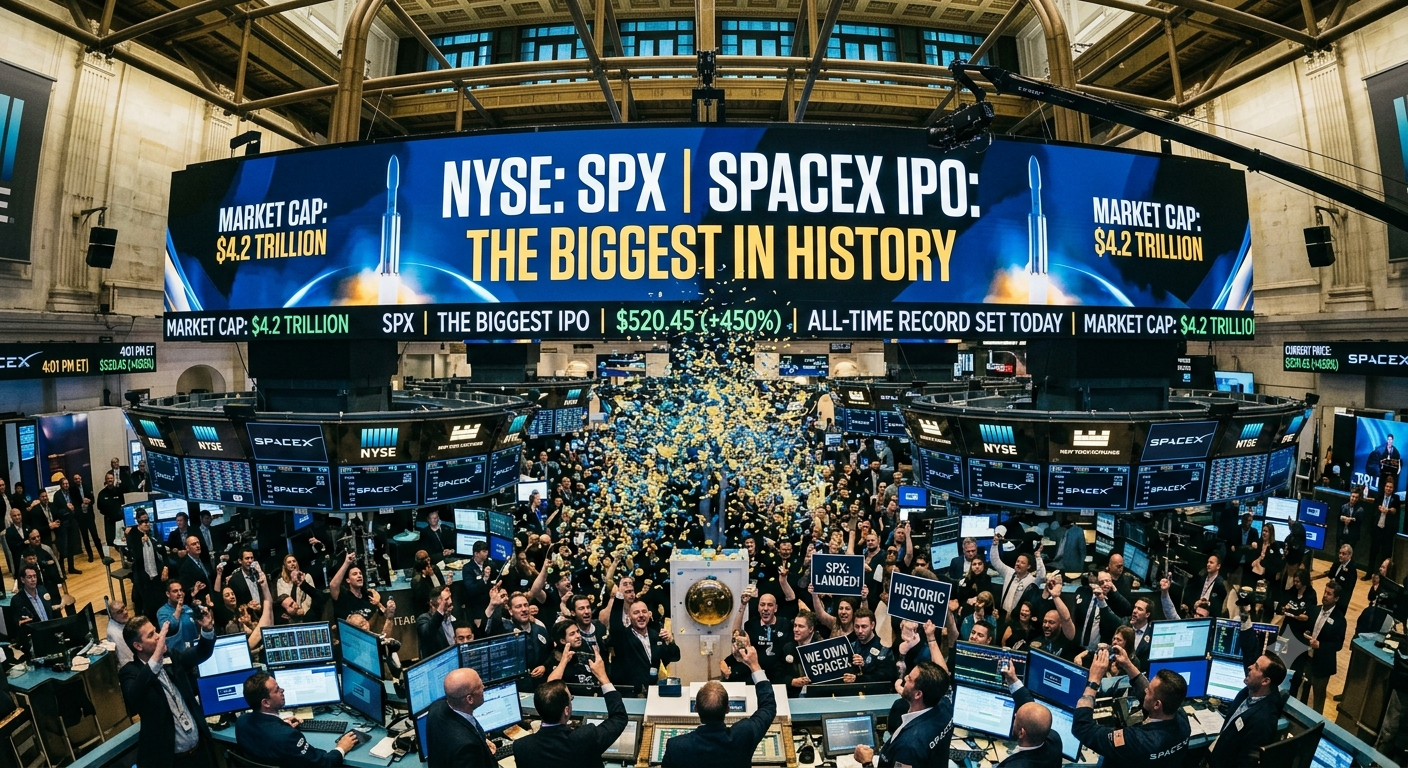
On Friday, June 12, 2026, Elon Musk's SpaceX completed the largest initial public offering in the history of global capital markets. Trading under the ticker SPCX on the Nasdaq, the company raised roughly $75 billion at its offering price — a figure that climbed to nearly $86 billion once underwriters exercised their overallotment option days later. No company had ever raised this much money going public.
To put the scale in perspective: the previous record holder, Saudi Aramco, raised about $29.4 billion in its 2019 listing. SpaceX's debut was nearly three times larger. The offering priced 555,555,555 shares at $135 each, valued the company at around $1.77 trillion at the open, and pushed Musk's personal net worth past $1 trillion — making him, on paper, the world's first trillionaire.
This was not merely a big stock sale. It was a defining moment for the AI and space economy, a stress test for the Nasdaq's infrastructure, and one of the most closely watched financial events of the decade. Here is exactly what happened, the numbers behind the record, and what the SpaceX IPO means for investors — including those in India.
What Happened: The Record-Shattering SpaceX IPO
SpaceX had spent years as the most valuable private company on earth, fueling endless speculation about when — or whether — it would ever go public. That question was answered in early 2026. After confidentially filing draft paperwork with the US Securities and Exchange Commission, the company set a fixed price of $135 per share rather than the usual price range, effectively giving investors a take-it-or-leave-it deal ahead of its Nasdaq debut.
Demand was overwhelming. Reports indicated the offering was heavily oversubscribed, with orders reaching roughly $250 billion — close to four times the number of shares on offer. Goldman Sachs led the syndicate, joined by Morgan Stanley, Bank of America, Citigroup, JPMorgan Chase, and more than twenty banks in total. Notably, SpaceX carved out an unusually large slice — up to 30% of shares — for retail investors through brokerages like Robinhood, Fidelity, and Charles Schwab, far above the typical retail allocation for an offering of this magnitude.
When the opening bell rang on June 12, SpaceX President and COO Gwynne Shotwell stood on the Nasdaq floor in New York while Musk watched from Texas. Within minutes, the company had rewritten the record books.
The SpaceX IPO didn't just break the record for the largest listing ever — it nearly tripled it, and minted the world's first trillionaire in the process.
The Numbers Behind the Biggest IPO Ever
1. The $75 Billion Raise — and the $86 Billion Total
At $135 per share across 555.6 million shares, SpaceX raised approximately $75 billion in the base offering. After the listing, brokers exercised their overallotment — the so-called “greenshoe” option that lets underwriters sell additional shares when demand is strong — lifting the final total to roughly $85.7 billion. That figure dwarfs every prior IPO: Saudi Aramco's $29.4 billion in 2019, Alibaba's $25 billion in 2014, and Facebook's $16 billion in 2012 all combined still fall short of what SpaceX raised in a single offering.
2. A 19% Pop on the First Day of Trading
Shares were priced at $135 but opened on the Nasdaq at $150 and climbed throughout the session, closing the first day at $160.95 — a gain of roughly 19% out of the gate. The stock touched an intraday high above $176, and more than 500 million shares changed hands on debut, a volume approaching Facebook's famous 2012 first day. By the following Monday, SpaceX jumped another 20% in its first full trading session, at one point leapfrogging Amazon in market value before the stock cooled off later in the week.
3. Elon Musk Becomes the World's First Trillionaire
Because Musk holds a large equity stake in SpaceX — reported at roughly a third or more of the company — the surging share price pushed his net worth above $1.1 trillion as trading opened. Combined with his holdings in Tesla and other ventures, the SpaceX listing made the 54-year-old the first person in recorded history with a net worth measured in trillions. By the first day's close, SpaceX commanded a market capitalization in the region of $2.1 trillion, placing it among the most valuable companies in the United States.
At GInfomedia, we help Indian businesses and creators turn major news moments like this into high-traffic, high-ranking content that grows their audience and revenue.
👉 Click Here to Chat with Us on WhatsApp and get a free content & SEO strategy consultation today!
Why Is SpaceX Worth $1.7 Trillion?
A natural question follows a number this large: how does a company that lost money last year justify a near-$1.8 trillion valuation? The answer lies in three intertwined businesses bundled into a single stock.
The first is Starlink, SpaceX's satellite-internet network, which now serves more than five million subscribers across well over a hundred countries. It is the cash engine of the company — a recurring-revenue connectivity business that analysts can actually model and that many believe could justify a few hundred billion dollars of value on its own. The second is the launch business, structurally dominant after flying around 170 Falcon 9 missions in 2025 and holding key NASA contracts, including work tied to returning astronauts to the Moon.
The third, and most speculative, is artificial intelligence. In February 2026, SpaceX merged with Musk's AI venture xAI in an all-stock deal that valued SpaceX at $1 trillion and xAI at $250 billion, creating a combined $1.25 trillion entity. That merger transformed SpaceX from a pure space-and-connectivity company into a vertically integrated “Space + AI” conglomerate. Musk's pitch to Wall Street is audacious: AI data centers in orbit, more than 100,000 satellites, and a path he claims could reach roughly $1 trillion in annual revenue by 2030, up from $18.7 billion last year. The SpaceX IPO was also framed as the first of a trio of AI mega-listings, with Anthropic and OpenAI reportedly preparing offerings of their own.
The Bull Case vs. the Bear Case
For all the euphoria, the SpaceX IPO is one of the most debated listings in years — and the skeptics have real numbers on their side. The company reported a net loss of roughly $4.9 billion for 2025 and lost another $4.3 billion in the first quarter of 2026, driven largely by the xAI segment's enormous cash burn. Capital spending on AI alone topped $7.7 billion in a single quarter, and the company has accumulated a deficit of more than $40 billion since its founding in 2002. SpaceX itself warned in its prospectus that it may not achieve profitability.
Bears point out that the stock trades at an extreme multiple of revenue and that much of the valuation rests on businesses that don't yet exist at scale — orbital data centers that haven't been built, and a next-generation Starship rocket still working through test flights. A former Nasdaq chief publicly cautioned that the shares were trading on aspiration rather than fundamentals. Bulls counter that betting against Musk has been a losing trade before, and that if Starship succeeds and orbital AI becomes real, even today's price could look cheap in hindsight. The honest summary: this is a high-conviction, high-leverage gamble dressed as a blue-chip stock.
What the SpaceX IPO Means for Investors — Including in India
The sheer size of this offering ripples far beyond one company. A $75 billion raise soaks up a meaningful share of all the IPO capital a typical year would see, and a Nasdaq rule change paved the way for rapid index inclusion — meaning many passive investors and index-fund holders now own a slice of SpaceX whether they chose to or not. For Indian investors, direct access to SPCX comes primarily through international brokerage platforms and US-stock investing apps that have grown popular in recent years, as well as through global and tech-focused funds that hold Nasdaq names.
The broader lesson is about a shifting market narrative. The SpaceX listing, arriving alongside the planned debuts of other AI giants, signals that capital is concentrating around a handful of frontier-technology platforms at unprecedented scale. Whether you participate directly or simply watch from the sidelines, events of this magnitude reshape benchmarks, valuations, and investor expectations across the entire market. As always, the prudent approach is to treat speculative, headline-driven listings with caution and to anchor decisions in your own goals and risk tolerance rather than the gravitational pull of a record-breaking number. This article is for information only and is not financial advice.
