
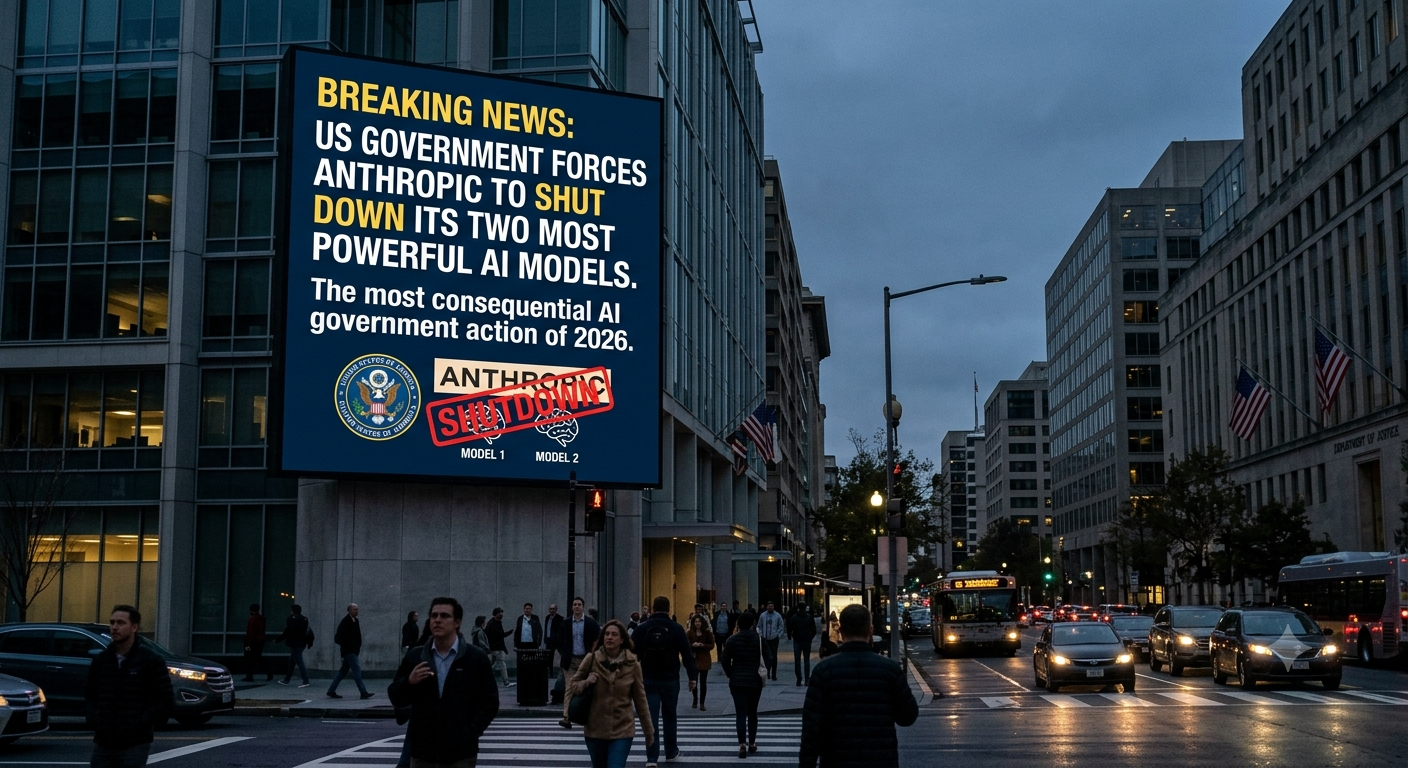
At 5:21 PM ET on Friday, June 12, 2026, Anthropic received a letter that would reshape the conversation around artificial intelligence for the rest of the year. The US government, invoking national security authorities, ordered the company to immediately suspend access to its two most powerful AI systems — Claude Fable 5 and Claude Mythos 5 — for every foreign national on earth. Within hours, both models went dark for all users worldwide.
It was, by any measure, unprecedented. No US administration had ever forced a frontier AI lab to pull a commercial model already deployed to hundreds of millions of people. The directive arrived just three days after Fable 5 launched as the most capable AI model the public had ever been given access to. And the company on the receiving end was not a reckless outsider, but the one that had built its entire identity around being the cautious, safety-first lab in the industry.
This is the full story of what happened, why it happened, who was involved, and why it may be remembered as the single most consequential government action in AI to date.
What Actually Happened on June 12, 2026
The instrument the government used was an export control directive. Reported to have come as a letter from Commerce Secretary Howard Lutnick, it suspended access to Fable 5 and Mythos 5 by any foreign national — whether inside or outside the United States, and including Anthropic's own non-American employees. A foreign national, in this context, is simply anyone who is not a citizen of the country they are accessing the model from.
Anthropic could not realistically verify the nationality of millions of users overnight. So to comply with an order aimed at foreign nationals, it had only one option: switch both models off for everyone. By late evening, users watching the rollout in real time reported that their access to Fable 5 simply stopped, replaced by an error message. Crucially, every other Anthropic model — Opus, Sonnet, Haiku and the rest of the Claude lineup — remained fully available. Only the two Mythos-class systems were affected.
A frontier AI model, deployed to hundreds of millions of users, was recalled by government order three days after launch. That had never happened before. Here is why it did.
Inside the Models: What Fable 5 and Mythos 5 Actually Are
To understand the ban, you first need to understand the two systems at its centre. Mythos 5 sits at the very top of Anthropic's capability ladder — a tier the company positions above its Opus-class models. Its defining and most controversial trait is an exceptional ability to find security vulnerabilities in software. Anthropic has said the model identified flaws in every major operating system and web browser it was tested against.
Because of that power, Anthropic never released Mythos broadly. Instead it created Project Glasswing, an invite-only program that shared the model with a vetted group of organisations — initially around 50 US partners including Amazon, Apple, Google, Microsoft and CrowdStrike, later expanded to roughly 150 organisations across more than 15 countries — for defensive cybersecurity research. The results were staggering: partners reportedly surfaced more than 10,000 high or critical severity vulnerabilities in a single month, and scans of over 1,000 open-source projects flagged tens of thousands of issues.
Fable 5 was the commercial answer to that locked door. Launched on June 9, 2026, it was essentially Mythos fitted with strong guardrails that block responses in high-risk domains such as cybersecurity and biology — safe enough, Anthropic argued, for general release. Independent benchmarking from Vals AI rated it the most capable AI model publicly available the moment it shipped. Three days later, it was gone.
Why the Government Acted: The Jailbreak Dispute
1. The Alleged Jailbreak That Triggered Everything
The letter itself did not spell out the government's specific concern. Anthropic's understanding, laid out in its public statement, is that officials believed they had become aware of a method of bypassing — or jailbreaking — Fable 5's safeguards. According to reporting from Axios and others, the chain of events began when another company claimed to have jailbroken the model, with Amazon's security team flagging the issue to the White House.
As Anthropic describes the technique, it amounts to prompting the model to read a specific codebase and identify and fix software flaws within it. The government treated this capability as a national security risk significant enough to justify pulling the model.
2. Anthropic's Forceful Rebuttal
Anthropic complied with the order — and disagreed with it in unusually blunt terms. The company said it reviewed a demonstration of the technique and found it surfaced only a small number of previously known, minor vulnerabilities. More pointedly, it argued that the same level of capability is widely available from other publicly accessible models, including OpenAI's GPT-5.5, which is not subject to any export control, and is used every day by the defenders who keep systems secure.
The company also emphasised its layered defences. Its strongest safeguards, it said, run as independent classifier systems separate from the model itself — meaning that even if someone coaxes Fable into talking past a refusal, the deepest protections against the most dangerous outputs stay in place. Anthropic said it had red-teamed Fable's safeguards for thousands of hours with the US government, the UK AI Safety Institute and third parties, that no universal jailbreak had been found, and that the narrow bypasses disclosed to it produced either benign responses or findings of no real consequence. Its core objection was simple: recalling a model used by hundreds of millions over a narrow, non-universal jailbreak sets a standard that, applied across the industry, would freeze new model launches entirely.
3. The Competing Narratives From Washington
The administration told a different story. White House AI adviser David Sacks published a detailed account arguing that officials had first given CEO Dario Amodei a clear choice — remediate the jailbreak or take the models offline — and that Anthropic declined to fix it before launch, choosing instead to keep its consumer model live. Sacks framed that decision as inconsistent with a company that had itself lobbied for Mythos to be treated as a potential cyberweapon. He also tried to decouple the action from Anthropic's earlier friction with the government, insisting the administration values the company's technology and views the matter as easily resolved.
The hostility was not uniform but it was real. Defense Secretary Pete Hegseth publicly celebrated an earlier decision to remove Anthropic from a government building. And in one of the episode's most telling human details, reports indicated that Andrej Karpathy — a celebrated AI researcher working with Anthropic — was himself locked out of the models because he is not a US citizen.
At GInfomedia, we help businesses build digital and AI infrastructure that is resilient, compliant, and future-ready — so a sudden policy change on one platform doesn't break your operations overnight.
👉 Click Here to Chat with Us on WhatsApp and get a free digital strategy consultation today!
The Irony: When Safety Marketing Backfires
The deepest layer of this story is the irony at its core. Anthropic spent months telling the world that Mythos was so dangerous it could not be released to the public — a model that finds zero-day vulnerabilities at speed, gated behind an invite-only consortium. That positioning was central to its brand as the responsible alternative to its rivals.
OpenAI's Sam Altman had been openly sceptical, dismissing Anthropic's handling of Mythos earlier in the year as "fear-based marketing." The argument writes itself: when a company spends months insisting its own technology is uniquely dangerous, governments — and the wider world — eventually take that message at face value. The very caution Anthropic used to differentiate itself appears to have invited exactly the kind of scrutiny that hit its business hardest. For a company widely expected to pursue a public listing this year, the timing could hardly be worse.
The Fallout and the Wider Reactions
The consequences rippled far beyond Anthropic's own servers. Microsoft CEO Satya Nadella weighed in with a warning about concentration risk in AI, observing that "a frontier without an ecosystem is not stable." Free-expression advocates at the Foundation for Individual Rights and Expression argued that forcing a company to effectively switch off its models to satisfy an export control raises serious First Amendment questions.
There were operational costs, too. Anthropic began issuing refunds to subscribers who had signed up during the launch window, with a refund deadline of June 20, 2026. The episode also collided directly with the company's enterprise ambitions: it had only recently announced a major partnership with Tata Consultancy Services to put Claude in front of 50,000 employees across dozens of countries. And in a move that signalled where this may be heading, Anthropic updated its privacy policy around June 16 — effective July 8 — to allow collection of government-issued ID and biometric data, a likely precursor to the nationality-verification mechanism any restored access would require.
What Happens Next — And When the Models Might Return
As of mid-June 2026, no firm restoration date had been confirmed. The encouraging signal is that both sides appear to want a resolution. David Sacks indicated the administration hopes Anthropic remediates the safety issue so the export control can be lifted and Fable returns to general release, and that it wants this resolved quickly. Anthropic, for its part, sent senior engineers to Washington for what observers described as crisis negotiations, and an international executive said the company was confident the models could be re-enabled within days.
The realistic paths to restoration likely involve some combination of technical remediation of the flagged jailbreak, enhanced monitoring and mandatory reporting to Commerce, and a verification system to enforce the nationality restriction the order demands. Whether that takes days, weeks or months depends on how quickly the technical dispute and the legal posture converge.
Regardless of the timeline, the precedent is now set. A frontier model can be recalled by government order, overnight, three days after launch. For every business that builds on top of a single foreign AI provider, that is no longer a hypothetical risk — it is a documented one. The most important lesson of June 12, 2026 is not about Anthropic at all. It is that access to the most powerful AI systems is conditional, revocable, and ultimately governed by forces outside any one company's control. Building resilient, diversified, well-audited AI strategies is no longer optional.
Frequently Asked Questions
Why did the US government shut down Fable 5 and Mythos 5?
It issued an export control directive on June 12, 2026, citing national security, after a reported jailbreak of Fable 5 was flagged. The order barred foreign nationals from access, forcing Anthropic to disable both models for everyone.
What is the difference between Fable 5 and Mythos 5?
Mythos 5 is Anthropic's most capable model, known for finding software vulnerabilities, and was kept tightly restricted. Fable 5 is a guard-railed version of Mythos that blocks high-risk requests, making it safe enough for public release.
Are other Claude models still working?
Yes. The directive applied only to Fable 5 and Mythos 5. All other Anthropic models, including Opus, Sonnet and Haiku, stayed online.
When will the models come back?
No confirmed date, but as of mid-June 2026 Anthropic said access could return within days once a remediation is agreed, and the White House signalled it wants a quick resolution.
