
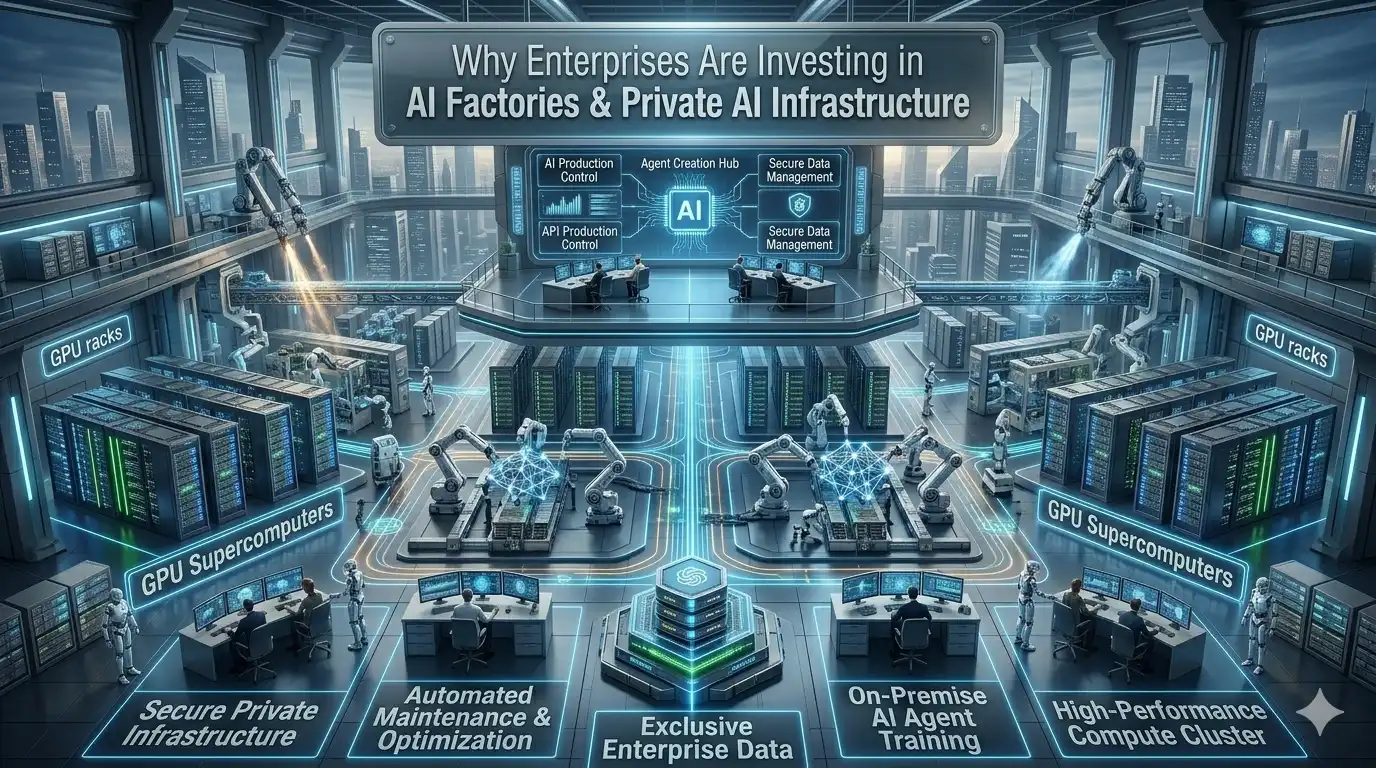
The Shift to Dedicated AI Computing
The corporate technology landscape is witnessing a massive transition. Global enterprises are rapidly moving away from public cloud chatbots to invest heavily in localized "AI Factories" and private AI infrastructure. Recent expansions in turnkey platforms—such as the collaboration between Hewlett Packard Enterprise (HPE) and NVIDIA—underscore this trend.
The driving force behind this surge in capital expenditure comes down to a fundamental shift in what businesses expect from artificial intelligence: moving from simple text conversations to highly autonomous execution.
AI is transitioning from an experimental software tool into a core corporate utility. By building private hybrid AI platforms, modern businesses gain the speed, security, and absolute control required to run autonomous systems safely.
1. The Pivot to Agentic AI (Autonomous Execution)
Until recently, businesses used generative AI primarily as a passive assistant—a human employee had to type a prompt, evaluate the response, and manually copy or input it into another digital tool.
Enterprises are now actively deploying Agentic AI. These are autonomous multi-agent networks capable of executing long-running, multi-step workflows across an organization's entire digital ecosystem. For instance, an operational agent can detect a supply chain delay, query internal inventory databases, negotiate with vendor software, and rewrite a purchase order entirely on its own.
Because these agents require deep, continuous read-and-write connections to core operational databases and legacy systems, relying on broad public cloud wrappers introduces severe performance and latency bottlenecks.
2. Governance and \"Rogue Agent\" Mitigation
When you grant an AI system the authority to take actions—such as deploying code to production, modifying customer databases, or transferring data between internal applications—safety and risk parameters skyrocket.
Private AI infrastructure provides a fully controlled, on-premises sandbox where businesses can strictly regulate AI behavior. Modern turnkey solutions integrate specific governance frameworks to mitigate these structural risks:
- Model and Skill Pre-Approval: Administrators can explicitly define exactly what tools, APIs, and actions an AI agent is permitted to call before it runs.
- Continuous Rewind Protections: Sophisticated backup integrations allow corporate IT to continuously monitor agent interactions. If an agent executes an unintended database modification, the system can instantly roll back the target environment to a clean, uncorrupted state.
The value of operational AI scales exponentially when the computing power sits next to the data. Minimizing network roundtrips to public clouds is essential for low-latency agent reasoning loops.
3. Data Sovereignty and Confidential Computing
For highly regulated industries—such as banking, healthcare, logistics, and legal operations—sending proprietary client data to external public AI models introduces massive compliance vulnerabilities.
Private AI Factories allow enterprises to process sensitive data within their own secure firewalls or localized sovereign data centers. Hardware advancements like NVIDIA Confidential Computing ensure that data and AI models remain completely encrypted *even during active execution* (while the chips are processing information). This offers cryptographic validation that corporate intellectual property cannot be exposed to external software vendors.
4. Raw Hardware Performance and Token Optimization
Running multi-agent AI ecosystems requires immense, sustained computational throughput. When multiple autonomous agents are continuously interacting, auditing log layers, and analyzing massive enterprise datasets, they consume millions of tokens (computational linguistic units) every hour.
To eliminate network lag and avoid unpredictable public cloud billing structures, organizations are designing dedicated localized AI architecture using high-performance components:
- Purpose-Built Compute: Next-generation hardware stacks utilize dense server configurations engineered explicitly for heavy AI workloads.
- High-Speed Networking: Enterprise-grade ethernet systems eliminate communication delays between clustered GPUs, ensuring that autonomous agent networks can reason, share context, and execute workflows in real time.
At GInfomedia, we help Indian businesses evaluate, plan, and implement enterprise AI strategies that are practical, scalable, and aligned with their specific industry requirements.
👉 Click Here to Chat with Us on WhatsApp and get a free digital strategy consultation today!