
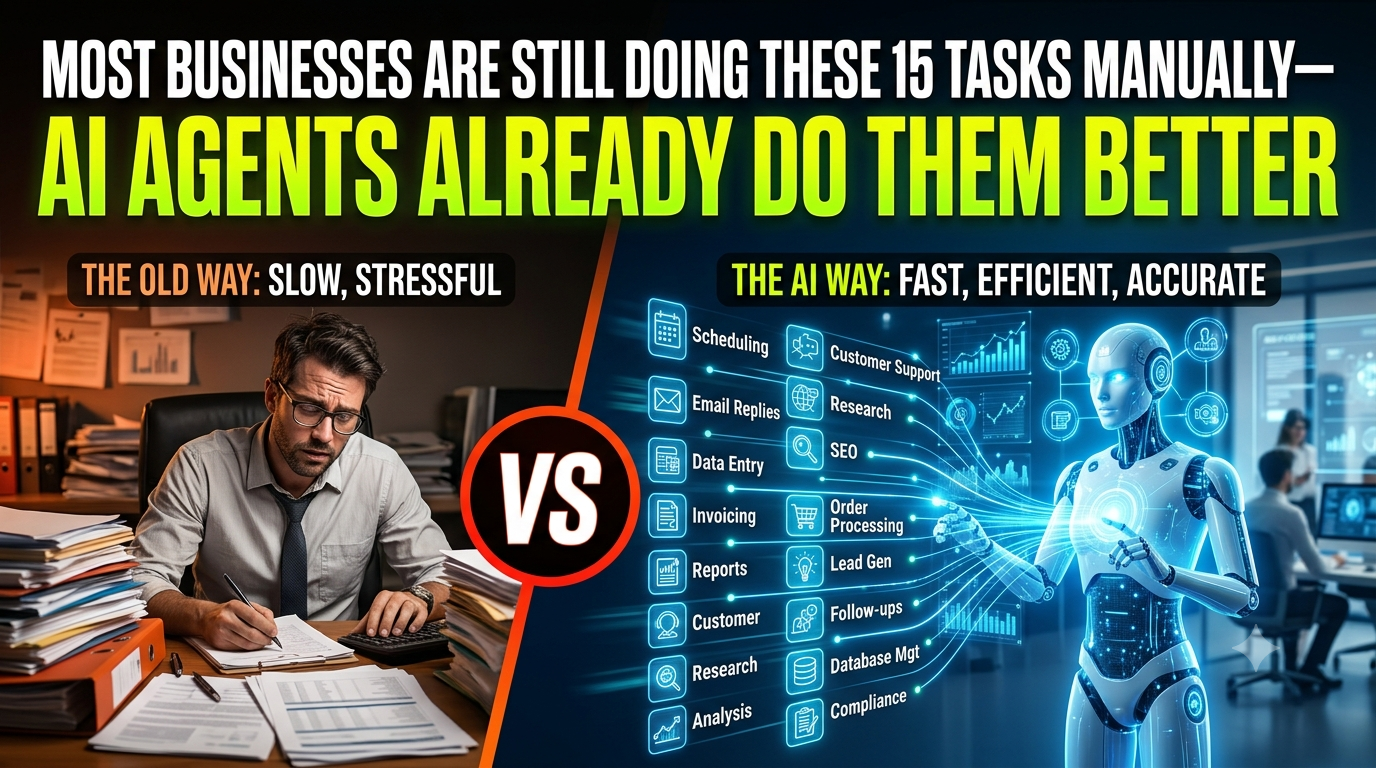
If you spent this morning copying data between spreadsheets, chasing an invoice, or sending the same follow-up message for the tenth time, you're not being thorough, you're doing work a machine already does better.
Here's the uncomfortable truth about 2026: most of the work that fills a normal business day no longer needs a human at all. Studies suggest knowledge workers lose close to 60% of their week to "work about work", status updates, manual data entry, repetitive coordination, the busywork between the actual work. For years that was just the cost of running a business. It isn't anymore. The same set of business tasks that used to eat your team's hours can now be handed to software that does them faster, cheaper, and around the clock.
This guide walks through the 15 business tasks most companies still do manually, and shows, task by task, how AI now does each one better. For every item you'll see the slow manual way, the automated way, and roughly what it's worth to switch. These aren't the highest-paid, most strategic parts of your job; they're the repetitive ones quietly draining time you could spend growing. The goal isn't to fire anyone. It's to stop paying people, including yourself, to do work software should handle, so the humans can focus on what actually needs a human.
One honest note up front: you don't need to automate all 15 at once, and you shouldn't. By the end you'll know exactly which manual tasks to automate first, what business task automation realistically costs in India, and how to prove the savings before you scale.
- ✅ The 15 manual tasks quietly draining your team's time
- ✅ The automated way to do each one in 2026
- ✅ Which tasks to automate first for the fastest ROI
- ✅ What business automation actually costs in India
- ✅ Where humans should still stay in control
Why Doing It Manually Is Now the Expensive Option
Three shifts flipped the math in 2026. First, the tools got good enough to trust, AI now follows multi-step instructions reliably instead of breaking on the second one, so it can run real workflows, not just demos. Second, the cost collapsed: an automation that needed a developer and a serious budget a couple of years ago now runs on a no-code platform for a few thousand rupees a month. Third, connecting your tools, CRM, inbox, WhatsApp, spreadsheets, accounting, stopped being a custom project thanks to standards like the Model Context Protocol and platforms like Make, n8n, and Zapier. Put together, automating repetitive tasks went from "nice someday" to "cheaper than the manual version today."
The deeper change is that automation stopped being dumb. Old automation could only follow rigid rules, "when X happens, do Y." Today's AI agents read context, make a judgment call, use your tools, and finish a whole task, then escalate to a person only when it's genuinely unsure. That's why the list below has grown from "answer FAQs" to "run the workflow end to end." If you want the deeper version of how these agents work, see our guide to the 15 business tasks AI agents already do better than humans, and the broader shifts in our 2026 AI automation trends.
| Factor | The Manual Way | The Automated Way |
|---|---|---|
| Speed | Hours, sometimes days | Seconds |
| Availability | Office hours only | 24/7, 365 days |
| Consistency | Varies, error-prone | Identical every time |
| Follow-through | Drops when things get busy | Never forgotten |
| Cost to scale | Hire and train more people | Same low subscription |
The 15 Tasks You're Probably Still Doing by Hand
These are ordered roughly by how much time they waste for a typical business. Read each one and be honest: how many is your team still doing manually right now? Circle the two or three that sting the most, those are your first tasks to automate.
1. Answering the Same Customer Questions Over and Over
The manual way: a person retypes the same replies about pricing, order status, and "how do I reset this" all day. The automated way: an AI customer support agent pulls answers from your docs and past tickets and resolves a large share of routine queries instantly, handing only the tricky ones to a human with full context attached. Leading tools now close 60 to 80% of tickets on their own while keeping satisfaction high, 24/7, with no overtime. This is usually the single biggest pile of repeat work in a business, which makes it the fastest win to automate.
2. Chasing and Following Up With Leads
The manual way: enquiries pile up, replies go out hours late, and follow-ups get forgotten the moment things get busy, so warm leads quietly go cold. The automated way: an AI sales agent wired into your CRM reads every enquiry, replies in seconds, scores it, and follows up on a schedule no human keeps perfectly. For Indian businesses fielding leads from IndiaMART, Justdial, and their website, automating lead follow-up alone often pays for the entire automation stack, because the leads you were losing to slow replies start converting.
3. Booking Appointments and Sending Reminders
The manual way: endless back-and-forth to find a slot, plus manual reminder calls and no-shows when someone forgets. The automated way: an agent checks availability, books the slot, and sends confirmations and reminders automatically. Clinics, salons, consultants, and service businesses feel this immediately, every reminder it sends is a slot that would otherwise have sat empty. Scheduling is pure rule-based work, which is exactly where business task automation shines.
4. Replying to WhatsApp and Chats by Hand
The manual way: messages arrive at all hours and a human can't answer at 2am, so the customer messages a competitor instead. The automated way: WhatsApp automation powered by an AI agent answers instantly, qualifies the lead, shares details, books the appointment, and sends a payment link, often in Hindi or a regional language. With 500 million-plus WhatsApp users in India and open rates near 98%, an agent that never sleeps on this channel is frequently the difference between a captured sale and a lost one.
5. Creating Invoices and Reconciling Payments
The manual way: someone types invoices, matches payments by eye, and scrambles at month-end, with typos and missed entries creeping in. The automated way: an AI agent captures the order, generates a GST-ready invoice, reconciles the payment, and updates the books, no manual entry. One Indian trading firm cut monthly GST prep from three full days to four hours this way. Invoicing is deadline-driven and unforgiving of error, which is exactly why automating it pays back every single month.
6. Copy-Pasting Data Between Apps
The manual way: a person reads a PDF or form and retypes the fields into another system, slowly, and with mistakes. The automated way: an agent extracts the data from invoices, forms, resumes, and contracts, structures it, and files it correctly in seconds, at a consistency no human sustains across a hundred documents. If anyone on your team is a human bridge between two apps, that's salary spent on something software does faster and more accurately. Data entry is one of the clearest repetitive tasks to automate first.
7. Sorting and Replying to Email
The manual way: you open 80 emails to find the 6 that matter, then draft the same kinds of replies again and again. The automated way: an AI agent reads, categorizes, drafts first-pass responses in your tone, and surfaces only what genuinely needs you. For founders and small teams, reclaiming the inbox is one of the most immediately felt wins of business process automation, you stop starting every day buried.
8. Screening Resumes and Scheduling Interviews
The manual way: hours spent reading resumes, replying to candidates, and juggling interview slots, so hiring drags on for weeks. The automated way: an AI HR agent screens resumes against your criteria, shortlists, schedules interviews, and sends onboarding documents. A Mumbai logistics company cut time-to-hire from 45 days to 18 by automating screening and scheduling, leaving the team to focus only on final-round decisions. The judgment stays human; the grunt work disappears.
9. Tracking Inventory and Orders
The manual way: stock counts in a spreadsheet, reorders by gut feel, and the occasional painful stockout or pile of dead stock. The automated way: an inventory AI agent monitors levels, predicts demand, flags reorder points, and updates records as orders flow in. A pharmaceutical distributor in Surat cut stockouts by 70% and excess inventory by 25% after automating this. It's an always-watching, never-distracted task, the kind of thing humans do poorly and software does perfectly.
10. Researching Competitors and the Market
The manual way: someone burns an afternoon browsing competitor sites, news, and pricing, then writes it up, by which time it's stale. The automated way: an AI agent works like a 24/7 research analyst, scanning sources, summarizing what changed, and flagging opportunities or threats early. You get a tight brief instead of a pile of open tabs, so a competitor's move or a new trend reaches you while it still matters. One of the most useful AI agent use cases for staying ahead without the hours.
11. Writing and Scheduling Content
The manual way: every caption, product description, and post written from scratch, then posted one platform at a time. The automated way: AI agents draft descriptions, outlines, ad variations, and social posts at volume, learn your brand voice, and publish on a consistent cadence. The honest caveat: AI is excellent at first drafts, repurposing, and volume, while your best original creative still wants a human hand. Used well, it handles the routine 80% so your people spend their time only where a human spark matters.
12. Cold Outreach and Prospecting
The manual way: a rep manually builds lists, researches each prospect, personalizes a message, and tries to remember who to follow up with, until it falls apart. The automated way: an AI sales agent identifies ideal customers, personalizes the first touch, follows up based on behavior, and escalates warm replies to a human to close. For solo founders and lean teams, this means a real outbound pipeline without hiring a full sales desk, one of the highest-leverage things a small business can automate in 2026.
13. Answering "Where Is That Documented?"
The manual way: people interrupt each other all week to ask where a process, policy, or past project lives, and new hires take forever to ramp. The automated way: an internal-knowledge AI agent lets anyone ask in plain language and instantly returns the answer with a link to the source. It's a game-changer for onboarding and for protecting your senior people's focus. As you grow, it turns scattered tribal knowledge into something searchable, a task no human "knowledge keeper" can do at scale.
14. Building Weekly Reports
The manual way: every Friday someone pulls numbers from five tools, cleans them, and stitches a report together, hours of work that's outdated by Monday. The automated way: an AI agent connects to your data sources, pulls fresh numbers on a schedule, builds the report, highlights what changed, and delivers it, untouched by human hands. Manual reporting alone can eat 8 to 12 hours a week; automating it hands that time straight back and makes the numbers more reliable.
15. Answering and Making Routine Phone Calls
The manual way: the phone rings during your busiest hour, after-hours calls go to voicemail, and routine enquiries pull staff off real work. The automated way: voice AI agents handle phone enquiries, booking, reminders, and first-line support, in India, increasingly in Hindi and regional languages, opening markets English-only tools can't reach. For any business whose line rings off the hook, or whose customers prefer talking to typing, voice is the next obvious thing to take off your team's plate.
Notice the pattern: every one of these 15 is repetitive, rule-heavy, and time-sensitive, the exact profile of work software does better than people. That's also how you spot your own next target. Don't try to automate all 15. Find the one manual task that's costing you the most time right now, automate it, measure the hours saved, then move to the next. Automation compounds, so the first win funds the second.
What This Looks Like for Indian Businesses
India is unusually well set up for business automation, and most local businesses haven't claimed the advantage yet. The country runs on a dominant WhatsApp channel with hundreds of millions of users, a UPI payments backbone that turns every transaction into clean data an agent can act on, and GST and ONDC digitization that creates constant demand for automated compliance. Modern agents already handle Hindi, Gujarati, Tamil, and other regional languages, so they meet your customers where they actually are, not where an English-only tool wishes they were.
The practical playbook for an Indian SME is simple: start where money leaks. Automate lead response so no IndiaMART or Justdial enquiry goes cold, put a WhatsApp automation agent on your busiest channel so a 2am customer still gets answered, and hand GST invoicing and reconciliation to an agent. The economics are hard to argue with, a serious small business automation stack in India typically runs ₹16,000 to ₹40,000 a month, a fraction of two or three salaries, and usually pays back inside two to three months. For a lean team in Mumbai, Pune, or Bangalore, automating the manual grind is how you out-run competitors carrying three times your headcount.
At GInfomedia, we help businesses across India turn manual, repetitive work into AI-powered automations, from WhatsApp and lead-response to invoicing, reporting, voice, and full multi-step workflows that run on autopilot and scale as you grow.
Click Here to Chat with Us on WhatsApp and get a free automation audit for your business today!
The Tasks You Should NOT Automate
Automation has a clear line, and crossing it is how businesses waste money. The research is consistent: fewer than 5% of jobs are made up entirely of automatable tasks, and the best results come from human-and-AI teams, not AI alone. Companies that fired their people and handed everything to bots have publicly walked it back when the automation stumbled on edge cases, upset customers, and judgment calls it was never meant to make.
Keep humans firmly in charge of high-stakes judgment, genuine creativity, relationship-building, negotiation, and anything where being wrong is expensive or personal. And never automate a broken process, if your follow-up is chaotic or your data is messy, automation just runs the chaos faster; clean it up first, then automate. The winning pattern in 2026 is AI on the repetitive 80%, humans on the critical 20%. That combination produces durable savings instead of a pile of automations nobody trusts.
How to Automate Your First Task This Month
If you take one thing from this, let it be this: the tools are ready and cheap, and the only thing between you and a recovered workday is starting. You don't need a big project, you need one task off your plate.
Run a one-week time audit, write down every repetitive, manual task your team does and how long it takes. Pick the single task from the 15 above that's both high-volume and rule-heavy, lead follow-up, invoicing, scheduling, support, or WhatsApp automation, and automate just that one with a no-code tool or a done-for-you partner. Measure the baseline before and the hours saved after. Once you have two weeks of clear data, automate the next task and keep a human checkpoint on anything sensitive. Measure at the task level so you always know which automations are actually earning their keep.
The cost of waiting keeps rising. Every week you run on manual effort is a week your automated competitors answer faster, serve more customers, and reinvest the hours you're still spending on copy-paste. Automate one task this month, reclaim your first few hours, and let the system compound from there.
Business Task Automation: Quick FAQs
Which business tasks should I automate first?
Start with whatever is most repetitive, high-volume, and rule-based, usually lead follow-up, invoicing, scheduling, customer support, or WhatsApp automation. Pick the one task causing the most frustration or the one that gets dropped when your team is busy. Automate that single workflow, measure the hours saved, then move to the next.
Will automating these tasks replace my employees?
No, it replaces the busywork, not the people. Business task automation takes over repetitive, rule-based tasks so your team can focus on judgment, creativity, and relationships, the work AI can't do well. Fewer than 5% of jobs are fully automatable, and the strongest results come from humans and AI working together.
How much does business automation cost in India?
A practical small business automation stack in India typically runs ₹16,000 to ₹40,000 a month, far less than hiring extra staff, and most automation projects pay for themselves within two to six months. Most owners start with one high-impact workflow and expand only what clearly delivers ROI.
